
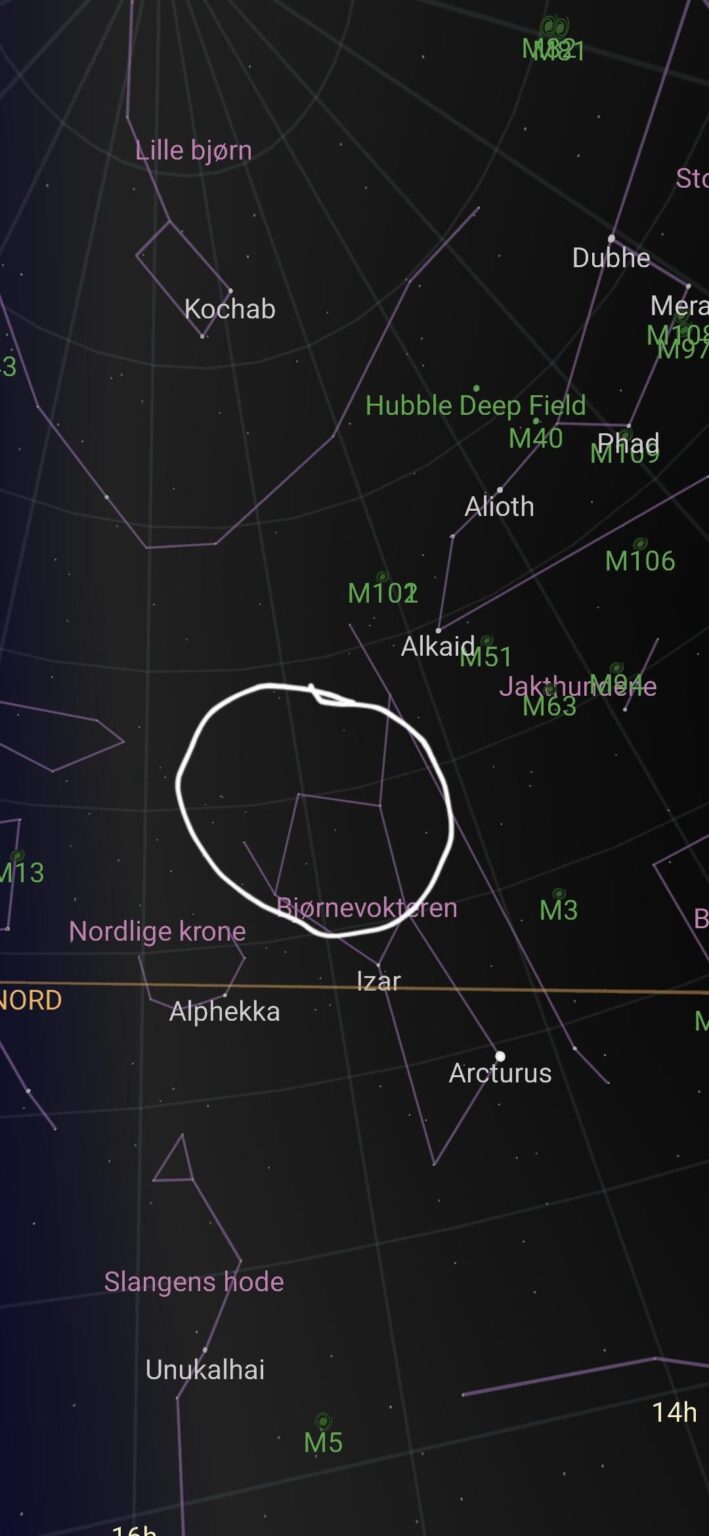
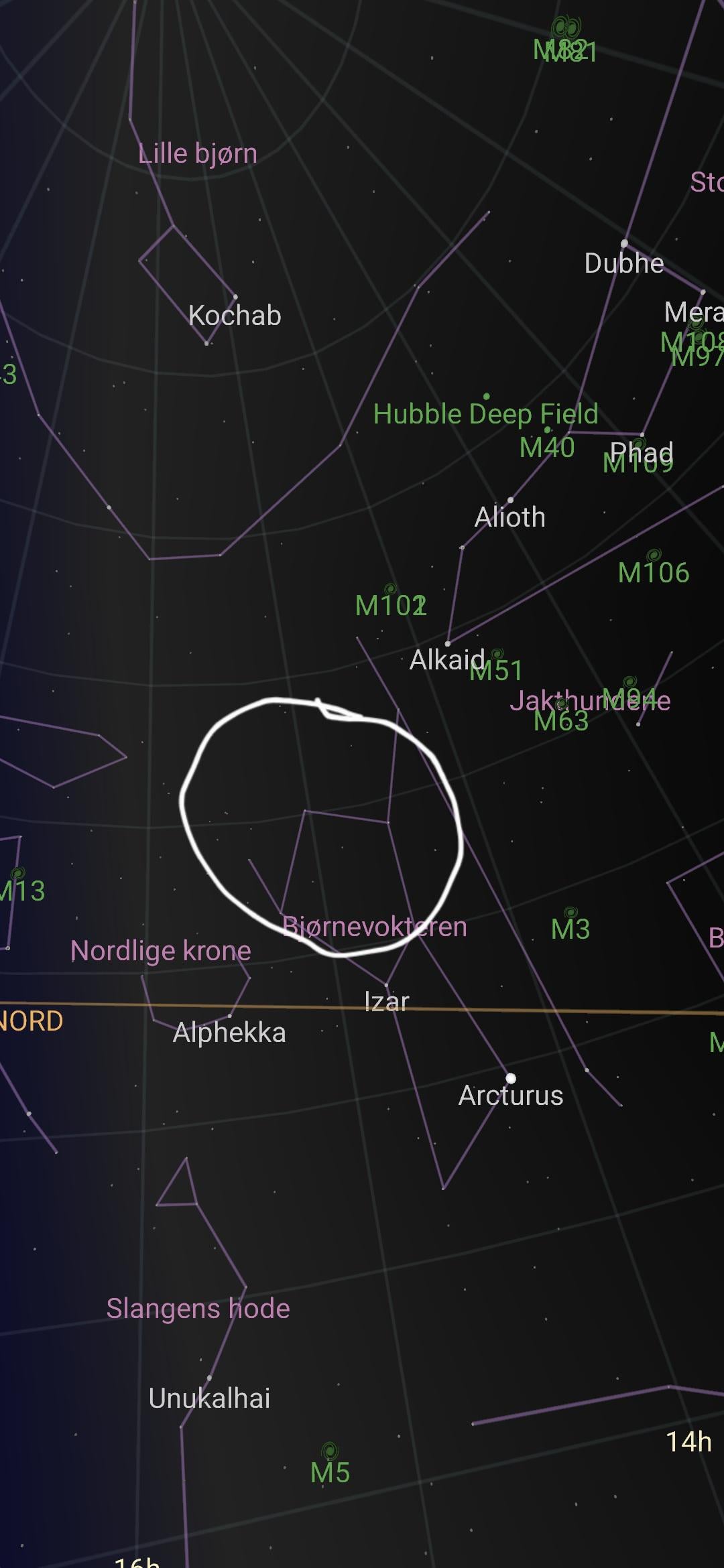
I was sitting outside my cabin right now at 7 pm Norway time in middle of Norway when I saw a sudden flash on the sky to northeast.
It was just below The Big Dipper (Karlsvogna).
It was a spot, quite bright.
Could it have been a star explosion? And is there a log of such events? I could have been a meteor coming straight towards me maybe, but my curiosity is killing me.
I tried to pinpoint the location of it on sky map, see attached image
https://i.redd.it/yea0y79i0wkg1.jpeg
18 Comments
Probably a transitory satellite flare. Iridium birds are notoriously bright.
More likely a satellite reflecting the sun.
A nova would last days if not weeks
A star explosion lasts several weeks at peak brightness. Is it still there now? If not, it is not a star explosion.
Thanks for your detailed report! Probably a satellite flare. Not very rare but always nice to catch one.
Stars are huge, so any explosion would take days or weeks to develop.
Most likely it was a small meteor or maybe a satellite catching sunlight briefly. If it was a star explosion people would probably have noticed globally, they aren’t just brief flashes and then nothing, if it’s big enough to see with the naked eye it would last days or months
The “blaze star” is a bit left of Alphekka. Probably NOT that, but keep looking there, anyway. It’s due to blaze soon-ish.
I think the chances of it being a visible supernova are pretty tiny. Hasn’t happened many times, and it would surely be on TV if that was what it was.
If you actually saw a star explosion, it would still be visible to our eyes and there would be many articles about it online already, and it would be all over the news. Whatever it was, it wasn’t an exploding star.
Any kind of nova (super or not) lasts much longer than that, usually months or even years. A nova is considered “fast” if it dims significantly within 100 days.
As others have said, a satellite flare is also possible, though usually those are clearly moving. Still one possibility, the other is what you already suspected which is a meteor that was headed close to straight towards you.
If it were a supernova that close you’d have had every telescope, Hubble, Webb and the rest pointing at it. We’d probably would have likely had an early warning from the couple of neutrino detectors around too.
Most likely, sunlight reflecting off the solar panels of a satellite for a moment.
There are a few videos of what Betelgeuse exploding might look like: [https://www.youtube.com/watch?v=MEQ1qBz1UJQ](https://www.youtube.com/watch?v=MEQ1qBz1UJQ)
It’s cool to know, but it’s also cool to have the capacity to leave things to mystery and embracing it as that.
With that said, it was likely a satellite that reflected light temporarily, or a meteorite. Occam’s razor.
Most likely case is that it was a meteor coming directly toward you, or a flare from a tumbling satellite.
No, that’s a circle drawn by a human. And not very well.
Orion, as it is near the ecliptic, is typically the location of geostationary satellites. These can, due to rotation or simply their orbital motion, produce a brief flash as solar panels or other metallic surfaces reflect sunlight back to us.
Rarely, you will see meteors head-on. This makes it a bright spot instead of a line. I was sailing down the Red Sea in 1998 (I recommend sailing far offshore if you like stargazing!) and there was a whole shower of them in a small area of the sky, for several nights. It’s nice that we have an atmosphere to catch them on their way in!
I also saw a star “blink” a week ago around 7pm at night. I was looking at a different part of the sky when I saw a star simply disappear. I suspect it was a solar panel or similar on a satellite glinting as it passed overhead
How long did it lasted? Was it stationary? By the sound of it, it seems it was just a brief flash, so that’s certainly excludes nova/supernova – those shine for days with slow decrease in brightness, there’s no sudden peak of brightness at the moment of explosion – too much light is still trapped inside the gas.
A meteor moves fast and shines for at least a second while visibly moving. Satellite reflections usually also last for a while – while they’re passing the angular distance where they reflect sunlight, so they have to travel at least the angular size of the Sun.
I suppose if it lasted for fraction of a second, it might’ve been a satellite during attitude change, that could shine for a brief moment without noticeable movement. Or a meteor that was moving directly toward you, so it had no apparent movement.
Appreciate all the replies. I have looked at the stars many time, but never saw anything like this. But it lasted no more than 2 seconds and it was stationary.
I guess It was not a super nova, but still exciting to watch