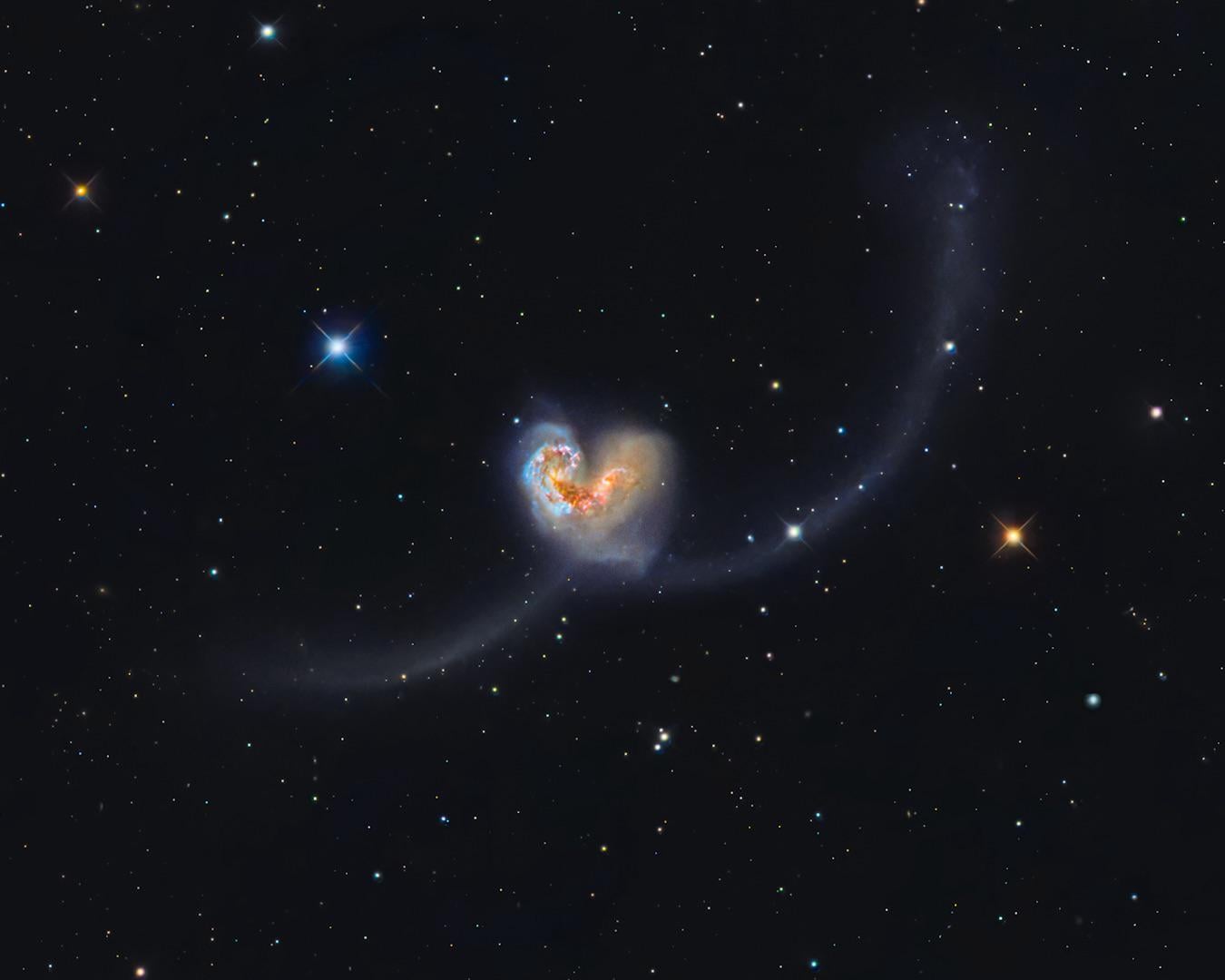
I photographed two galaxies that have been colliding for over 600 million years, and yet somehow – they formed a heart while doing it…
https://i.redd.it/ycyf7dnhvdmg1.jpeg

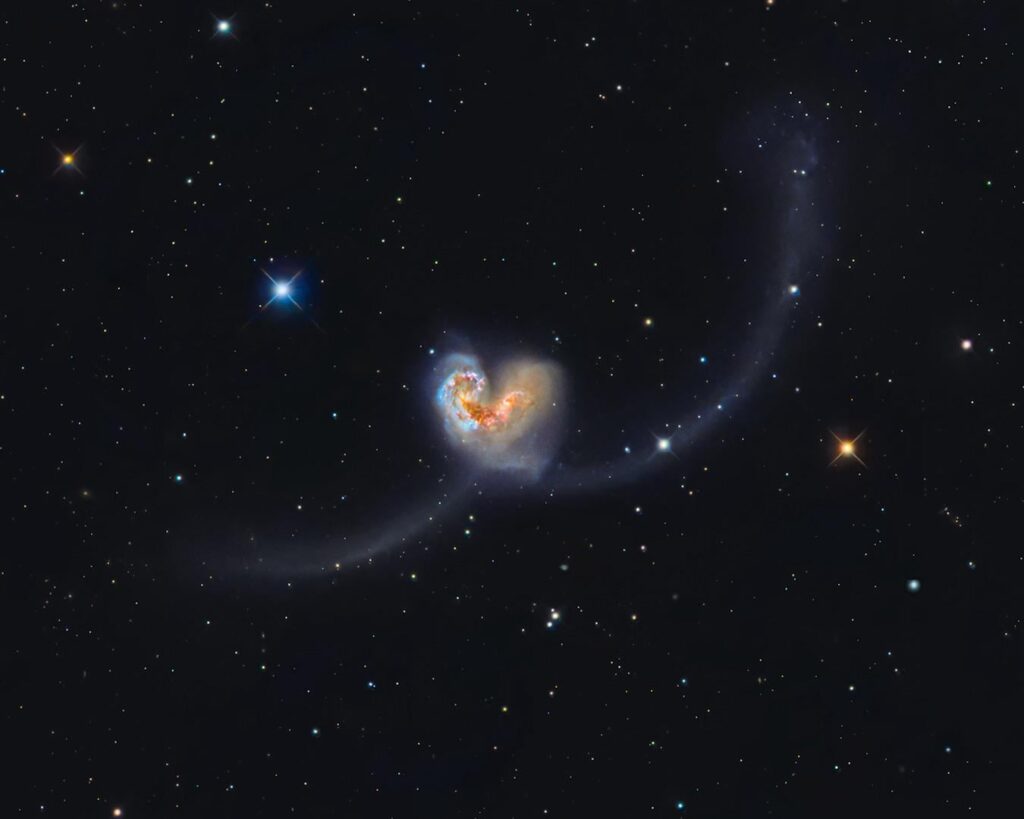
I photographed two galaxies that have been colliding for over 600 million years, and yet somehow – they formed a heart while doing it…
https://i.redd.it/ycyf7dnhvdmg1.jpeg
27 Comments
The Antennae Galaxies (NGC 4038/4039)
What you’re looking at isn’t a painting, a render, or an AI composite. This is a real, ongoing galactic collision, and it has been happening for approximately 600 million years.
The Antennae Galaxies are two spiral galaxies in the process of merging, located roughly 45 million light years away in the constellation Corvus. When they first began their collision, complex life hadn’t yet emerged on Earth. Dinosaurs hadn’t existed. And yet this slow-motion catastrophe has been unfolding across the cosmos ever since, two galaxies pulling, stretching, and tearing each other apart under the force of their combined gravity. What makes this collision so striking isn’t just the scale of it. It’s the shape. The gravitational interaction between the two galaxies has drawn out two long, curving tidal tails of stars and gas, and from our line of sight, they arc into something that looks unmistakably like a heart. The universe didn’t intend this. There’s no design here. Just physics, gravity, and 600 million years of chaos producing something that looks almost tender. During collisions like this, gas clouds compress violently, triggering intense bursts of star formation. The bright knots and blue regions visible in this image are nurseries, regions where new stars are being born directly out of destruction. Billions of stars are being displaced. Entire solar systems disrupted. And new ones are being created in the aftermath. This is what the universe looks like when it tears itself apart.
Acquisition Details : Luminance — 8 hours (300s subs) RGB — 2h 30m (180s subs) Hα — 2 hours (300s subs) Total Integration — ~12.5 hours
Telescope — GSO RC 10 Camera — ZWO ASI 2600MM Pro Mount — Warpastron WD20 Bortle Scale — ~4
Dm for prints and high resolution images. More of my work on Instagram as [prathameshjaju](https://www.instagram.com/prathameshjaju)
That’s hot. That’s a hot way to live.
They were meant to be together 🫰🏻
Stealing this for a green saver! Nice work!
So, distances between stars when that goes on can cause catastrophic interactions? e.g. Scenario, another star comes slinging though our solar system, say, closer than Jupiter?
I just found my next needle felt project! Thank you for capturing this!!!
I have a title for it too!
Also how did you capture this incredible image? Space, photography and art are some of my favorite things.
Edited because I had more thoughts.
Edited the edit because i forgot to include the edit.
🙄
Awwwwwwwwwwwwwwww cuuuuuuuuuuuuuuuuuuute.
It strikes me that the heart is facing us. Is it incredible because of the slim chance, or inevitable because of the size of the universe?
Butterfly? Heart? Same shape.
???
if we’re to be exact,we formed the shapes our hearts have after those galaxies, so actually our hearts are colliding-galaxy shaped
Made me think of Hearts of Space 🤎, if anyone grew up with that 🙂
Since this is happening so slowly, would it be noticeable by any living creatures that might be potentially on any planets in those systems? Would it have any physical effects on the planets?
Awww love is in the..vacuum?
What a beautiful sight ❤️🌸
Oh beautiful! I love seeing colliding galaxies and pictures of them at different stages of collision. Nice camera too!
600 million years Jesus get a room already.
What is it like for the planets within both galaxies? If there were life there, what is the situation? Gorgeous? Horrifying?
Fascinating stuff.
When two galaxies love each other very much, they give each other a really big hug!
Whoa, I found colliding galaxies in the shape of a heart with long antennae shooting out the bottom! I’ll call them the ~~heart~~ Antennae Galaxies!
So cool… I am gonna save this into ny phone
When two galaxies love each other very much….
You say colliding, I say….
That’s buttcheecks with a doody–butt turtle-heading.
What are you doing step galaxy
Happy 600 million year anniversary you two! Your relationship is such an inspiration.
What is your secret to making it last?
💙💫🧡
Calm down🙂↔️ ive seen this picture 4 years ago:) actually who captured this huh
The darkness and the celestial bodies in alignment
wow that image is simple and clean
brb getting my key