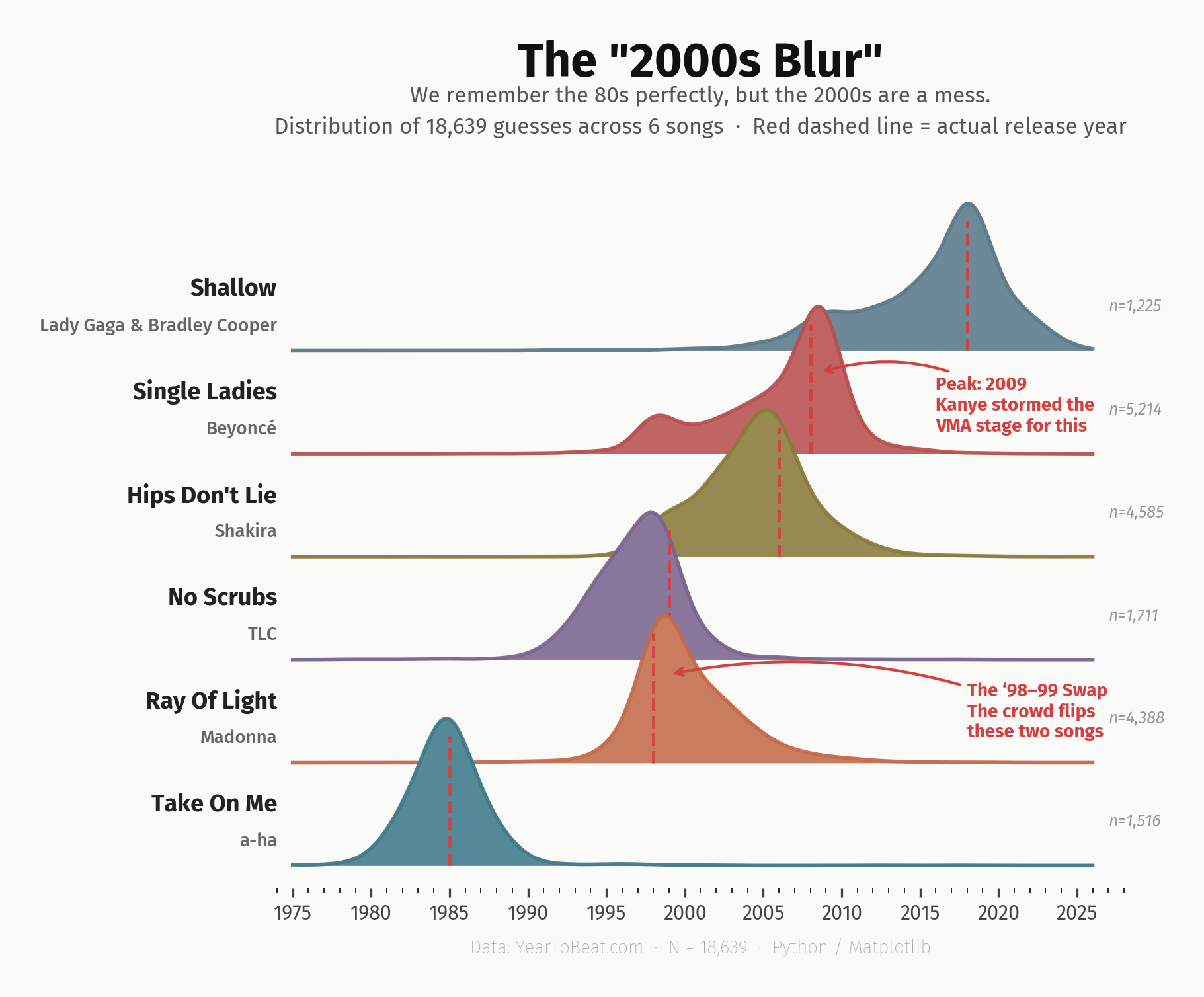
[OC] The “2000s Blur”: We remember the 80s perfectly, but the 2000s are a mess. Analysis of 18,000 guesses on song release years.
Posted by Take_My_Money

![[OC] The "2000s Blur": We remember the 80s perfectly, but the 2000s are a mess. Analysis of 18,000 guesses on song release years.](https://www.byteseu.com/wp-content/uploads/2026/03/1ois04bwjmng1-1536x1272.png "[OC] The “2000s Blur”: We remember the 80s perfectly, but the 2000s are a mess. Analysis of 18,000 guesses on song release years.")
[OC] The “2000s Blur”: We remember the 80s perfectly, but the 2000s are a mess. Analysis of 18,000 guesses on song release years.
Posted by Take_My_Money
26 Comments
**Source:** Data collected from **Year To Beat** ([https://yeartobeat.com](https://www.google.com/url?sa=E&q=https%3A%2F%2Fyeartobeat.com)), a daily browser game where players watch music videos and guess the release year.
**Tool:** Python (Matplotlib/Scipy).
**Insight:** There is a “Mandela Effect” with TLC and Madonna. The crowd consistently guesses that No Scrubs (1999) came out before Ray of Light (1998), flipping the actual historical timeline. Also, the variance in guesses increases significantly as we move from the 1980s to the 2000s.
What was the criteria for picking these particular songs? You only have one from the 80s vs a ton from the 2000s.
Interesting project though.
Seem like pretty reasonable guess ranges to me? They’re all quite close, plus you need way more songs here to show any real trend.
I find the 2000s blur to be a real thing.
Yeah because radio stations worldwide had the “best hits of the 80s, 90s and the super hits of today” way until 2015.
Did they listen to the song during the questioning
“We” remember the 80s perfectly? Lmao shoutout to all the 50 year olds in the room
Me and my friends sometimes play a game called 90s or 2000s. When a classic (to us mid 30s millennials) comes on anywhere we try to remember if it came out in the 90s or 2000s. We usually get it wrong. A lot of songs we think of as 90s were 2000s.
So yeah I believe this phenomenon
Take on me should have had a mini-up-tick when family guy did it.
https://youtu.be/mWErfaJjfE4
The fact that there are no Blur songs is confusing and haunting (?)
Feels like a shaky conclusion drawn from a very thin data set. It says more about the songs selected than anything.
Blur was more of a 90s band
Who is “we”?
If the people you ask grew up in the 80s, of course they’ll remember the debut of those songs better.
You might want to consider removing Moves Like Jagger by Maroon 5 from the game, or start the video after the first few seconds because the video tells you the year just a few seconds into it.
Im so glad I only have heard of one of these songs. I did a good job listening to system of a down and rage against the machine until my ears bled
I suppose there’s an element of survivorship bias here. Most people aren’t old enough to have listened to music throughout the 80s, so all the remains of the 80s is the relatively limited set of very popular songs that are *still* popular 40+ years later. But most people alive today have heard anything since 2000, good or bad – I’ve certainly been exposed to a wider catalogue of more recent songs than 80s songs, so they all run together.
Minor thing on presentation: the red dashed line showing the true year is a little hard to pick up on a few of them because of low contrast with the color of the bell curve. Maybe black would work better? (I have poor color vision)
I think there’s a very obvious explanation for what’s happening here and I’m amazed that with over 50 comments on this thread, no one has pointed it out yet. This, to me, is a really under-discussed topic.
Clear Channel (now iHeartMedia) achieved its dominant market position immediately following the Telecommunications Act of 1996, which eliminated national caps on radio station ownership. The company went on a massive, rapid buying spree between 1996 and 2001, growing from 43 stations to over 1,200.
Clear Channel, as it monopolized the radio industry, also monotonized it. There are comments in this thread noting how similar music is now to what it was 20 years ago. Well, we all know how so many of the popular movies nowadays are just reboots of old franchises. It’s the same effect in radio. Radio stations play music that’s the same or similar as it was in the late 90s and early 2000s. It has stunted the growth of our culture in the realm of music.
One 80s song: “We remember the 80s perfectly”
What’s with the bimodal distribution?
I don’t even know any of those songs.
Because 90s drugs were EPIC.
I mean, music was more monolithic culturally in the 80s; when a song was big (or getting pushed by record labels) it was everywhere.
By the 00s, the rise of the internet and the decline of radio and broadcast TV meant that you were less likely to hear or know about songs in genres you don’t care about or by artists you don’t care about; it makes sense that this would cause knowledge of music to splinter and become less universal.
This cant be legit, I don’t see the Thong Song.
Edit: fuck that was 1999.
We don’t consume linear content anymore and have on-demand access to any song we want. If those newer songs were limited to just the radio/MTV and the few that bought it, I think we all would remember the release year.
And the amount of music that is released now is incredibly higher than the 1980s.
Ray of Light was one of my first MP3s
My theory is that before 2000, music used to have huge stylistic changes from one year to the next. Like the Beatles making Please Please Me, then three years later making Sgt. Pepper. Or rap being MC Hammer and Vanilla Ice, then boom, suddenly it’s Tupac and Snoop Dogg. It made it easier to place things chronologically.
And for whatever reason that just kind of stopped happening. My theory is the corporate overlords that run the music industry decided it was too risky, and so we’re just kinda stuck in 2009 forever