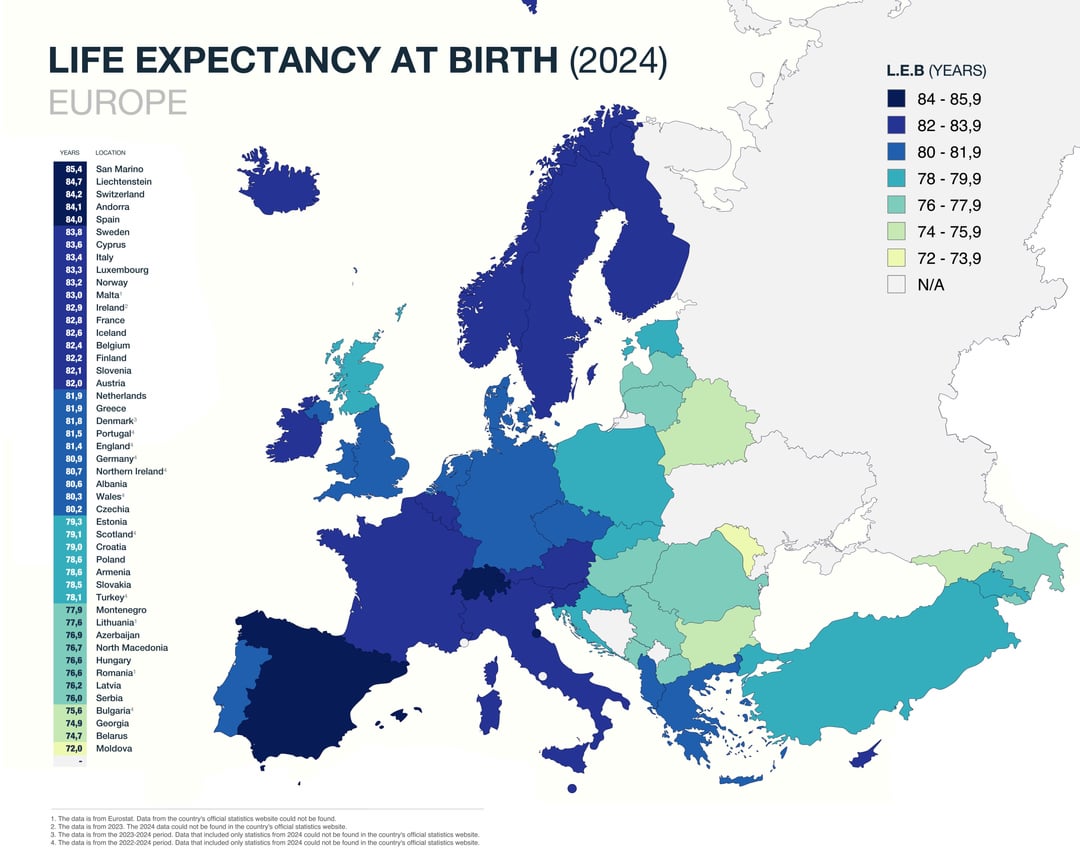

The data used to create this map is collected from each country's official government / statistics website _(sources in the second picture)_.
Posted by Substratas

![[OC] Life Expectancy at Birth in Europe (2024)](https://www.byteseu.com/wp-content/uploads/2026/03/ycocvr8zumng1-1024x814.jpg "[OC] Life Expectancy at Birth in Europe (2024)")
The data used to create this map is collected from each country's official government / statistics website _(sources in the second picture)_.
Posted by Substratas
4 Comments
San Marino beat Liechtenstein once again.
Living the good life in Spain
People often misunderstand what life expectancy means.
It sounds like it means “a kid born now will likely live to 2106”. Which raises all sorts of questions about how we are predicting events up to then.
What it actually means is more like the statistic you get from following this procedure:
Take a population, and reduce it by the number of kids who die at age 0. Then take what’s left, and reduce it by the age 1 deaths. Repeat up to the last age where we have figures, eg age 110 or so. The survival stats for each age group are simply taken for the last year. “How many 65 year olds survived to 66 this year?” is easier to answer than “will the kids born in 2026 survive to 2092”.
That hypothetical population that has lived every age from 0 to 110 has various summary statistics, such as the mean, which is the number we end up reporting for each country. We repeat the exercise every year, and then we get a time evolution of the life expectancy.
The East/West divide is always incredibly stark when looking at European health data. Also, it’s fascinating to see micro-states like San Marino and Liechtenstein taking the absolute top spots over the major wealthy nations. Clean and easy-to-read map!