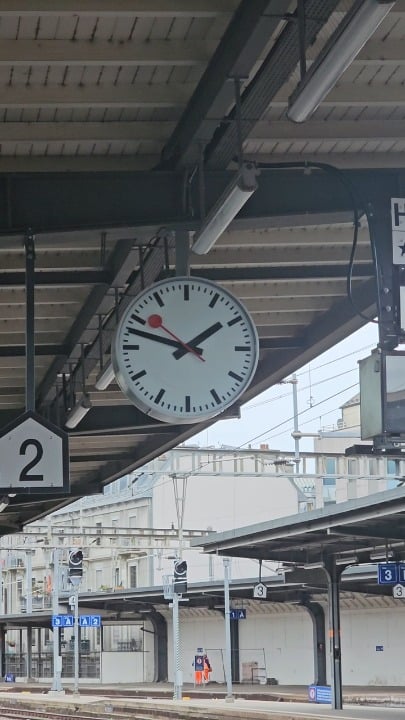
I feel like the “second” is moving slower at the exact minute on the clocks in gares. If so, how is this compansated, are other 59 seconds faster?
https://v.redd.it/ywcw7enks7og1
Posted by devoutre

I feel like the “second” is moving slower at the exact minute on the clocks in gares. If so, how is this compansated, are other 59 seconds faster?
https://v.redd.it/ywcw7enks7og1
Posted by devoutre
14 Comments
Yes. Any other existential questions?
Yes ! the clocks are synced by a signal at the minute; if the clock would be faster, it could beat the signal and you can’t stop the clock to allow for the “real time” to catchup.
So all the clocks are deliberately made a bit “slower” and then wait for the sync signal to skip the last second.
Yes.
The stop is on purpose and allows to synchronise all clocks and have the minute always start at the same time.
Careful, this is not a real clock, but a synced display of the central watch.
It’s famous for doing this
This is by design. Swiss train clocks are synchronised with a country-wide master clock by the minute, which means that the minutes hand turns simultaneously all over the country, but the seconds hand doesn’t because that’s 60 times more impulses and nobody needs precision by the second. As a result, you need to have the seconds hand go faster in order to make sure that it will always be at 60 when the minutes hand moves. If for whatever reason the seconds hand was just slightly late, it would remain stuck in place for an entire minute, waiting for a movement of the minutes hand to start its next revolution.
In fact they simply stop time for a second. so the 60 seconds (not 59 in fact) are still each a second long!
all the SBB clocks are sync’d centrally to the station’s master clock, this system was originally created in 1944 before modern day radio syncing (such as the [DCF77 out of Germany](https://www.ptb.de/cms/en/ptb/fachabteilungen/abt4/fb-44/ag-442/dissemination-of-legal-time/dcf77.html)). so the seconds hand runs _fast_ (not slow – completing a revolution in shorter time) and waits for the minute signal from the master clock to start again.
Wdym you „feel“ like, are you not sure? It obviously stops for a moment…
You feel?? 🙂
It stops.
It’s a very clever technique to make sure all clocks are synchronized in a train station, before electronic clocks were a thing. It’s a beautiful Swiss invention.
The hand makes a full turn in a little less than one minute. Its imprecise because it is a purely electromechanical clock, but all clocks wait then at the 12 position. A signal is sent to all clocks at the same time to start the minute again, ensuring sync.
The clock is fine. We just slow down time at the full minute.
Fun fact, the SBB watch features the same 2 second delay 🙂
The clock moves slowly since you’ve been away from my baby… hehehe/s
But yes, it’s true it moves slower, it’s because it’s a synchronization technique.