Talk about aggregate data! Would be helpful to have a bit more information here. Like by country at a minimum. My guess is that the rate of deaths has declined in the West along with smoking prevalence.
W0LFSTEN on
Of all the ways to highlight the mortality of smoking, this is not one I would use.
frolix42 on
Even though consumption is declining, happily, this makes sense when I consider that smoking still usually kills older people, and that cigarette use massively increased in the 2nd half of the 20th century.
My father is an example of this. He started smoking around 1970, quit 10 years ago, died of lung cancer in 2024.
Also they are a cheap luxury that’s still very popular in the populous developing world.
CollinHell on
Somehow I doubt that doctors in the 1900s were properly attributing deaths to smoking, weren’t pregnant women smoking cigarettes with their doctor’s approval (or even recommendation) as late as the 1950s?
ViridianKumquat on
Century boundaries are wrong. Should be 1901-2000 and 2001-present.
DeepJunglePowerWild on
This just makes sense no? Smoking deaths are a lagging statistic. If we all (as a global population) started smoking like crazy tomorrow, the deaths wouldn’t come for some time. If smoking as at its peak in the 1950-2000’s, the most deaths from it would be 1985-2025 if you put a 25 year lag on it. Also – everyone who dies now who smoked will probably have it as a reason they died where as in 1960 if someone died from a risk of smoking it probably wouldn’t be attributed to the smoking.
NameShortage on
Probably lots of young smokers died in the trenches which skews the numbers.
ThePreciseClimber on
20th century (1901-2000)
21st century (2001-2100)
MylastAccountBroke on
All the people who started smoking in the 70s turned 40 in the year 2000, when it’ll really start catching up to them.
Sort of like how Vaping won’t really catch up to people until the 2040s.
FaceRockerMD on
Back then they just had smoking. Now we have smoking and obesity!
marigolds6 on
11.5 Billion people lived at any time in the 20th century. 1.65B alive at the turn of the century and 10B births during the century.
9.6B people have lived so far in the 21st century. 6.1B at the turn of the century and 3.5B born since.
When you add in the impact of tuberculosis (1B), smallpox (300-400M), and influenza (50-100M) on early death in the 20th century, the number of people who could die of smoking so far in the 21st century is nearly equal to the entire 20th century.
The rest of the difference is almost certainly attributed to longer life spans overall from better nutrition, giving people more time to die of smoking related deaths.
_regionrat on
Smoking didn’t kill anyone before like the 80s, so this checks out
_V115_ on
Lots of reasons for this. I don’t think smoking is any more deadly now than it was last century, though I don’t know much about modern vs older cigarettes and their differences so I could be wrong on that.
Global population at start of 20th century was around 1.6 billion people. By 2000 it was 6.2 billion, and now it’s over 8 billion. This makes me wonder how the centuries compare on death tolls from any cause.
We are probably much better at diagnosing diseases related to smoking (heart disease, lung cancer, etc) than we were last century.
We’ve also reduced deaths from many, MANY other causes since then. Infant mortality, heart disease, infectious diseases, foodborne illnesses, asbestos, lead poisoning, etc. When you reduce other causes of death, remaining causes of death take up a bigger fraction of the death toll.
And ofc, if you were born in, say, 1930 or later, as long as you make it to 70 years old, your death happens in the 20th century. Similarly, many deaths in the 20th century would’ve been in people born in the late, mid, or even early 1800s. So keep in mind this is not strictly a 1900s vs 2000s comparison
Jackdaw99 on
Given that medical and surgical advances have doubled the survival rate from lung cancer — not to mention heart disease and so on, which can in some cases be attributed to smoking — this strikes me as unlikely, grossly misleading, or simply untrue.
Bapepsi on
Perfect article for showing that people have no idea how to understand data.
qawsedrf12 on
I wonder how much the lag time of 30+ years factors into this, despite smoking rates being lower
watching Mad Men right now, where they are dealing with smoking concerns in advertising and mentioned a smoking+cancer connection, 1965 in the show
should also get some country differences, France currently is at 40%
while in the US, smoking rates have fallen 73% among adults, from 42.6% in 1965 to 11.6% in 2022.
dancingbanana123 on
Interesting that it says tobacco specifically. I would assume modern nicotine users, at least in the US, use something with synthetic nicotine, like vapes or pouches.
HoneyBucketsOfOats on
There are also a LOT more total people
Ok_Actuary9229 on
That doesn’t sound plausible. More likely they simply didn’t attribute deaths the same way in the 1900s.
thiosk on
a bar graph (nah)
a bar graph about a hot button political thing (hmmm!)
EnderCN on
Both of my parents died of smoking related lung cancer in the 21st century. Both of them quit smoking in the 20th century. You are seeing the collateral damage from 20th century smoking at its worst right now, at least in the US.
Expensive-Soup1313 on
Nr1 : data over smoking deaths were probably not there before 1950s . This leads out already 50y , and that is even very cautious.
Nr 2 : before 1950 there were already 2 ww’s with many casualties under the age of 50, where basically practically near 0 people die of smoke related diseases. Most illness from smoking happen when smoking well over 20years , when cancer and heart/blood circulation problems start.
Nr 3 : population in 1900 to 1999 was much much lower then it is +2000.
Nr 4 many people before 1980s died of other diseases then smoke related , or could have been smoke related but not recognised or labeled as such. When my gf died, which was early 1980s , he had health issue so they went to check on him in hospital. They operated/opened him , looked inside , closed him up , said cancer… nothing we can do. That is on these days unimaginable . Science has made huge improvements in the medical field.
CorticalVoile on
Sure, all those 120 year olds have died of smoking and covid and no other reason
KofFinland on
In 1900 it was only 1600 million people, and now it is 8300 million people. People ratio 1600/8300 = 0.19 while years ratio 23/100=0.23 so the ratios are quite close. Might be just coincidence. If the percentage of people smoking is about the same, the increased amount of smokers is the simple explanation?
Just like people have bigger new loans every year, because due to inflation you need a bigger loan to buy your house.
good4steve on
It’s only when you leave the US that you realize that for many parts of the world, smoking is quite normal and common. I visited a Tully’s (coffee shop) in Japan that literally had a smoking room in it.
speaking_moose on
The abstract calls for taxes.
30 to 69 years old? What’s the criteria, just that they smoked? Are they counting a 30 year old smoker who dies in a car crash the same as a 69 year old with emphysema?
MasterMarci on
This should be measured by the birth year of the person and not when they die. It obviously takes time to die of smoking related illnesses.
grog23 on
Well we started the 20th century with 1.7 billion people and there are currently over 8 billion people now, so that would make sense
caucasian88 on
If you started smoking in 1960 at 18, the effects would be in full swing by 2000 when you’re 58. Smoking is a cumulative thing like that, so this shouldn’t be surprising. Plus the debate was still raging into the late 20th century, with pregnant women still smoking in the 80s-90s and restaurants still having smoking sections.
Decapitat3d on
I think this data is skewed a bit due to doctors not attributing as many deaths to smoking in the 20th century and the fact that the population is much larger than it was. I think the percentages of people dying from smoking have probably stayed the same or declined, but because the data is skewed due to misattributed deaths in the first place we’ll never really know for sure.
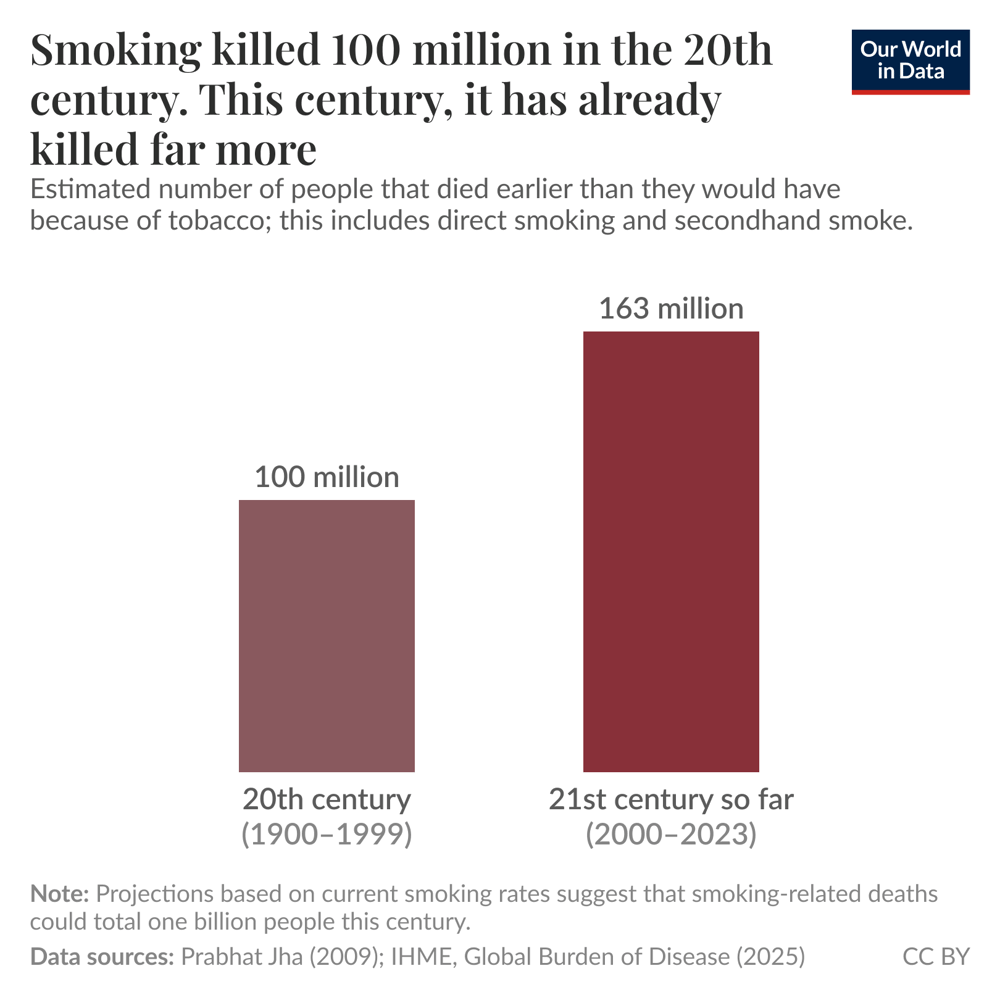

30 Comments
Talk about aggregate data! Would be helpful to have a bit more information here. Like by country at a minimum. My guess is that the rate of deaths has declined in the West along with smoking prevalence.
Of all the ways to highlight the mortality of smoking, this is not one I would use.
Even though consumption is declining, happily, this makes sense when I consider that smoking still usually kills older people, and that cigarette use massively increased in the 2nd half of the 20th century.
My father is an example of this. He started smoking around 1970, quit 10 years ago, died of lung cancer in 2024.
Also they are a cheap luxury that’s still very popular in the populous developing world.
Somehow I doubt that doctors in the 1900s were properly attributing deaths to smoking, weren’t pregnant women smoking cigarettes with their doctor’s approval (or even recommendation) as late as the 1950s?
Century boundaries are wrong. Should be 1901-2000 and 2001-present.
This just makes sense no? Smoking deaths are a lagging statistic. If we all (as a global population) started smoking like crazy tomorrow, the deaths wouldn’t come for some time. If smoking as at its peak in the 1950-2000’s, the most deaths from it would be 1985-2025 if you put a 25 year lag on it. Also – everyone who dies now who smoked will probably have it as a reason they died where as in 1960 if someone died from a risk of smoking it probably wouldn’t be attributed to the smoking.
Probably lots of young smokers died in the trenches which skews the numbers.
20th century (1901-2000)
21st century (2001-2100)
All the people who started smoking in the 70s turned 40 in the year 2000, when it’ll really start catching up to them.
Sort of like how Vaping won’t really catch up to people until the 2040s.
Back then they just had smoking. Now we have smoking and obesity!
11.5 Billion people lived at any time in the 20th century. 1.65B alive at the turn of the century and 10B births during the century.
9.6B people have lived so far in the 21st century. 6.1B at the turn of the century and 3.5B born since.
When you add in the impact of tuberculosis (1B), smallpox (300-400M), and influenza (50-100M) on early death in the 20th century, the number of people who could die of smoking so far in the 21st century is nearly equal to the entire 20th century.
The rest of the difference is almost certainly attributed to longer life spans overall from better nutrition, giving people more time to die of smoking related deaths.
Smoking didn’t kill anyone before like the 80s, so this checks out
Lots of reasons for this. I don’t think smoking is any more deadly now than it was last century, though I don’t know much about modern vs older cigarettes and their differences so I could be wrong on that.
Global population at start of 20th century was around 1.6 billion people. By 2000 it was 6.2 billion, and now it’s over 8 billion. This makes me wonder how the centuries compare on death tolls from any cause.
We are probably much better at diagnosing diseases related to smoking (heart disease, lung cancer, etc) than we were last century.
We’ve also reduced deaths from many, MANY other causes since then. Infant mortality, heart disease, infectious diseases, foodborne illnesses, asbestos, lead poisoning, etc. When you reduce other causes of death, remaining causes of death take up a bigger fraction of the death toll.
And ofc, if you were born in, say, 1930 or later, as long as you make it to 70 years old, your death happens in the 20th century. Similarly, many deaths in the 20th century would’ve been in people born in the late, mid, or even early 1800s. So keep in mind this is not strictly a 1900s vs 2000s comparison
Given that medical and surgical advances have doubled the survival rate from lung cancer — not to mention heart disease and so on, which can in some cases be attributed to smoking — this strikes me as unlikely, grossly misleading, or simply untrue.
Perfect article for showing that people have no idea how to understand data.
I wonder how much the lag time of 30+ years factors into this, despite smoking rates being lower
watching Mad Men right now, where they are dealing with smoking concerns in advertising and mentioned a smoking+cancer connection, 1965 in the show
should also get some country differences, France currently is at 40%
while in the US, smoking rates have fallen 73% among adults, from 42.6% in 1965 to 11.6% in 2022.
Interesting that it says tobacco specifically. I would assume modern nicotine users, at least in the US, use something with synthetic nicotine, like vapes or pouches.
There are also a LOT more total people
That doesn’t sound plausible. More likely they simply didn’t attribute deaths the same way in the 1900s.
a bar graph (nah)
a bar graph about a hot button political thing (hmmm!)
Both of my parents died of smoking related lung cancer in the 21st century. Both of them quit smoking in the 20th century. You are seeing the collateral damage from 20th century smoking at its worst right now, at least in the US.
Nr1 : data over smoking deaths were probably not there before 1950s . This leads out already 50y , and that is even very cautious.
Nr 2 : before 1950 there were already 2 ww’s with many casualties under the age of 50, where basically practically near 0 people die of smoke related diseases. Most illness from smoking happen when smoking well over 20years , when cancer and heart/blood circulation problems start.
Nr 3 : population in 1900 to 1999 was much much lower then it is +2000.
Nr 4 many people before 1980s died of other diseases then smoke related , or could have been smoke related but not recognised or labeled as such. When my gf died, which was early 1980s , he had health issue so they went to check on him in hospital. They operated/opened him , looked inside , closed him up , said cancer… nothing we can do. That is on these days unimaginable . Science has made huge improvements in the medical field.
Sure, all those 120 year olds have died of smoking and covid and no other reason
In 1900 it was only 1600 million people, and now it is 8300 million people. People ratio 1600/8300 = 0.19 while years ratio 23/100=0.23 so the ratios are quite close. Might be just coincidence. If the percentage of people smoking is about the same, the increased amount of smokers is the simple explanation?
Just like people have bigger new loans every year, because due to inflation you need a bigger loan to buy your house.
It’s only when you leave the US that you realize that for many parts of the world, smoking is quite normal and common. I visited a Tully’s (coffee shop) in Japan that literally had a smoking room in it.
The abstract calls for taxes.
30 to 69 years old? What’s the criteria, just that they smoked? Are they counting a 30 year old smoker who dies in a car crash the same as a 69 year old with emphysema?
This should be measured by the birth year of the person and not when they die. It obviously takes time to die of smoking related illnesses.
Well we started the 20th century with 1.7 billion people and there are currently over 8 billion people now, so that would make sense
If you started smoking in 1960 at 18, the effects would be in full swing by 2000 when you’re 58. Smoking is a cumulative thing like that, so this shouldn’t be surprising. Plus the debate was still raging into the late 20th century, with pregnant women still smoking in the 80s-90s and restaurants still having smoking sections.
I think this data is skewed a bit due to doctors not attributing as many deaths to smoking in the 20th century and the fact that the population is much larger than it was. I think the percentages of people dying from smoking have probably stayed the same or declined, but because the data is skewed due to misattributed deaths in the first place we’ll never really know for sure.