
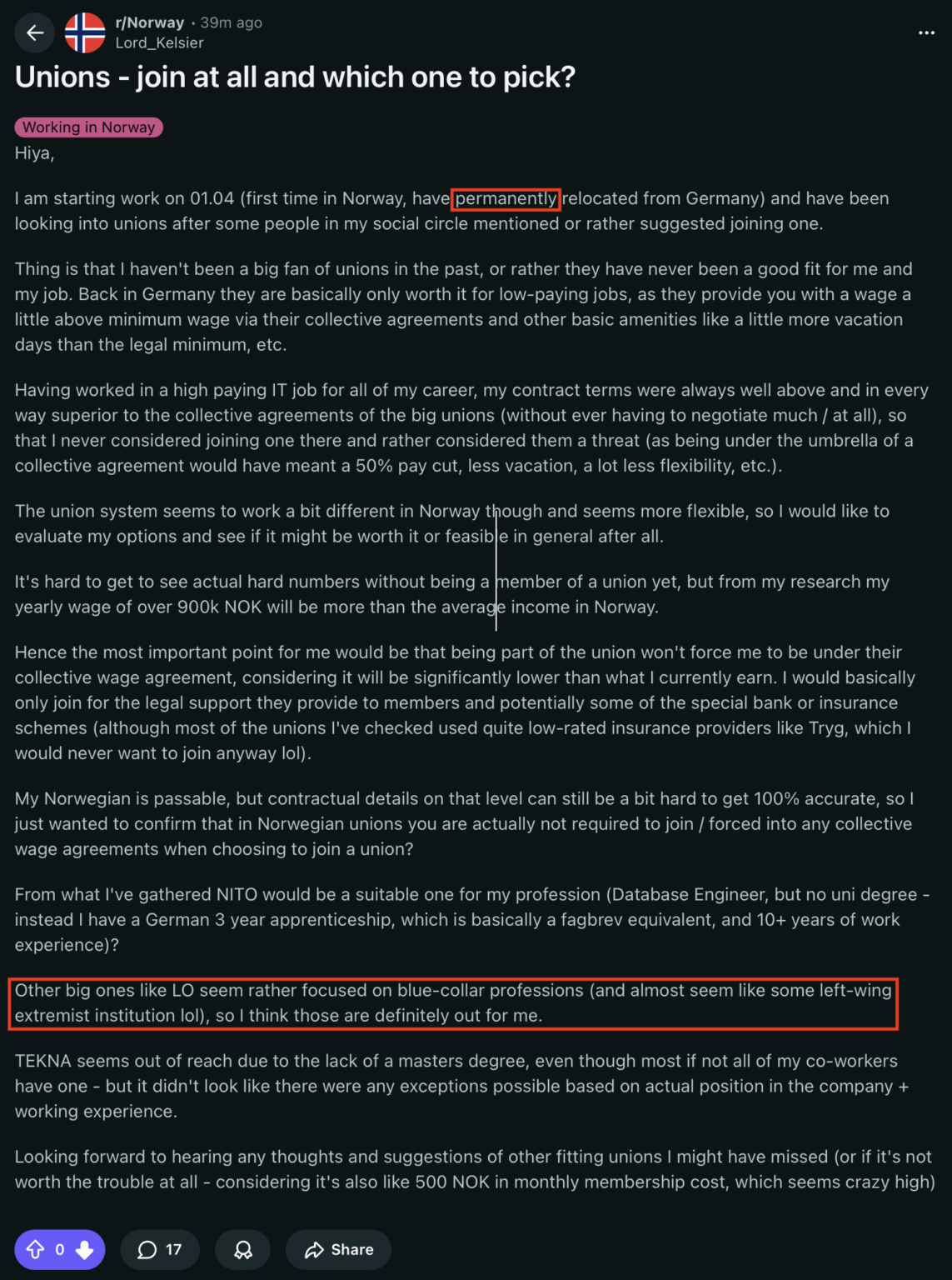
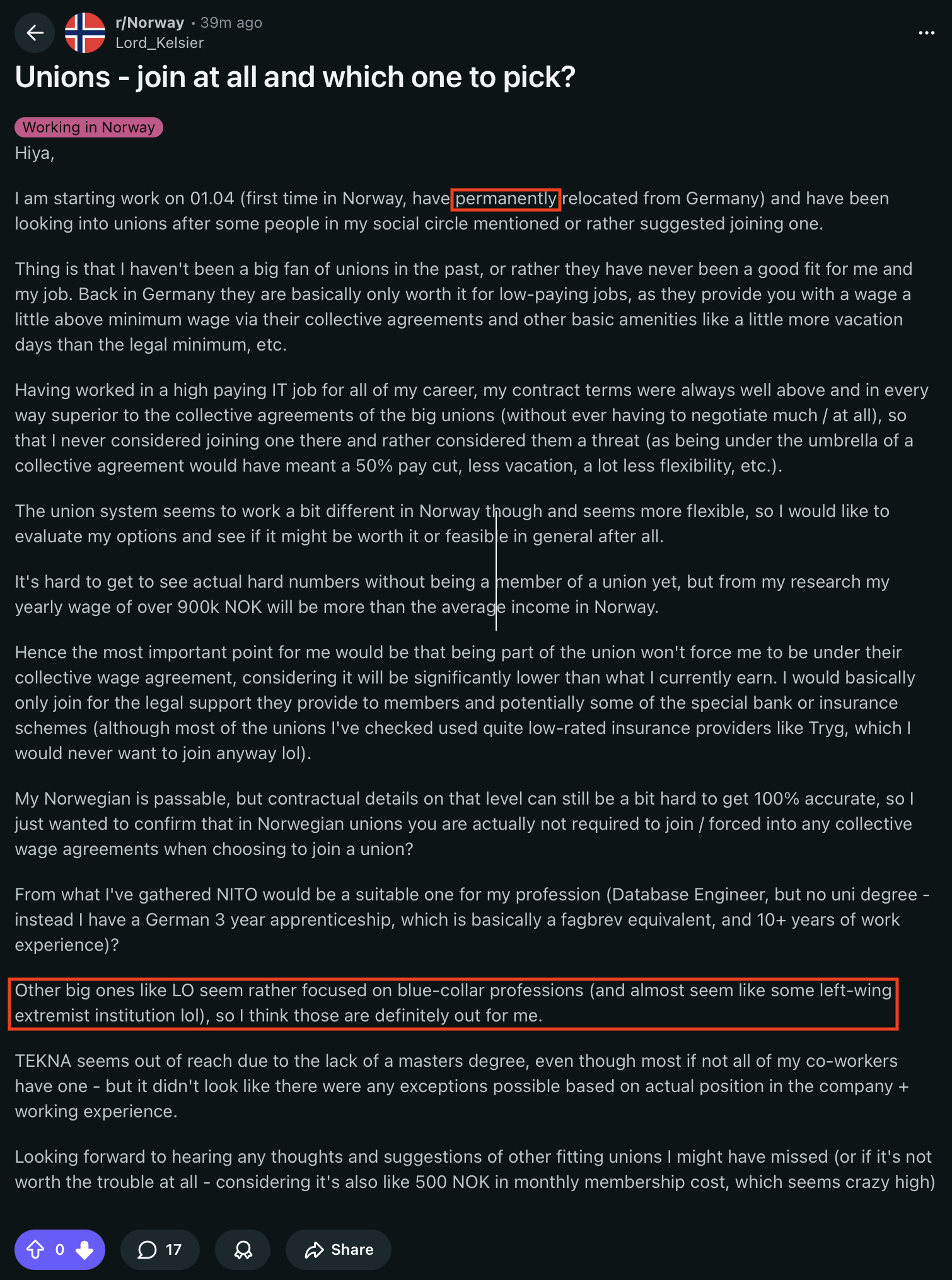
As far as I understand it, "extremist" refers to someone that supports political violence or wants to overthrow democracy.
I am just really confused, on if someone holds such negative views on the Norwegian Confederation of Trade Unions (LO), why would they want to permanently work in Norway?
https://i.redd.it/sruiil09nfpg1.png
Posted by Successful-Jelly-772
31 Comments
LO being extremist is hilarious. its like saying AP is extremist now because they where actual communists in the 1920’s
LO is not extremist. Its an organisation for the working class. Norway is a great place to live and work. Good balance between work and private/family life.
The person is almost certainly a brainbroken nazi and/or AfD and Trump supporter in Germany and there are LOTS of them, particularly from the former east and that’s why they see it that way. There’s no point in trying to understand them and what conspiracy theories and form of nazism and right-wing extremism they follow. Norway just has to hope he doesn’t cause problems there because he’s almost certainly a problem in Germany.
Also, lots of nazis and brainbroken right-wingers try to move to Norway because it’s used as a symbol of whiteness and unfortunately, both Norway and Iceland encourage right-wing tourism, as it has been described in analyses. They think they’re returning to the birthplace of their ancenstors.
I’ve never been in a union, especially not LO since as mentioned it’s very left wing and support Arbeiderpertiet (workers party) with millions every year.
In some professions it’s a good thing to be in a union, i’ve never needed that, I’m my own union and have striked 3 times before and succeded 🙂
500 nok per month, crazy high when you earn over 900k a year – lol
His parenthesis is maybe a little far out, but he says almost.. LO are left wing and they are focused on low income professions. That makes them not an option for plenty of Norwegians as well.
Don’t get your panties in a twist just because non-ap-voters want to move to Norway
Also “first time in Norway, have permanently relocated from Germany” . Why would you move to a country you have been to??
LO extremist? LOL.
I know plenty of people earning a lot more then him that are union members, many of them simply because they see it as “giving back to society and creating the same chances for others they got”. This guy strikes me as hyperindividualist asshole that thinks Norway is some white utopia, where he as ubermensch (notice the lowkey bragging about his salary and other things) will be welcomed with open arms. He probably won’t last a year in Norway.
Do you have the link to the original post?
If you don’t believe in a solidarity work market where if one group is mistreated, we all join in a strike to show who makes the country run, *you do not belong in the Norwegian job market*.
LO is the reason why we have minimum salaries *at all* in Norway; something politicians were *hardcore* against.
LO and other strong labour unions are the no 1 reason Norway is a great place to live.
[removed]
I mean, some people are on the further right side of politics. It’s not illegal. And while I certainly don’t view LO as extremist, they are the union with the closest ties to political parties, sometimes unhealthy close to parties. I would never vote far right and I’m a big supporter of unions myself, but I would never ever be a member of LO. Personally I’m a YS affiliated union.
Germans living here like to complain about Norway and say that everything is better back in Germany. We didn’t ask for them, so I don’t know why they move here
It seems to me most people posting here thinks Norway is some sort of paradise where it’s all get and no give.
I recon they will find out the truth soon enough.
Norway is great, but not perfect.
One of the main reasons workers do have it mostly good in Norway is the unions. It is however volentary to join. This guy seems to care about the free legal help and not much else as the other things are beneath him and that’s fine, but if you are more or less lawyering up before you’ve even started a new job, my guess is he won’t last long.
The guy seems like an individualist “world champ” who will make life hard for whoever he has to work with or whomever has the misfortune to hire him.
Not to worry, though; in a historical perspective germans have not lasted long in Norway. I give him 5 years before he’s back home …
You sure this is an actual person, though?
There are many reasons why.
1. People may move to norway because of work. You may have a better life here.
2. Ive also heard people move to norway because of their food and drinkable tap water???
@u/Lord_Kelsier
I’m not sure anyone wants you here 😄
Also, if you don’t like or support our unions, then, DO NOT expect or participate in ANY of the listed goodies below that the unions have given us:
8-hour workday / 40-hour workweek (1919)
Result of labor movement pressure after WWI. Became the standard in the Working Environment Act.
Five-day workweek (1960s)
Gradual shift from 6 days to Monday–Friday through collective bargaining.
Paid vacation – 25 days minimum
Established via the Holiday Act (Ferieloven). Standard is 4 weeks + 1 day, but most union agreements give 5 weeks.
Sick pay (100% salary for up to 52 weeks)
Norway’s full wage compensation during illness is among the most generous globally. Strongly defended by unions.
Parental leave with wage compensation
Up to ~49 weeks at 100% pay (or longer with partial pay) through the national insurance system.
Overtime pay requirements
Minimum 40% overtime premium, often higher in collective agreements.
Job protection / dismissal rules
Employers must have “saklig grunn” (just cause) for termination under the Working Environment Act.
Pension rights (AFP early retirement scheme)
Union-negotiated pension schemes allowing retirement earlier than standard age in many sectors.
Workplace safety laws
Strong Health, Safety, and Environment (HSE) rules and mandatory safety representatives (verneombud).
Collective bargaining rights and union representation
Workers can elect shop stewards (tillitsvalgte) who negotiate with employers.
Wage coordination (“frontfagsmodellen”)
System where export industries negotiate first to control inflation and maintain wage equality.
Training rights for workers and apprentices
Structured apprenticeship systems and protections partly driven by union–employer cooperation.
—
I do however expect you to ONLY follow these work rules that was common before unions gave us what I listed below:
Workweeks of 60–80 hours
Six days per week was standard; 10–14 hour days were common in factories and mines. No legal limit on hours.
No paid vacation
Workers who took time off simply did not get paid; many could not afford to take any leave.
No sick pay
If a worker became ill or injured, income stopped immediately. Many families fell into poverty after illness.
Child labor
Children as young as 10–12 worked in factories, sawmills, and fisheries before stricter labor laws in the early 1900s.
Dangerous workplaces
Industrial accidents were frequent; there were no mandatory safety rules, inspections, or safety representatives.
Instant dismissal
Employers could fire workers without explanation or notice.
No overtime pay
Extra hours were often unpaid or paid at the same rate as normal hours.
Employer control of housing and stores
In some mining or industrial towns workers rented housing from the employer and bought goods in employer-owned stores, creating dependency.
Blacklisting union supporters
Workers who attempted to organize could be fired and prevented from getting jobs elsewhere.
Strike repression
Employers frequently used strikebreakers or police/military to suppress strikes.
Large wage inequality and unstable pay
Wages fluctuated with seasons and markets; layoffs were common during downturns.
No unemployment benefits or social safety net
Before modern welfare policies (early–mid 1900s), losing a job meant no income support.
I have a feeling this person is actually American, not German.
LO is why Norway is Norway. Just about every good thing we have is due to their efforts.
LO is not uncontroversial. While they dont deserve to be called “extremist” they lean heavily left.
I’m a native Norwegian and will not join any LO union due to their politics.
Is it just me, or does 900k as a database engineer in 2026 sound insanely crazy?
Unless we’re talking about the AI field.
I can’t stand IT professionals that don’t realize they are working class. I’m an experienced programmer and the lack of solidarity among my colleagues are just sad.
NITO and TEKNA are better than nothing but they act more like guilds than unions.
The decades long wet dream for owners and managers is to make developers redundant. It is still a quite privileged job as there are lack of skilled workers and the jobs are often critical or necessary for revenue. And nothing managers or business professionals can do.
But that makes it our damned DUTY to stand in solidarity with less privileged workers. If not for kindness at least so they will stay with us when our time comes. And it will come.
LO is a very left leaning organisation. They support parties on the left with millions and will refuse to cooperate or agree with anything on the right. If the left propose policies that are good for their workers, feel free to support them. But they will support anything the left stands for, just because theire ideology denies them any affiliation with the right, even though many of their members don’t vote for the left parties. This creates an imbalance that I do not like. So personally I will not be a member in LO. I have found a politically independent union to join.
At least there is some joy in the fact that the only union that seems to be good enough for this stuck up asshole, is a union that doesn’t think he is good enough.
Just this “…haven’t been a big fan of unions (…) never been a good fit for me and my job.”
The rest is to throw away of any doubts.
There are several reasons to join a union. Salary is just one. And unions like NITO and Tekna will fight for your salary even if you are among the high earners.
The unions are there to safeguard that the employer follows the law. Help members in disputes. Follow up on tarrif agreements, etc.
The unions will often also have good collective agreements with insurance and bank. Most members will save more a year on the insurance alone than the membership cost.
I’ve never seen a German use a Russian Smiley face)
People who don’t feel like unions are a “good fit for them” often have egocentric priorities.
They don’t understand that you don’t just join for yourself, but to ensure that we protect each other if someone/something start messing with our livelihood.
I find it annoying when i have to listen to these type of people’s ego trips.
A typical tight-as-ducks-arsehole German. 500kr monthly fee when you’re on 900k 😂