
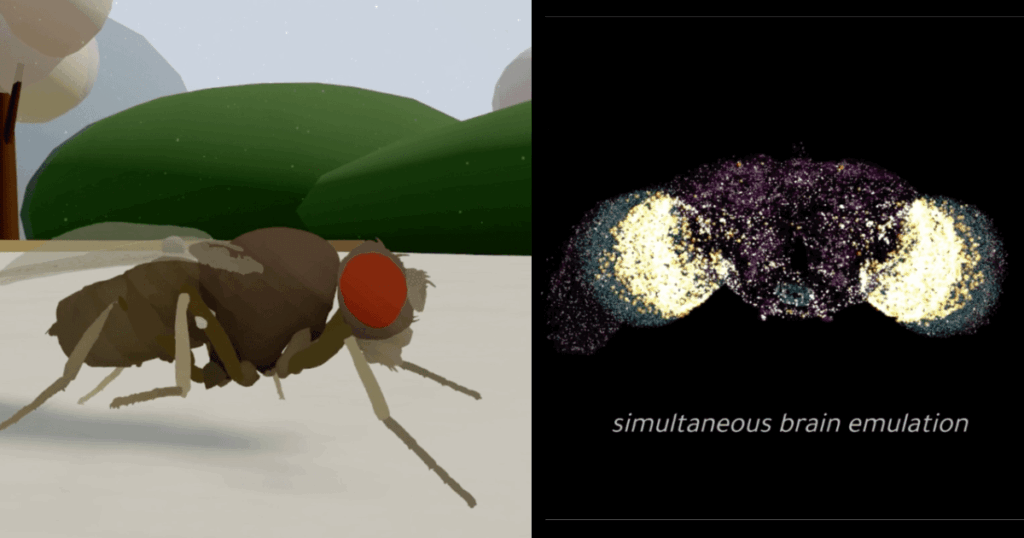
Today something very similar to the Matrix could have been born:
Eon Systems: a virtual fly with a simulated real brain
Eon Systems has published (March 10, 2026) technical details on their “embodied fly” project: a simulation in which a model of the Drosophila brain controls a physically realistic virtual body. 
How it works
The simulated brain is based on a leaky integrate-and-fire (LIF) model constructed from the connectome of the adult Drosophila brain, with ~140,000 neurons and ~50 million synaptic connections.  The virtual body is NeuroMechFly, an anatomically precise neuromechanical model with 87 independent joints, created from a micro-tomographic X-ray scan of a real fly, run on the MuJoCo physics engine. 
The operating cycle has four phases: sensory stimuli from the virtual world activate identified sensory neurons → the brain updates its activity → some descending neurons translate the brain output into motor commands → movement changes the sensory state, feeding the brain back.
Demonstrated behaviors
In the demonstration video, the fly uses invisible taste cues to navigate to a food source (stylized as banana slices), stops to groom itself when covered in “virtual dust,” then resumes walking and begins eating. Foraging behaviors and an escape response to threatening visual stimuli (looming) were also implemented.
Recognized limitations
The team is very honest about the limitations: the neuronal model is simplified (no detailed biophysical dynamics, no plasticity or learning), the interface between brain and body uses only a small number of descending neurons as “control handles”, and internal biological states such as hunger, arousal or hormonal context are not modeled.
Long term goal
Eon is working on a framework for specifying the fidelity of emulations and brain uploads, which it intends to share in the medium term, and seeks academic and industrial collaborations on this topic.  The embedded fly is described as a first concrete demonstration of how emulating an embodied brain in a body might work.
https://eon.systems/updates/embodied-brain-emulation
Posted by MasterPen6
4 Comments
I complottisti diranno che è una simulazione in una simulazione
Nell idea originale gli esseri umani dovevano essere usati dalle macchine come una rete neurale per far ricavare potenza di calcolo.
Morfeo avrebbe dovuto far vedere a Neo un chip dentro struttura ma si resero conto che l immagine del Chip era semplicemente troppo aliena per lo spettatore medio
Quindi si sono inventati la cosa mezza insensata dell “uomo ci serve come fonte di energia” e da qui l immagine di Morpheus che mostra la Duracell, molto più comprensibile per Homer Simpson.
Seguitemi per altre storie di come Matrix abbia imbastardito e stuprato il cyberpunk.
>139.255 biological neurons. 50 million connections. Preserved, scanned, reconstructed, and emulated. In a landmark [**2024** ***Nature*** **paper**](https://www.nature.com/articles/s41586-024-07763-9), the model matched the biological fly’s neural responses with 91%
Direi che è lunghetta arrivare a 80 miliardi di neuroni e 99.99999999% di fedeltà.
È già lunghetta a simulare una singola cellula con una precisione atomica al momento, presumo.
[Cortical Labs](https://corticallabs.com/)