Python mathpoltlib code and data from the chapter page 88 in volume 3 linked to by wikipedia.
-p-e-w- on
Two patterns can be consistently observed in society:
* Predictions for the future, including scientific ones, tend to be hilariously inaccurate, with widely assumed future developments (e.g. manned NASA Mars missions by the 1980s) just flat out failing to materialize, while overwhelmingly important trends (such as the rapid growth of the Internet) aren’t on anyone’s radar.
* Nevertheless, people always insist that broad and disruptive policy changes are made based on things that they are absolutely certain will happen 30 years from now.
irrealewunsche on
I was interested as to what the death rate/1000 was globally, and apparently it was 7.8 last year.
ChestHistorical6945 on
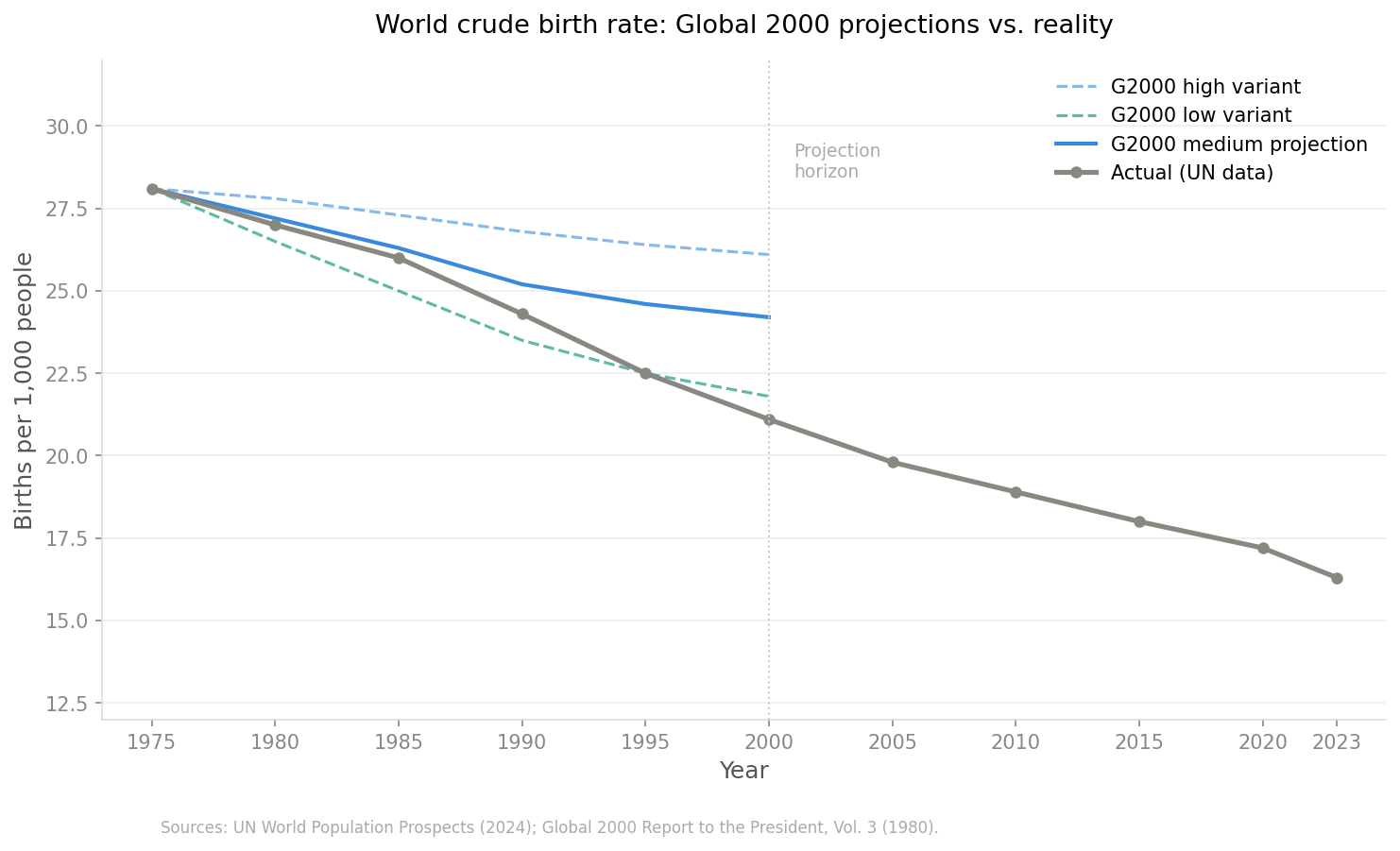
Basically, the expectations were bad but we still managed to do worse.
Ill-Construction-209 on
We shouldn’t be too alarmed by this. Despite the decline, that rate still represents population growth.
allwordsaremadeup on
I’m interested in the associated resource-use predictions and whether they hit closer to the mark. Population as a footprint means little, as the rich consume/pollute many many multiples of the poor.
deepserket on
Would have been cool to see the projections at different points in time like in this graph:
It looks like projections were rather spot on until the 90s.
The fall of communism, the rise of China and a dozen other events that nobody had seen coming that way all had negative influence on birth rates.
It would be expected that a few events would push things in ine direction or another. What wasn’t foreseen was that so many developments all pushed in the same directions.
There weren’t many unforseen developments in the late 80s and early 90s that resulted in people having more children than expected and plenty that went the other way.

![Global 2000 birth projections and what happened [OC]](https://www.byteseu.com/wp-content/uploads/2026/03/ch4r5vwe3zpg1-1024x623.png "Global 2000 birth projections and what happened [OC]")
8 Comments
‘***The Global 2000 Report to the President*** was a 1980 report commissioned by President [Jimmy Carter](https://en.wikipedia.org/wiki/Jimmy_Carter). It warned that [world population growth](https://en.wikipedia.org/wiki/Population_growth#Population_growth_rate), [pollution](https://en.wikipedia.org/wiki/Pollution) and [resource depletion](https://en.wikipedia.org/wiki/Resource_depletion) would have dramatic consequences by the year 2000 if no changes in public policy were made’ [https://en.wikipedia.org/wiki/The_Global_2000_Report_to_the_President](https://en.wikipedia.org/wiki/The_Global_2000_Report_to_the_President)
Python mathpoltlib code and data from the chapter page 88 in volume 3 linked to by wikipedia.
Two patterns can be consistently observed in society:
* Predictions for the future, including scientific ones, tend to be hilariously inaccurate, with widely assumed future developments (e.g. manned NASA Mars missions by the 1980s) just flat out failing to materialize, while overwhelmingly important trends (such as the rapid growth of the Internet) aren’t on anyone’s radar.
* Nevertheless, people always insist that broad and disruptive policy changes are made based on things that they are absolutely certain will happen 30 years from now.
I was interested as to what the death rate/1000 was globally, and apparently it was 7.8 last year.
Basically, the expectations were bad but we still managed to do worse.
We shouldn’t be too alarmed by this. Despite the decline, that rate still represents population growth.
I’m interested in the associated resource-use predictions and whether they hit closer to the mark. Population as a footprint means little, as the rich consume/pollute many many multiples of the poor.
Would have been cool to see the projections at different points in time like in this graph:
https://preview.redd.it/irk15zdxkzpg1.jpeg?width=770&format=pjpg&auto=webp&s=35bc93ddea76cb0081a60d7d29d8439dad4789a7
It looks like projections were rather spot on until the 90s.
The fall of communism, the rise of China and a dozen other events that nobody had seen coming that way all had negative influence on birth rates.
It would be expected that a few events would push things in ine direction or another. What wasn’t foreseen was that so many developments all pushed in the same directions.
There weren’t many unforseen developments in the late 80s and early 90s that resulted in people having more children than expected and plenty that went the other way.