
![[OC] Baby Names are Becoming More Diverse, But Shorter.](https://www.byteseu.com/wp-content/uploads/2026/03/nr9r091600qg1-1024x1024.png "[OC] Baby Names are Becoming More Diverse, But Shorter.")
US baby name data 1880-2024.
Source: Social Security Administration
Data includes all given names registered to the SSA starting with birth year 1880. Names with <5 people are omitted by the SSA to protect privacy. Spellings of names are unique, and each name is stored with the sex assigned at birth. The SSA's data only includes the first 15 letters of a name, although it estimates extremely few names are longer than 15 characters.
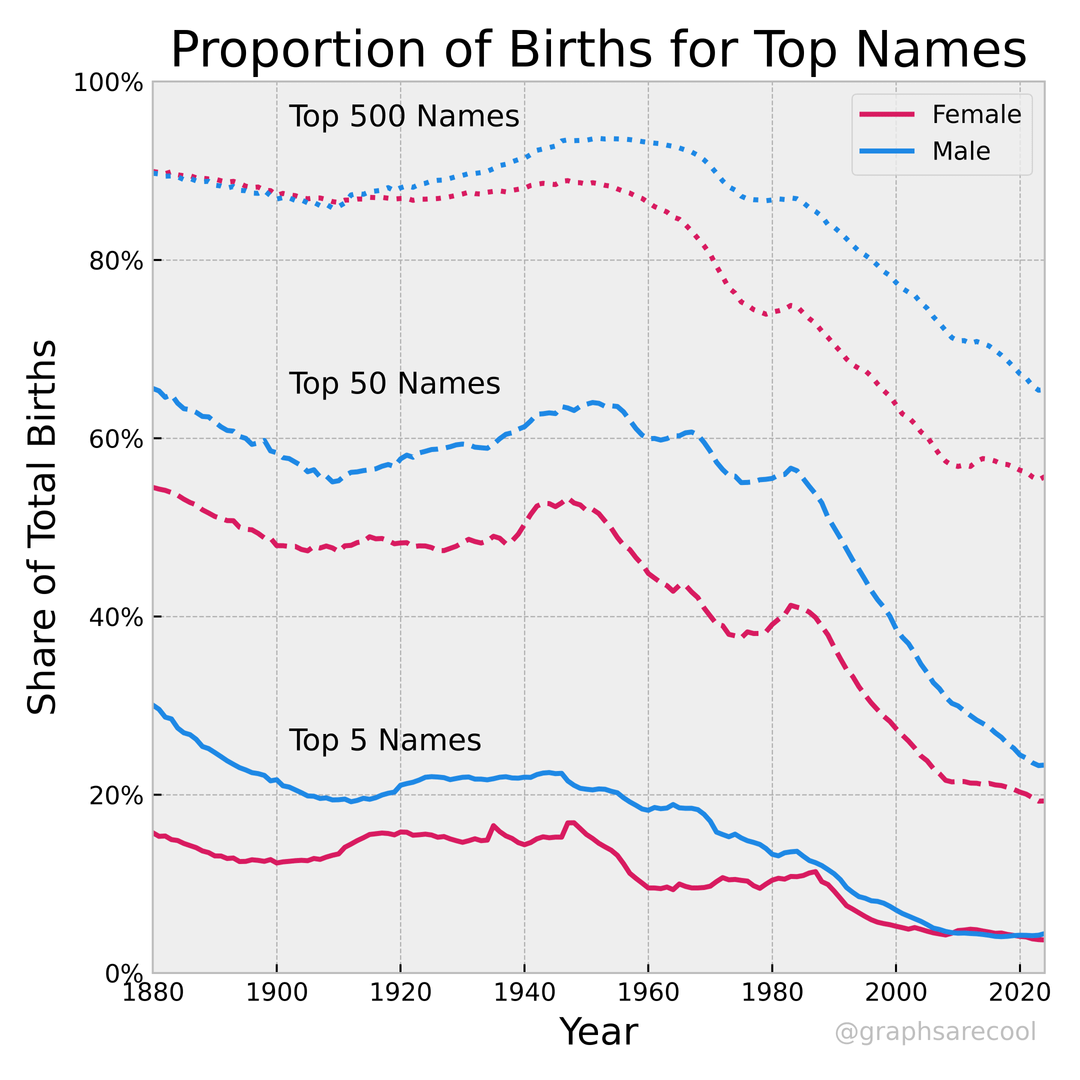
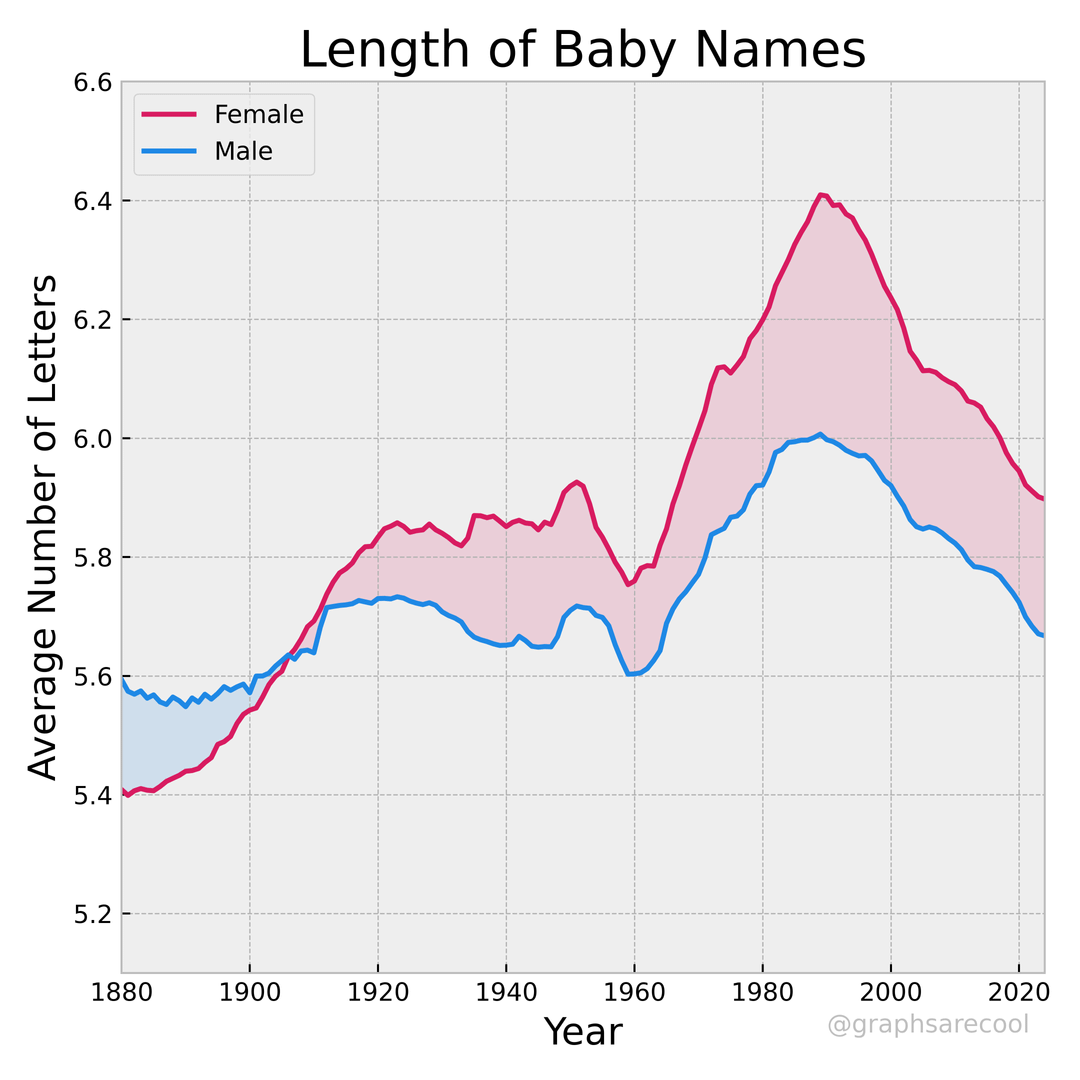
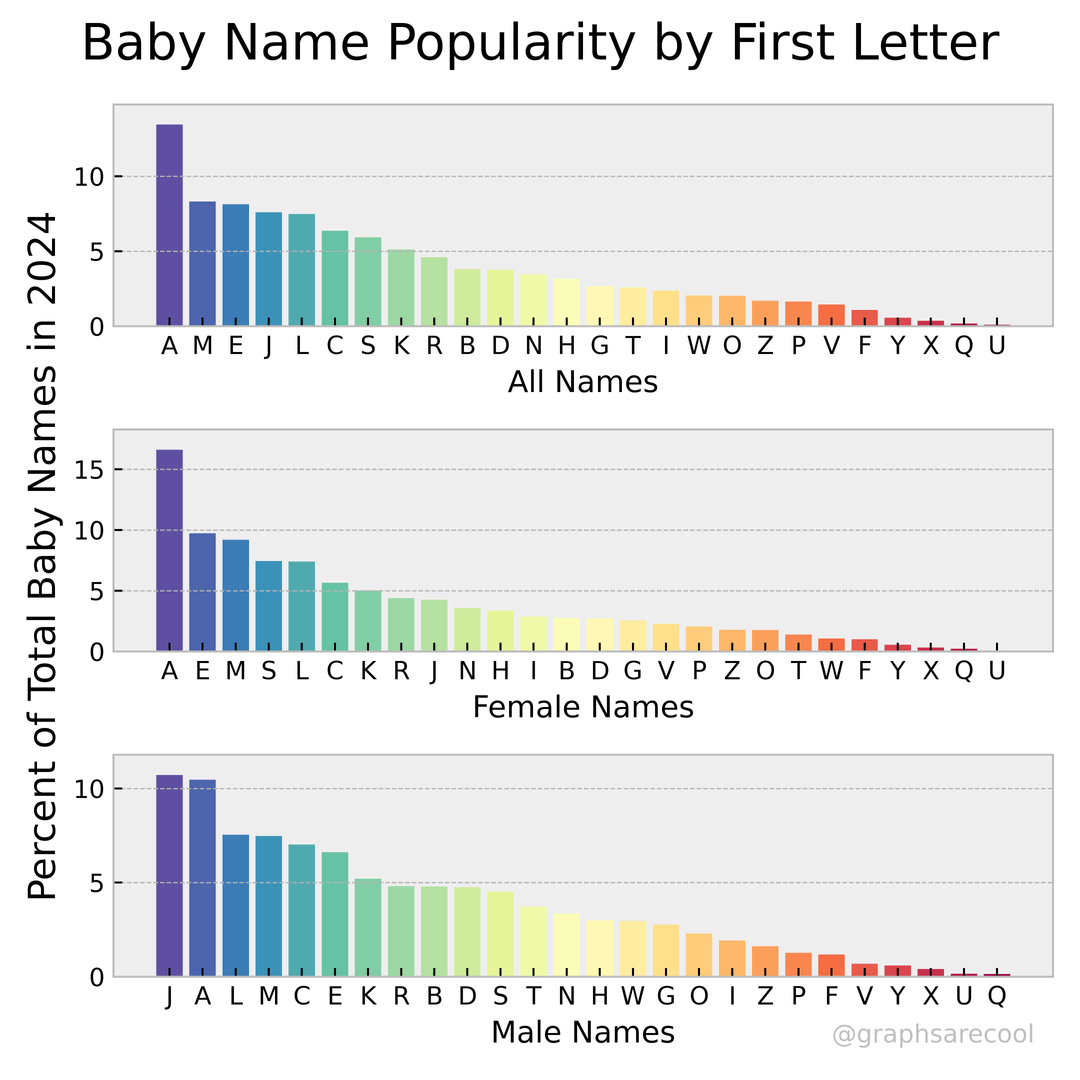
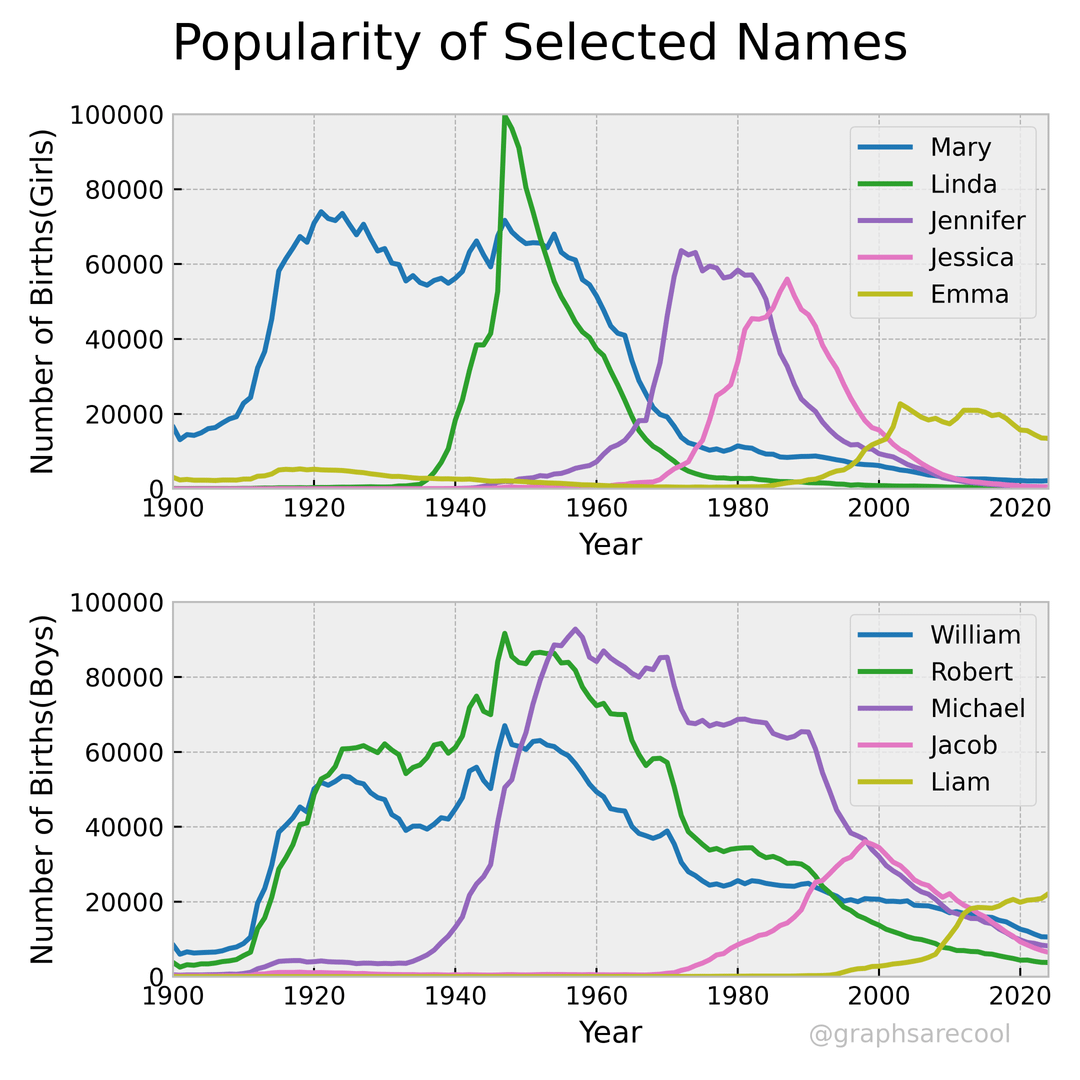
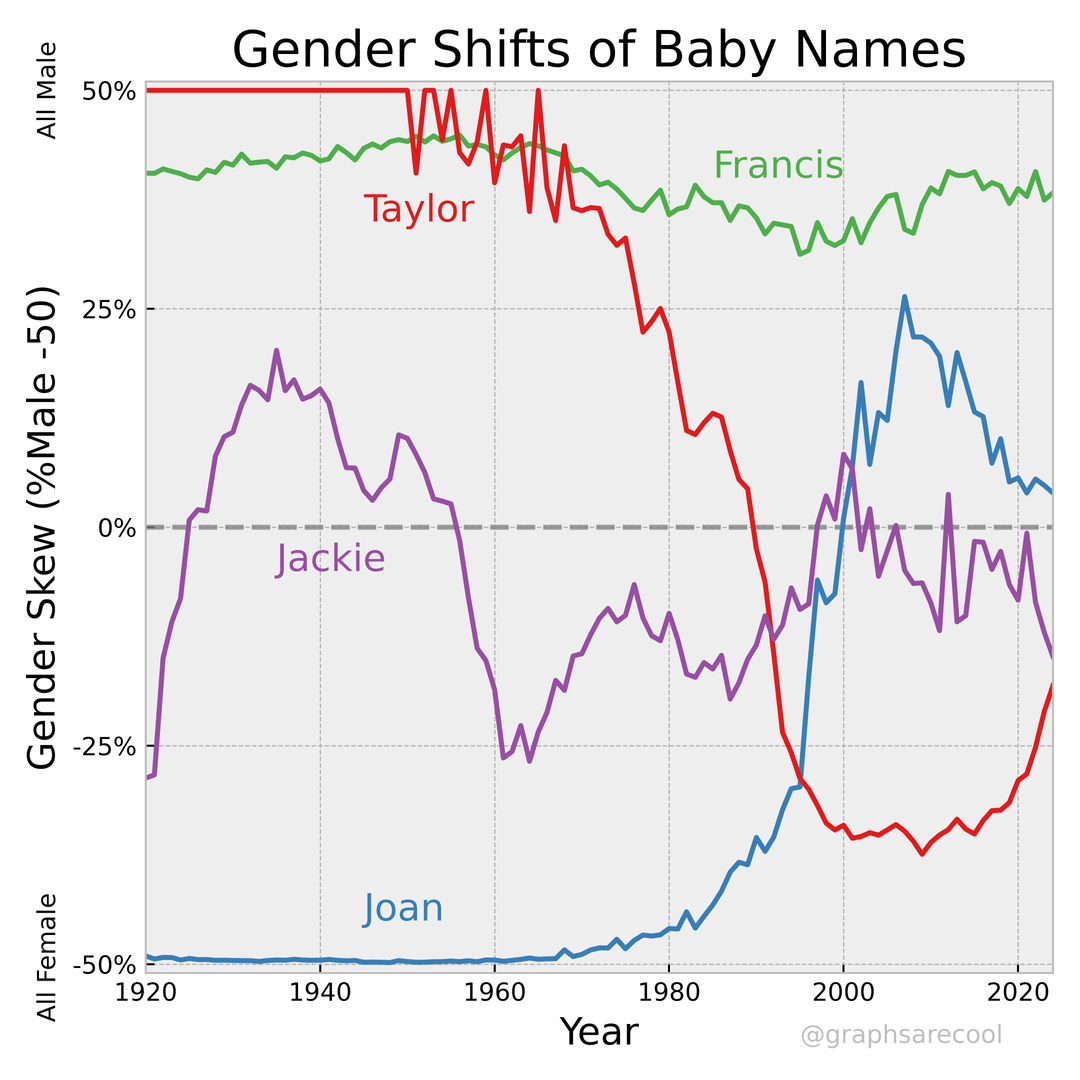
Slide 1 plots the proportion of all babies with a name in the top N names of that year, and shows that names are steadily getting more diverse. Slide 2 shows the average number of letters in baby names, which has been decreasing since the 90's. Slide 3 shows the most recent baby names by first letter. Slide 4 shows the rise and fall of selected names that had significant spikes in popularity. Slide 5 shows 4 different unisex names and how the sex of babies with that name have changed over time.
Posted by graphsarecool
35 Comments
Source: SSA [https://www.ssa.gov/oact/babynames/limits.html](https://www.ssa.gov/oact/babynames/limits.html)
Tools: Python with matpotlib.
Men named Joan? What culture’s that?
And if anyone’s wondering about girls’ names in the 1980s, I’m going with the popularity of Jennifer and Stephanie.
I named my little boy JALMCEK
I think the first letter popularity graph would be much better in alphabetical order so we can more easily see differences and similarities between the genders.
This is fascinating to me as a teacher born in the 80s.
There are typical names to my generation. Jason, Brandon, Jessica, Brittany, etc: names that you definitely had in every class, that changed with each generation.
Occasionally now I’ll write a story problem and I’ll want the names to be of my students’ generation: things that sound like them, and don’t sound like middle-aged or old people. And I find myself struggling sometimes with “what even IS a ‘typical’ popular name for a zoomer” without actually using students’ names. You kind of had the ‘-aiden’ trend for a while (Jayden and Kaiden and Braiden and Peydon and Ayden and…), but I feel like these later generations just don’t share common names as much as we used to, and it’s hard to pick out very many random names that feel like high school age names specifically.
Looks like it’s not just my imagination.
I still don’t get Liam.
Why not just name the child William and call him Liam? It’s half a name.
William can be Will, Willy, Bill, Billy, or Liam.
Liam is just Liam.
Was Liam really that rare of a name in the US? I’m in Canada and Liam is a completely “normal” guy name and barely has any connotations of being an Irish name or whatever.
This is well done. I’ve seen plenty of charts on baby name trends; this one actually showed me some new things (charts 1-3). Chart 4 should really be based on %, not #, but it wouldn’t really change the story. I know a ton of Jennifers and Jessicas!
The gender one is interesting; I’m betting the Joan trend is a function of a drop in female Joans more than an increase in male Joans.
The first chart surprised me – it indicates that female names tend to be more diverse than male names, but growing up reading “Top 10 Baby names”, it seemed like female names were more consistently multi-year repeats than male names.
I have to imagine the letter A being so heavily favored has to do with it being first in the alphabet.
Picks up a book of names, reads thru the first couple pages, “that one looks good. All done.”
This is pretty well done. My one complaint is that the baby name popularity by first letter is sorted by most to least. I think sorting by alphabetical order would be easier to take in at a glance.
What happened in the early 1940s for the Linda spike?
Eh. If they’re alternate spellings of the same name, do they really count as different names?
Also. Where’s Karen??
The beginnings and spellings are more diverse, but the endings are the new trends. Look at names that end in A: AvA, OliviA, AmeliA, EmmA, SophiA, NovA, etc.
On the final chart, the axis label creates confusion. It uses a dash before the 50% which reads as if male is -50% instead of 50%.
Of course “Francis” remained up there. The conventional feminine versions like “Frances” and “Francesca” already existed. And if you were already a family predisposed to naming your kid Francis, you were likely also predisposed to picking the gender conventional version when the kid turned out to be a girl.
I find the Jackie trend interesting, becoming much more common in females with the ascendancy of the Kennedys, and then backing off greatly following the assassination.
interesting why is that ? Could a contributing factor be because of immigration from non European countries increasing ?
It’s interesting that J is first for boys.
In improv, when people have to come up with a name for the other person in the scene off the top of their head, for men they overwhelmingly choose a J name, just on instinct. So much so that we’ve sometimes had to say ‘no J names’.
Has anyone seen the video about Jalens in the NBA? 🤣
r/tragedeigh
NGL I don’t think this data bodes well.
Some people seem to avoid “popular” names for the stupid reason of making it more unique which some of them have the bright idea of giving their children stupidly spelled names.
My family has normal names (Haley, Nathan, Jacob ,etc.,). Guess what my sister named her kids? Tripp & Fox. They sound like a quirky cartoon duo. Not human names.
Aren’t William and Liam the same name? They are <checks quickly> for Neeson and Gallagher.
I’m curious about the spelling of “Francis.” I’ve seen it with an “i” for boys and “e” for girls.
Jackie and Joan weren’t popular names for either gender. An actual popular gender neutral name was Jordan or Jamie
A girl would be named Jacqueline and go by Jackie
I’m genuinely surprised that P is the sixth least common letter for males. Gone are the days of the saints, I suppose (Peter, Paul, Patrick, etc).
Was Mary really that unpopular in the 1900 decade? I always thought it was the most popular girl name in the English world since forever
Girls are being given traditional boy names like James and Michael, and both sexes are being given surnames (Taylor, Mason, Madison) and place names as first names (Dallas, Paris). My guess is that the trend of the shortening of names is a reflection of the shrinking vocabulary and simplification of language that has resulted from lower reading proficiency levels.
If anyone wants to know how this is going, you can pop into r/tragedeigh
The trend in naming for this generation is “unique,” which is mostly expressed by starting with a familiar name and devising a creative way to spell it. It’s pretty horrifying.
There’s a separate trend of classic names coming back. I gave both of my kids pretty classic names that would have been at home in the 1920s or any time since, because I didn’t want to saddle them with a name that was very clearly of a specific decade or generation. Both of those names have turned out to be particularly popular and spiked during this generation anyway.
Francis for women was usually Frances
I wonder whether the increased diversity of names is at least partly about increased diversity of the population itself.
I thought that Francis is the way you spell it for males and Frances for females. I know this because of a Frances that I once misspelled her name.
You could do some interesting things with the first two letters and get that as a over the years chart.
So “Je” would capture the Jennifer to Jessica in the 70s and 80s. This can also span genders – Michael and Michelle both peaked in the 70s. There’s the consistent “Ja” baseline for a while of James and Jason and later Jayden and Jamie and Janet and Janice. And the Cristopher and Christine peak.
Uhh Joan is definitely not a unisex name. This is bizarre. Something that you aren’t addressing in this is also the change in country of origin of the US population. The diversity should go up as there are many less European names in the top 50. Some names are . . . also choices. You can look at them all by going into the SSA database. We did this when picking our kids names. The number of names that are just misspellings of common names is frightening.