
![[OC] Many "Proteins" could be described as Fats or Carbs instead.](https://www.byteseu.com/wp-content/uploads/2026/03/nnxrn1ocg0qg1-1024x756.png "[OC] Many “Proteins” could be described as Fats or Carbs instead.")
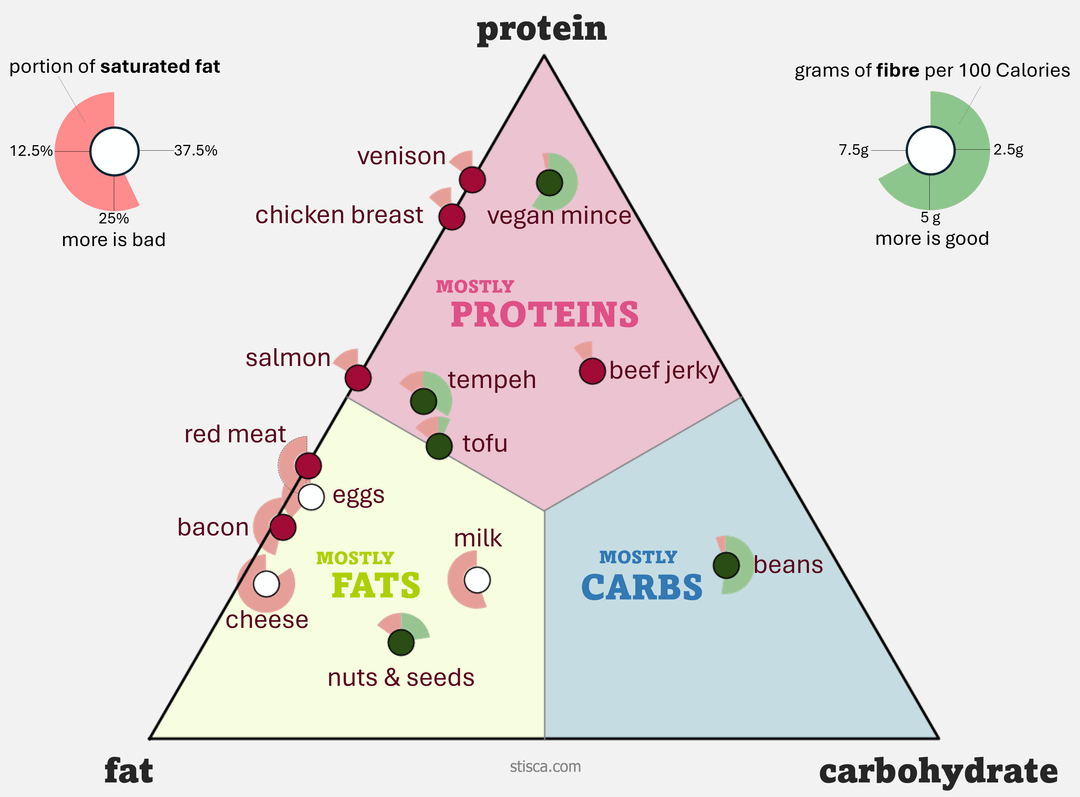
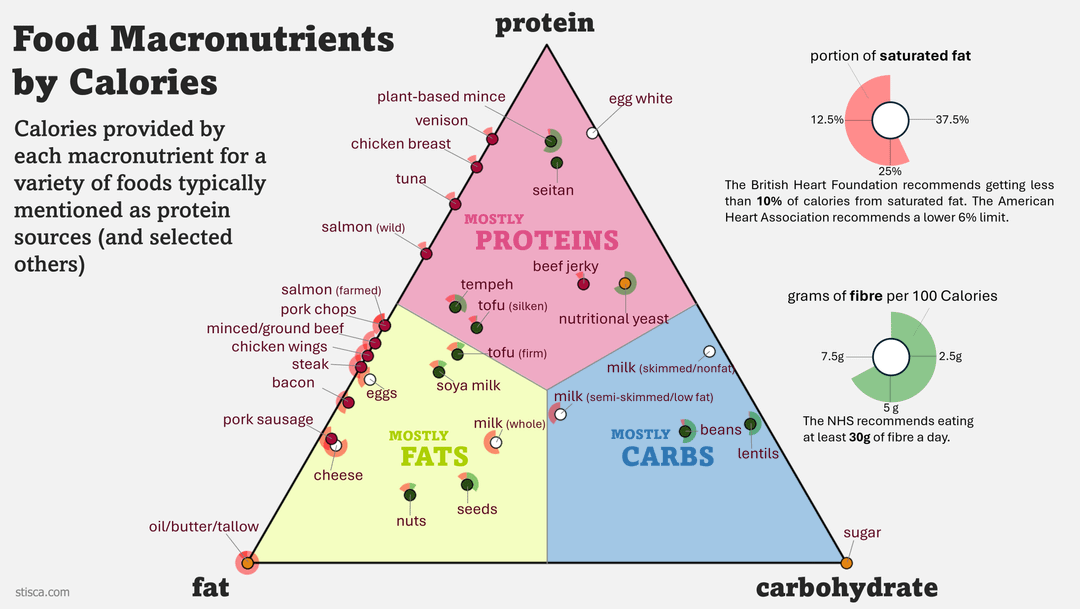
Many foods described as "protein" have more fat of carbs when measured in calories. Some come with more unhealthy saturated fat than is ideal, while others add extra fibre.
Full analysis, details, data, and source code: https://www.stisca.com/blog/macronutrientplot/
Posted by stan-k
29 Comments
“vegan mice” i need to go back to bed
What, pray tell, the fuck is “Vegan mince?”
Going from lentils to sugar makes the jump look unrealistic. Really need something like pasta, bread, rice, potatoes
Really highlights why gym bros have the stereotype of eating chicken breast and egg whites
Pump the brakes bro, RFK is liable to add you to a MAHA hit list for this.
On a more serious note this is a really interesting graphic. Love the color-coded wheels for saturated fat and fibre to show additional nuance/ dimensions.
It does seem a bit biased towards plant proteins though – for a more complete picture it’d be good to go further and show other aspects like polyunsaturated fat content and some indication of amino acid balance (digestibility? quality? Not sure what you’d call it).
Firm tofu seems incorrect. There is nearly double, if not more than double the amount of protein than fat on the nutrition labels I see.
People need to stop referring to foods as parts of them
Maybe don’t refer to foods as a single component at all. Stop oversimplifying and pay more attention to what you are eating
This is just missing context. Most people know the difference between meat and “products that can be a source of protein”
so I should eat a lot of tempeh? I guess? am I reading this right?
Cheese can’t be a single point. There are so many different types of cheeses, all with different fat to protein ratios.
Am I just blind and not seeing shrimp, crab, lobster and other shellfish?
This basically summarizes that people are unaware fat has more than twice the calories per gram of protein and carbs, the later two being equal. 9 for fat, 4 for carbs and protein.
low fat milk would like a word
What is vegan mince? I’ve been vegetarian for 20 years and have never heard of it. Is it like TVP or is it specifically like the Beyond or Gardein ground beef that’s a mix of different foods?
Most meats are mostly water.
This is interesting, but definitely not a “beautiful” graph from a visualisation point of view.
Despite the repeatedly pointed out fact that for example “cheese” cannot be a singular point, why do we have detailed percentage of fibre and saturated fats, but not proteins per food?
And why are saturated fats and fibre part of the same circle while being completely different metrics, or am I misunderstanding something?
Feels like several things are conflated here.
Who describes foods as “proteins”? I mean, yeah, sure, I know the shorthand as in “you should eat more protein”, which means “food relatively high in protein”, but I don’t think I’ve ever heard anyone assume that the entire food is just “the protein”.
“Protein sources”, on the second images – sure, fair, but that conflicts with the headline of this post, which doesn’t seem to consider that something can be a good protein source (as in: a better source of protein than many other foods by volume/mass/cost/calories/availability) without protein being the main macronutrient (especially since the recommended daily intake is not “equal amounts of each”).
As a vegetarian, where should I get my protein then?
I love that you’re breaking down the simplistic view of “foods are either fats, proteins, or carbs.” Almost all foods have all three, and it’s only silly fad diets that demonize one category while putting another on a pedestal.
But I object to the “more is bad” and “more is good” captions on the fiber and saturated fat circles. It breaks the objectivity of the diagram and undermines the de-simplifying of what food is that it accomplishes.
Along similar lines, it seems inaccurate to label the three sections “mostly proteins”, “mostly fats”, and “mostly carbs”. “Mostly” would be the items that are closer to the corners. The items that are closer to the center aren’t mostly one or another.
Where woukd semen fit on this chart?
I’m not sure I would even classify dietary fiber as a carbohydrate. I mean, technically it is. But the benefits of it make it basically a net zero calorie.
So, lentils and beans are “mostly” carbs. But those carbs are “mostly” fiber. If you subtract out the fiber, are beans more carbs or protein?
I think what this chart is missing is that the human diet is not expected to consist of equal calories from each macronutrient. So a food that is 25% protein, 50% carbs, and 25% fat by calories is still a decent source of protein because most people are not targeting more than 25% protein in their diet.
also… these measures seem unitless. some are in grams, some are a percentage (of what? who knows?) Why are we not dealing in something like calories from fat, protein, and carbs, or percentages of recommended daily intake of each… hell, even just grams of each. this is wildly useless to me.
I don’t find this chart helpful, but I have a background in food science and nutrition. Maybe it’s meaningful to others. Thanks for contributing to the sub!
Data is beautiful.
Headline is not.
[edit to add:
I like poems a lot]
Language is constitutes by how it is used. All of these are “proteins”.
**TL;DR** I’m no expert, but this chart should not scare you or guide you away from these sources of protein. Food is food. It is neither good or bad, and everything needs to be eaten in moderation.
I mean, sure, most things that actually taste ok aren’t mostly protein. I saw a great paper discussing the potential existence of a 100% protein food (like sugar is to carbs and oils are to fat), but the conclusion was that, while there are things that are technically edible that are 100% protein (for instance the gel-suspended food that microbiologists use to feed bacterial colonies), they would taste absolutely awful. Additionally, fat has over double the calories per gram, meaning that all foods are more than doubly skewed towards that corner. Also, the carbs in beans and the carbs in sugar are fundamentally different. The carbs in beans can be nutritionally classified as carbs, but they aren’t the simple carbohydrates that are found in sugar and are not particularly well absorbed by your body. The bacteria in your digestive track take care of most of those (and that’s why beans give people gas). It’d be like saying that trees are full of carbs- sure they are, nutritionally, but you’re not going to absorb any of them if you eat sawdust.
Lastly, you need some fats and carbs! You cannot live off a 100% protein diet, and even the most wholistic and natural sources of food are going to have a mix of all 3. I really do not get the new obsession with eating protein-heavy foods all the time. All weight loss is about maintaining a calorie deficit- working out can help you by (slightly) increasing the number of calories you can eat while in a deficit, but no amount of working out will lead to you losing weight without also being in a calorie deficit. Protein-heavy foods can help *some* people lose weight because it can be more satiating, but do you know what the most satiating food (as in satiation per calorie) known to mankind is? A boiled potato. All nutritional health is about making sure you’re taking in all needed vitamins and minerals, enough fiber, and that’s kinda it. Eating crap food that happens to be high in protein won’t fix your nutrition if you’re not bringing in more vitamins, minerals, and fiber.