
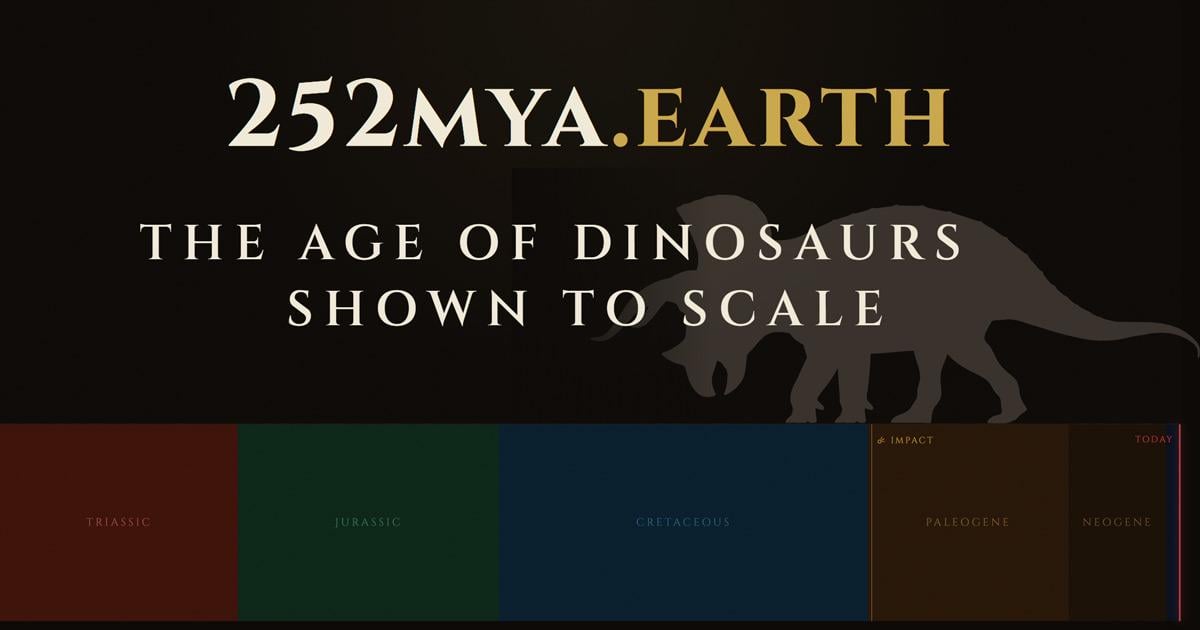
![A to-scale scrolling timeline of the last 252 million years. 1 pixel = 10,000 years [OC]](https://www.byteseu.com/wp-content/uploads/2026/03/SfnbfgwdB-PzDAHGPAe_IaFNEgwQhFu5XHY4X_goyuA-1024x538.jpeg "A to-scale scrolling timeline of the last 252 million years. 1 pixel = 10,000 years [OC]")
I’ve been watching the new Netflix dinosaur documentary and was like:
What is 50 million years anyways? In the documentary I did not get a sense of what this amount of time means.
So I built a to-scale scrolling timeline of the last 252 million years, from the Permian-Triassic boundary to today where 1 pixel is 10000 years:
To me it was funny to see that quite some of the famous dinosour would be more anachronistic next to let's say a Brachiosaurus vs. next to a Smartphone.
Posted by Joetunn
9 Comments
**[OC] Data sources and tools**
**Tools:** Plain HTML, CSS, and JavaScript. No libraries.
**Data sources:**
Geological time scale: International Commission on Stratigraphy.
Species dates and period boundaries: NHM London Dinosaur Directory, Paleobiology Database, and Wikipedia as an initial reference, cross-checked against primary literature.
Peer-reviewed literature consulted:
* Mass extinctions: Benton (2015); Erwin (1993)
* Early dinosaurs: Nesbitt (2011); Martínez et al. (2011)
* Angiosperm evolution: Friis et al. (2011)
* Bee evolution: Cardinal & Danforth (2013)
* Whale evolution: Gingerich et al.
* Human evolution: Hublin et al. (2017); Villmoare et al. (2015)
* Chicxulub impact: Alvarez et al. (1980); Schulte et al. (2010)
Some dates are rounded for presentation and the timeline is still being refined. If you spot an error I’d genuinely like to know.
Outstanding!! Loved it! Thanks for that. The wording was beautiful, all the dinosaurs that couldn’t fly were wiped out in a geographical instant. The mammals filling the gap. Fantastic mate
I like it! In the future, you might consider including a way to zoom out and see larger portions of the timeline in perspective.
Had a similar idea, but glad to see someone actually build it.
You should add geographical events, too
are you the same person who made the scroll across the radius of our solar system? the moon is one pixel
That timeline idea sounds cool! Visual aids are great for getting a sense of millions of years. You might want to check out books or resources on geologic timelines that show major events in Earth’s history. Seeing these events together can help you understand the scale better. Interactive websites or apps that let you zoom in on different periods can also give you more context. Keep exploring these resources. There’s a lot out there that can help you learn more about Earth’s history beyond what documentaries cover.
Neat – and the asteroid effect was really cool. Might be nice to include some wikipedia links for people to learn more. e.g. https://en.wikipedia.org/wiki/Cretaceous%E2%80%93Paleogene_extinction_event
Great work. Love the choice of colours and minimalist design (do you plan on adding more information, or adding filters to make it less/more informational?).
Some things I noticed (mostly linguistic) that you may or may not want to change (friendly, constructive editing comments):
– I would take out “the” when referring to generalities like dinosaurs, mammals, food chains & so on, because we’re talking about things that apply to all of the referred noun and you don’t need the definite article. Mammals are hit hard. Dinosaurs have been around for 147 million years – and so on.
– The wording surrounding Archaeopteryx is vague. If you’re saying evolution is taking its (evolution’s) first steps to flight, you might want to change it as Pterosaurs and insects have been flying for a very long time. If you mean evolution is pushing whatever becomes Archaeopteryx to take its first steps to flying, be more grammatically clear.
– T-rex appears. Dinosaurs are not an era, so I’m not sure if that sentence is appropriate. They weren’t confined to one geological era, for example.
-I did not expect that asteroid impact. Awesome. (the info box, though, overlaps with the background timeline – maybe move it higher?)
-The long silence. This is just a nitpick, but things are happening all the time, and I’m sure they were dramatic with respect to biomes (maybe somebody more knowledgeable on the early Cenozoic can chirp in.) Give us mammals more credit, even if we’re clearly inferior to our dinosaur kin.
At the very end, you get across how much will change in that final pixel. Maybe a fun future project might be coding that pixel to expand itself into a condensed roll call of human milestones, a sort of timeline giving way to another timeline. Just a thought.
Your concept of swiping right is not the same as mine.