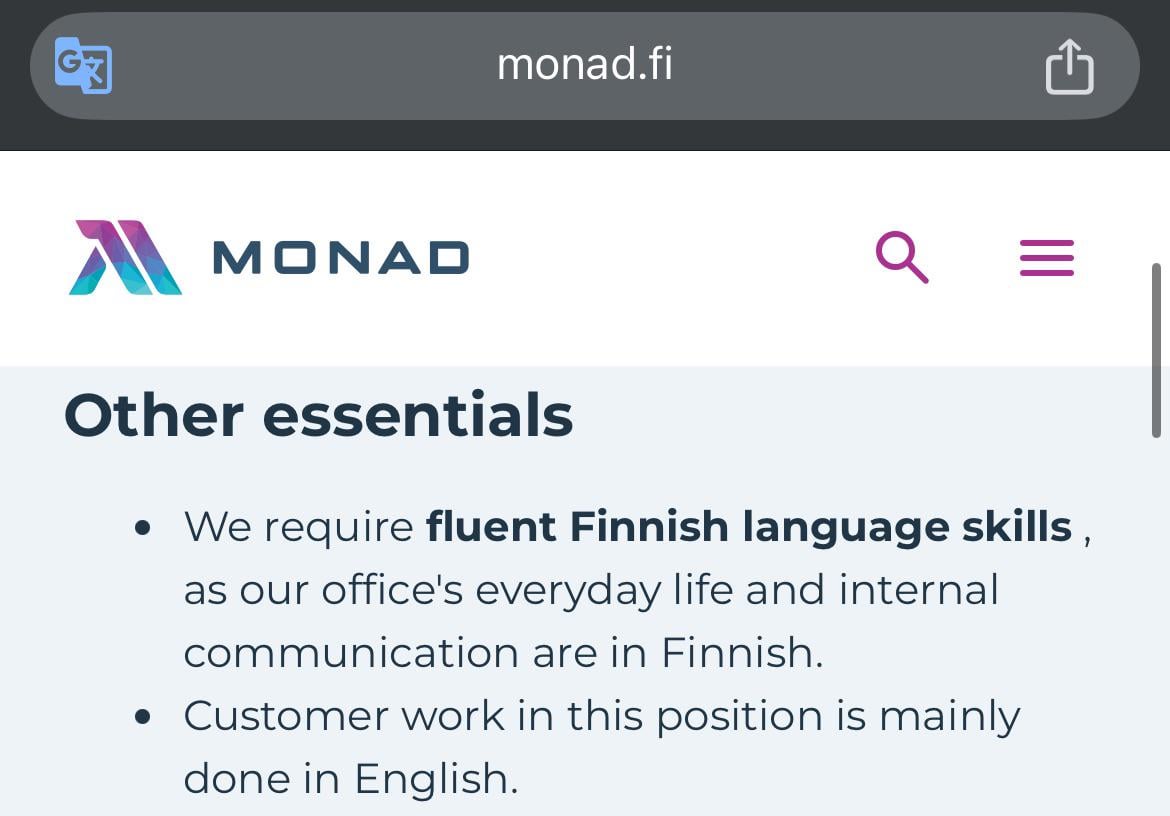
This is for a computer vision consulting job: https://monad.fi/rekry/machine-vision/
https://i.redd.it/hsg51bmpcdqg1.jpeg
Posted by Purple-Chicken3380

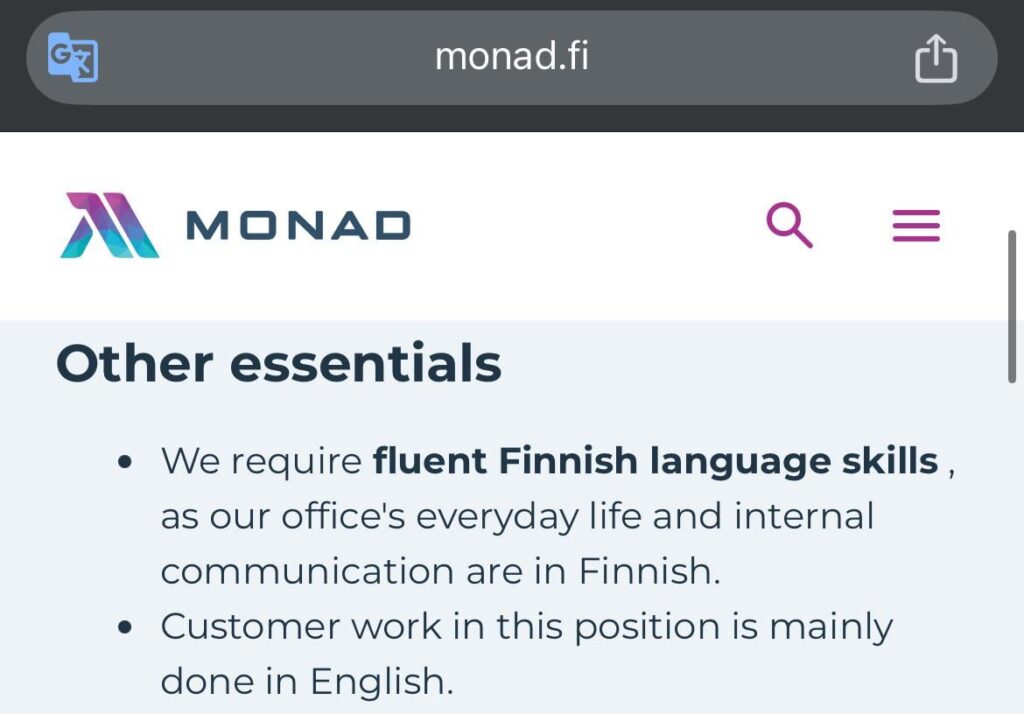
This is for a computer vision consulting job: https://monad.fi/rekry/machine-vision/
https://i.redd.it/hsg51bmpcdqg1.jpeg
Posted by Purple-Chicken3380
17 Comments
Why would there need to be any other reason? The working language there is Finnish and the customer work is English, those are enough for the requirement.
They said it right there in the posting: the office’s everyday life and internal communication are in finnish.
When your colleagues, your boss, and your subordinates speak Finnish, the candidate’s requirement for fluent Finnish is, of course, due to something else besides facilitating communication within the team. Sure.
It’s… Said right there.
Because they want to communicate Finnish with the fellow employees quite popular with Finnish companies.
“We don’t want to hire foreigners, but at the same time we and other companies say that we’re looking for foreign talent so that our public imaginary numbers go up in the stock market.”
I worked in engineering office and because there was single english speaking person, everyone was required to speak english even during breaks so the single foreign person would not feel like outsider.
This was Ok to most workers but I can imagine there are plenty of people and companies who would find this frustrating.
So thr language rule is simply for making life simpler for everyone. Even if everyone was fluent in english, its often easier to do things in your native language and single non Finnish speaker would force all content in english.
If you meet the other requirements of this job, learning a new language is piece of cake for you.
IMO it’s sufficiently and plainly explained there. They largely serve customers in English but operate internally in Finnish.
Looking at their customer base, they work a lot with public sector that often operates in Finnish. Language is often required in the contracts.
I think if anything the “mainly done in English” doesn’t mean it’s 100% English. The office banter reason is a bit sus, easy to navigate internal comms w today’s tools, and anyone can pick up enough Finnish to get by speaking at an office. Unless you’re presenting to a team or something.
Not this crap again, we live in Finland if you like it learn language if not move to Commonwealth countries
Apart of the reason mentioned, translating all documents that are ever used within the company, is not only REALLY expensive, but also quite a headache. Remember, that many of those have severe legal consequences. I honestly wonder what insurance would do in the worst case if a translation in say safety instructions was off.
Maybe the fact it’s located in Finland, where the two spoken languages are Finnish and Swedish? Could it be so simple?
Very simply put: They can find candidates that speak fluent Finnish. If for some reason Finnish speaking candidate pool is not enough (such as my company), then even if the whole company is speaking Finnish, you might hire non-Finnish speakers for the value they bring is higher than burden they cause.
This company believes it doesn’t justify the burden. In business everything is considered as what is the cost and what is the return.
Super unpopular opinion here, so start your downvotes:
This might seem like a simple “well, we are in Finland, we should speak Finnish” or “it might keep the office atmosphere familiar to the locals”, but it is also an excellent way to shoot yourself in the foot. Because it ‘restricts’ you to only serve to domestic or maybe Nordic customers. A quick glance at their success stories confirms this.
I have seen more than enough Finnish-only companies struggle to get traction outside Finland, let alone the Nordics. Just a good product isn’t enough, especially not if it is a software/ service product. (Yes, there are exceptions) If you require Finnish proficiency, you basically ensure that even the non-Fins you hire are already soo deep into the Finnish way of thinking, they stop being ‘ambassadors’.
If, as a company, you want to gain traction outside of the Nordics, you need to have ‘fresh’ foreign input. And that also requires non-Finnish engineers. Think of it like this: if a customer ask you to ‘paint a nature landscape’ you will probably end up with a forest and a lake. While a customer in Italy might expect a painting of the Mediterranean. It might sound like a silly example, but cultural differences in expectations and interpretation are a massive problem in all industries. And you don’t solve that by just having some local sales people.
It’s a Finnish company based in Finland that wants to keep talking their native tongue. Not super complicated. That job posting is even in Finnish. I wouldn’t go to Poland expecting to be able to speak Finnish in a company there.