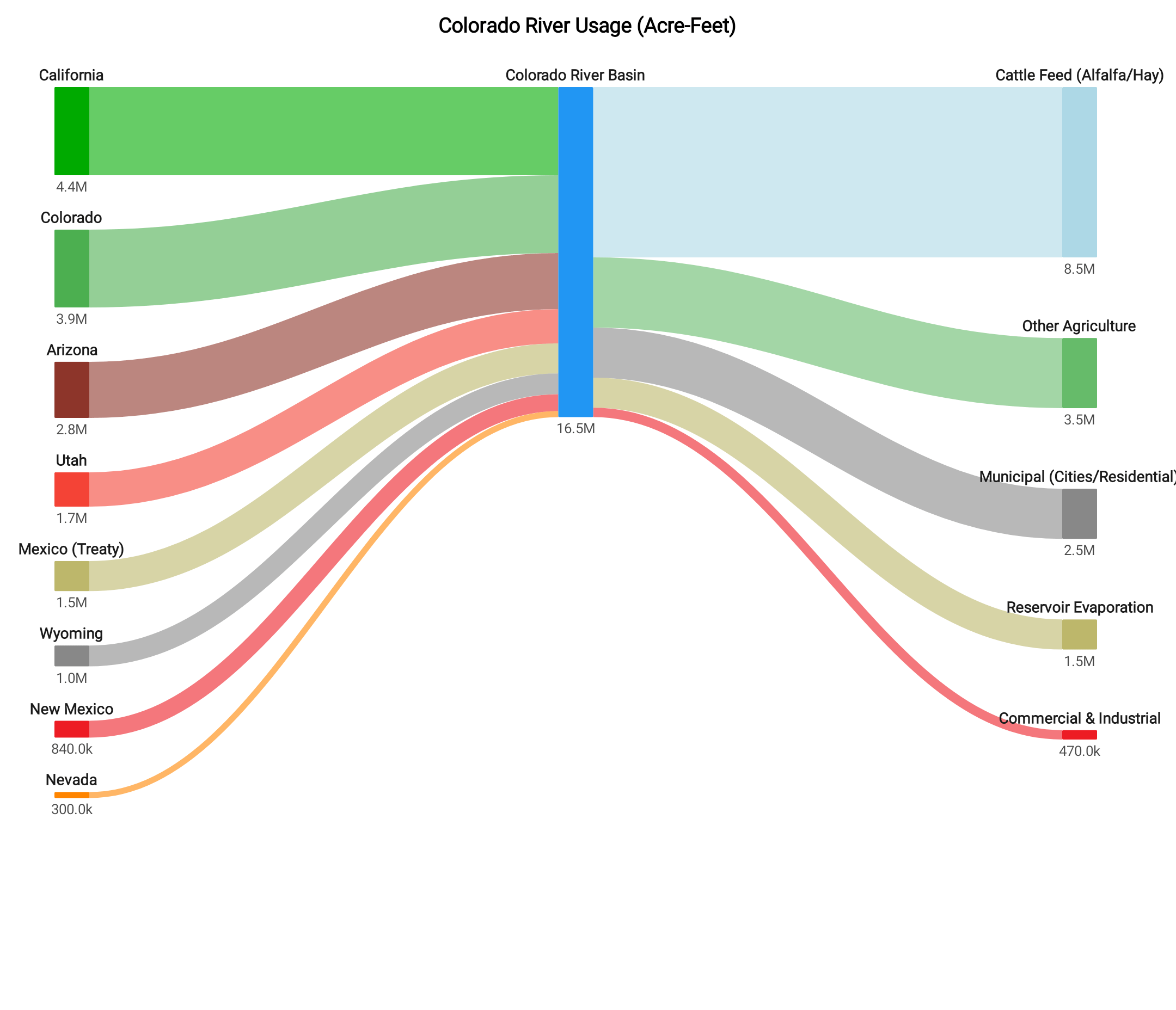
[OC] Where the Colorado River actually goes: Cities use a fraction of what is used to grow cattle feed in the desert.
Posted by drunkaccountname

![[OC] Where the Colorado River actually goes: Cities use a fraction of what is used to grow cattle feed in the desert.](https://www.byteseu.com/wp-content/uploads/2026/03/61i8t7578nqg1-1536x1320.png "[OC] Where the Colorado River actually goes: Cities use a fraction of what is used to grow cattle feed in the desert.")
[OC] Where the Colorado River actually goes: Cities use a fraction of what is used to grow cattle feed in the desert.
Posted by drunkaccountname
16 Comments
Source: Synthesized from US Bureau of Reclamation allocations and recent comprehensive basin studies published in Nature Water. Numbers represent approximate average annual flow in Acre-Feet.
Tool: [Sankey Monkey app for Android ](https://play.google.com/store/apps/details?id=com.dips.sankeymonkey)
Well if we don’t use every drop, Mexico might get some.
we export like ~30% of that feed. for shame
I would love to know how much of that is currently going to cool data centers. I’m having a hard time figuring out exactly how bad it is, with all the shouting from both sides.
Also, I didn’t know we have a treaty obligation to leave a certain amount of water for Mexico. That’s interesting.
I know Sankey diagrams don’t really work for two-way contingency tables, but I’d certainly be interested in that breakdown.
This is the wrong chart for this data
Why is our atmosphere hogging so much evaporated water?!?!
The Mexican allotment should be broken out separately for the uses side of the graph.
We can fix about 1/3 of that reservoir evaporation, hayduke lives
People love to demonize almonds, saying it takes a gallon of water to grow a single almond.
Really though almonds aren’t actually that bad when it comes to calories per gallon, fiber per gallon, and healthy fat per gallon. Almonds are small, but very densely packed with energy and nutrition. California grows most of the world’s almonds (about 95%), and uses about 1 million acre-feet of water per year.
Alfalfa, in California, takes 4.4 million acre-feet per year.
I’d love to see “waste” pulled out too. A huge amount of that forage and agriculture category just evaporates or runs off after it’s been pulled from reservoirs or irrigation ditches and that doesn’t seem to be accounted for.
Look at all that water the sky keeps stealing.
This implies 100% of the river is used up. I’d be curious to know what the percentages are if it were to show what flows into the ocean (or wherever it ends)
I’m not sure there’s a single thing you can do that’s better for the environment than not eat beef. Water usage, deforestation, methane output. And that’s not even getting into the health benefits of cutting out red meat.
Ah yes, what a great use of our water: feeding cows.
It boggles my mind honestly. I grew up in East Texas on a cattle ranch. We grew hay for the cows and in good years we’d sell and and on bad years we’d buy it locally. Like why not just get land east of the rockies to grow the grasses for cow feed?