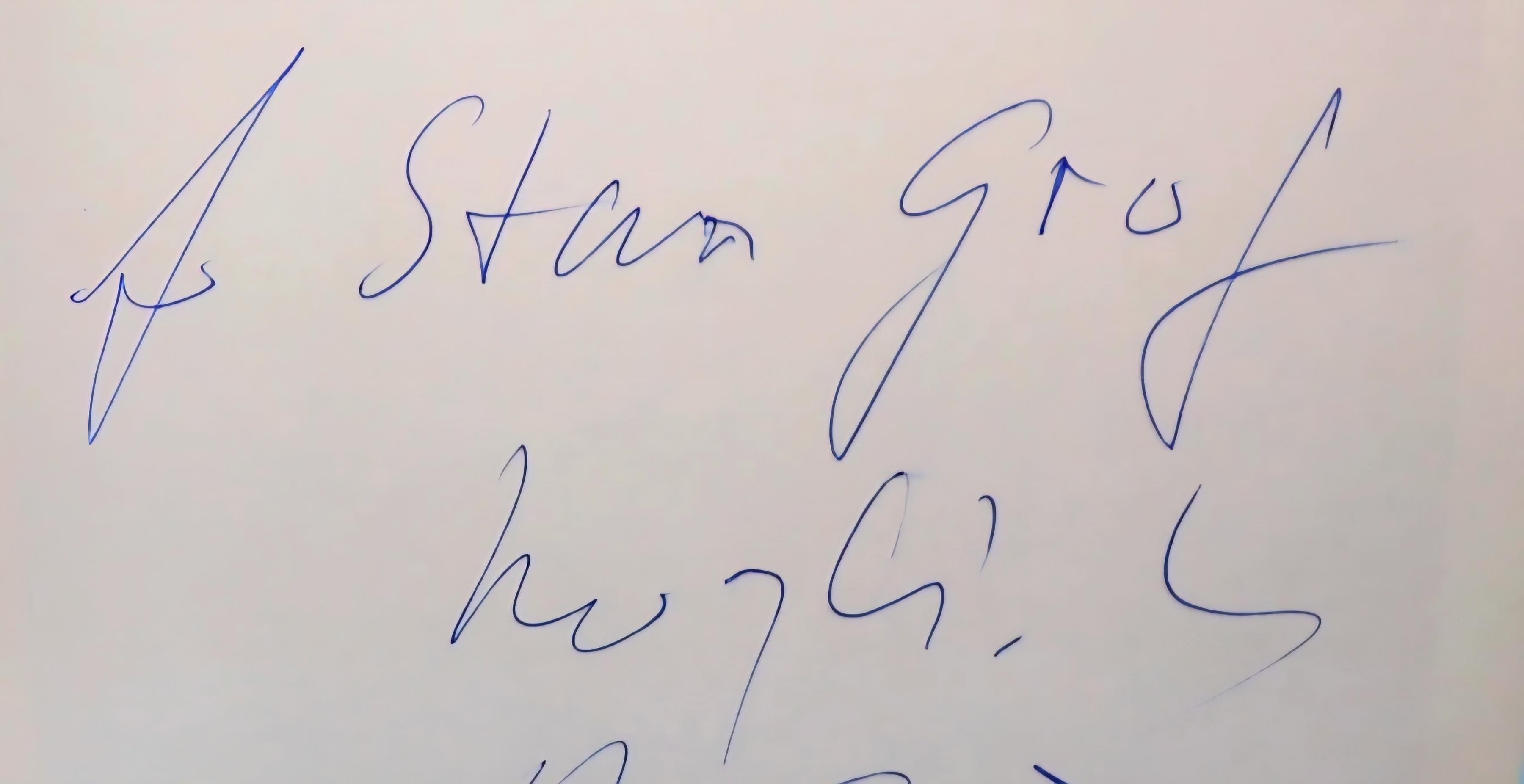
Hello, can anyone kindly translate this to english? I apologize if this is the wrong sub. It is an inscription in a HR Giger book.
https://i.redd.it/8yl56c8y0nrg1.jpeg
Posted by spiritusFortuna

Hello, can anyone kindly translate this to english? I apologize if this is the wrong sub. It is an inscription in a HR Giger book.
https://i.redd.it/8yl56c8y0nrg1.jpeg
Posted by spiritusFortuna
3 Comments
Turns out Giger’s writing was just as thick as his Swiss dialect.
Listening to Giger on tape leading through his museum was a bliss to listen to.
I am sure the third word is something like “Graf”, the first letters of the second words are “Sta” or “Stu”. the rest is not decipherable to me.
Last word could be “herzlich” (warmly/heartfelt), quite common in a greeting phrase
The last word in the first line looks like “Graf”, which is a common German surname. The word before it the would be a first name. It looks like “Stan”, which is however *not* a common German first name.
Nonetheless, I googled “Stan Graf” and found, that there actually exists a semi-famous “Stan Grof” (note the “o” instead of the “a” in the last name) who is a contemporary of Giger:
https://www.stangrof.com/
The first word (which looks like a single letter) is probably “für”, meaning “for”.
So, we have (presumably):
>für Stan Grof, herzlichst
meaning
>for Stan Grof, warmly/cordially
most likely followed by an autograph (by Giger?) that is not in the picture.