
![[OC] Global Family Size Is Converging on the Replacement Rate](https://www.byteseu.com/wp-content/uploads/2026/04/5eb2uve8m5tg1-1536x835.png "[OC] Global Family Size Is Converging on the Replacement Rate")
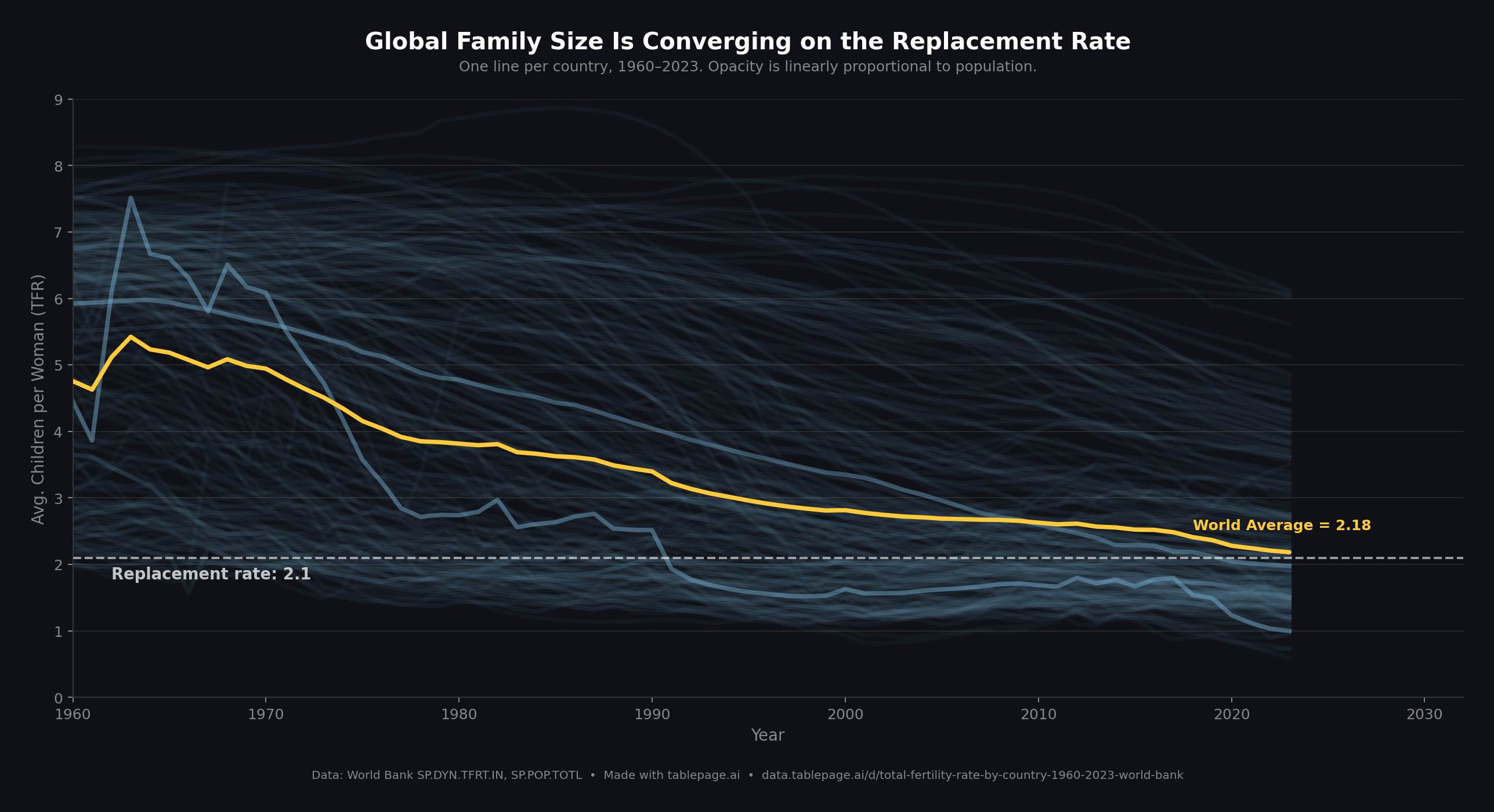
Edit: It’s fertility rate not family size, and also it’s heading towards, not necessary converging.
Thanks for pointing it out!
Interactive Dataset: https://data.tablepage.ai/d/total-fertility-rate-by-country-1960-2023-world-bank
Posted by aspiringtroublemaker
18 Comments
Is it really converging on the replacement rate? It seems to be heading monotonically downward, beyond replacement rate to below 1.5
I don’t think you know what converging means. It’s on a downwards trend and just happens to be at replacement right now.
What’s the billionaires plan here? Living is becoming to expensive to make a kids. Without kids there are no new customers to buy their stuf
Make the Charts input data use the table filters so we can see the charts for our countries. Then add Immigration and emigration data. I bet you we will see the difference match more or less the replacement decline in several European countries.
Edit: ah you probably need to calculate country specific repacements based off of death rates.
I’m guessing replacement rate changes too.
When infant mortality was high, you may have required 5 children to guarantee 2 children get to adults and reproduce to make four grandchildren
As infant mortality decreased, and mortality of any kind before reproduction age, goes down, I imagine 2.1 trends to 2.
At the same time, fertility health, having children later, and different choices would increase this number from 2 upwards
Title is inaccurate – what’s being graphed is fertility rate which can be distinctly different from family size.
Why do I still keep seeing stats about global population set to hit 10B if we’re already at replacement rate and still decreasing?
I think ‘converging’ probably not the right word to use in this context. It is heading towards replacement rate. But there is no reason to suggest it will converge. It seems likely it will keep heading down
Converging or just decreasing? I see no indication of a log shape
Wouldn’t it actually be good in order to bring down the world population to a more sustainable level?
This hides very important nuance. Black and Muslim birthrate is above the line nearly 3 or above.
European and Asian birth rate is near 1.
In which countries were women having an average of 6 to 7+ children in the 60s?
I’m guessing these are probably poorer countries with higher infant mortality, which is why they were having more children…
I’m serious when i say this: GOOD.
this graph does not show convergence
This is wonderful news for global sustainability. Growth champions are horribly misguided.
Glad to see, hopefully It keeps dropping!
Population continues to grow after fertility approaches replacement because of demographic momentum – there are still large cohorts of people in their reproductive years born during the high-fertility era, so even near-replacement fertility produces a large absolute number of births. It’s like a loaded freight train hitting the brakes: the deceleration is real but the train keeps moving. Most UN projections show continued global population growth through roughly 2080-2100 even in the medium-fertility scenario, because the current young adult bulge in high-fertility regions hasn’t finished working through the system.
Kinda neat how many places are overpopulated and nature is doing it’s job adjusting.