**Data source:** OpenStreetMap (amenity=toilets nodes), queried April 2026. Licensed under ODbL.
**Tools:** PostGIS for spatial queries within municipal boundaries, HTML/CSS for visualization.
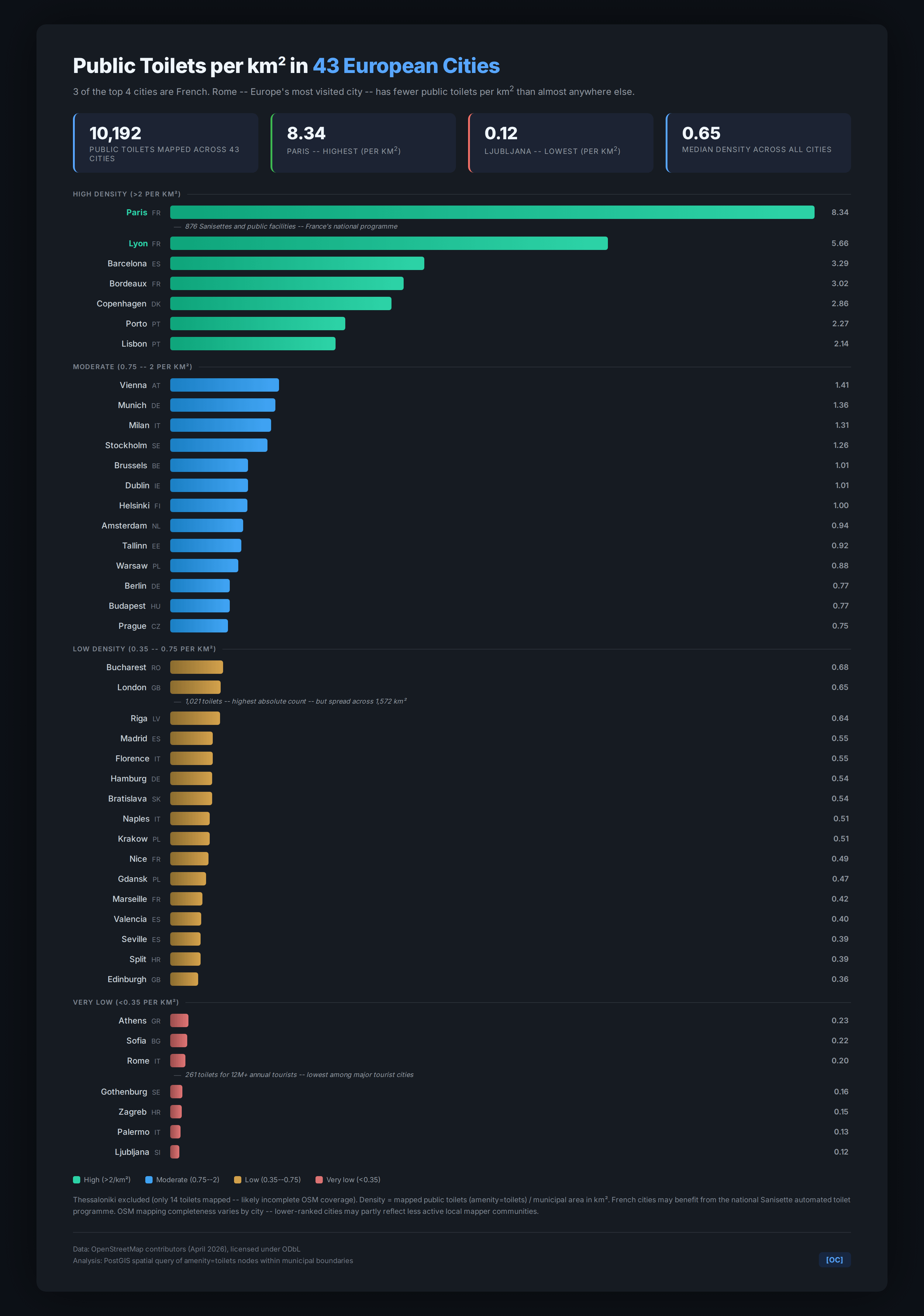
**Methodology:** Counted all mapped public toilet nodes (amenity=toilets) within the administrative boundary of each city. Density = toilet count / municipal area in km². Thessaloniki excluded due to very low mapping coverage (14 toilets).
**Notes:** OSM mapping completeness varies by city — lower-ranked cities may partly reflect less active mapper communities rather than fewer actual toilets. French cities benefit from the national Sanisette automated toilet programme (Paris alone has 750+ units).
holytriplem on
Those Paris public toilets are some of the grossest in the developed world though.
I’m looking at you in particular, *Bercy Bus Station*
swingyafatbastard on
I’m assuming you’re counting the Seine for Paris?
anortef on
What counts as public toilet? because I have lived my whole life in Barcelona and never seen one.
captainhalfwheeler on
Paris toilets are completely unusable.
loggywd on
When you say public toilet, do you mean dedicated toilets owned and run by the government or do they include business toilet publicly accessible too. Because many cities have bylaws to make businesses open their toilets to the public.
hughperman on
As far as I can see from https://mapscaping.com/public-toilet-finder/ , the Dublin layer isn’t really “public toilets” in the sense of “official toilets”. More like “toilets you can get to without paying in a library, museum, university, train station, food court, large shop, etc”. Which is useful, but the number here gives a false sense of official public amenities, which is more like 1 or 2 in the entire city.
gr7calc on
Plotting against population density, rather than area, would be better.
vilkazz on
Why is Lithuania never considered to be part of Europe?
bhalazs on
Lyon is great, they have those self-cleaning toilets that get fully rinsed (not just the toilet seat but the walls, sink, everything) after each use
Armydoc18D on
“Well good luck finding a toilet in Ljubljana”’, I always say.
StaedtlerRasoplast on
Amsterdam is heavily skewed to public urinals. As a woman visiting last year I was surprised by how sparse the public bathrooms were and where they existed they were quite expensive
Apple_Turnover93 on
Isn’t using the administrative boundary a bit misleading given the varying criteria of how each country defines what a city is?
I forget the exact term but isn’t there something like ‘urban/metropolitan area’ which better reflects the actual city?
vacri on
London has loads of public toilets, they’re just not called “public toilets”. Go to a pub, and you’ll be able to utilise the facilities
Wasbeerboii on
If you could filter on free/paid. The Netherlands would be in the bottom 3 of free toilets.
ale_93113 on
Lyon is so good that it raises the standard for everyone
On any given bridge on the city, and there are lots of bridges on the two rivers, there is almost always a toilet on one of the ends, it makes finding them super easy and convenient!
I think that they should be, in all cities, at the very least on the street next to every metro station, that way they are plentiful and can easily be located
voxelghost on
At least on phones, it’s really difficult to follow a city entry out to see the number in the right margin. Why no x axis
Ftroiska on
Either you have public toilet or you have trees to go behind…
BLFR69 on
Public toilet in paris ? LOOL
Cronogato on
In Spain, we have a non written agreement that the toilets in pubs and cafés are for public use, no questions asked even if you are not buying anything. And we have plenty of these in every neighborhood.
Eelpieland on
Well that explains the smell in Paris
Dardanelles17 on
Ljubljana has the best public toilets i have ever seen. They clean them like every hour.
booyaa1999 on
How did you choose which cities to add into the data?
Vectoor on
I wonder if this is mostly a population density in the city limits graph.
Grobo_ on
Public toilets are non existent in Barcelona, feels like 80% are beachside and run by the Bars that open during season.
ShelfordPrefect on
I wonder which if the 19 different definitions of “London” they used… there probably aren’t many public toilets per square km in Radlett or Wimbledon
kevpatts on
Dublin: zero public toilets.
BlackFoxTom on
It would be nice to add Tokyo as a benchmark
Given they have arguably the most famous public toilets program
Also Singapore, Kyoto, Taiwan, HK
Outrageous-Cod4534 on
interesting ! this just proves the point public toilet density ≠ cleaner streets.
Will be nicer if population density can be taken into account. London is a good case, the city technically is enormous, but most population concentrates in zone 1.
Noobxs on
This is particularly cruel for rome since there is public drinking fountains to fill up your water everywhere

![[OC] Public toilets per km² across 43 European cities](https://www.byteseu.com/wp-content/uploads/2026/04/73asnebyi3ug1-1079x1536.png "[OC] Public toilets per km² across 43 European cities")
30 Comments
**Data source:** OpenStreetMap (amenity=toilets nodes), queried April 2026. Licensed under ODbL.
**Tools:** PostGIS for spatial queries within municipal boundaries, HTML/CSS for visualization.
**Methodology:** Counted all mapped public toilet nodes (amenity=toilets) within the administrative boundary of each city. Density = toilet count / municipal area in km². Thessaloniki excluded due to very low mapping coverage (14 toilets).
**Notes:** OSM mapping completeness varies by city — lower-ranked cities may partly reflect less active mapper communities rather than fewer actual toilets. French cities benefit from the national Sanisette automated toilet programme (Paris alone has 750+ units).
Those Paris public toilets are some of the grossest in the developed world though.
I’m looking at you in particular, *Bercy Bus Station*
I’m assuming you’re counting the Seine for Paris?
What counts as public toilet? because I have lived my whole life in Barcelona and never seen one.
Paris toilets are completely unusable.
When you say public toilet, do you mean dedicated toilets owned and run by the government or do they include business toilet publicly accessible too. Because many cities have bylaws to make businesses open their toilets to the public.
As far as I can see from https://mapscaping.com/public-toilet-finder/ , the Dublin layer isn’t really “public toilets” in the sense of “official toilets”. More like “toilets you can get to without paying in a library, museum, university, train station, food court, large shop, etc”. Which is useful, but the number here gives a false sense of official public amenities, which is more like 1 or 2 in the entire city.
Plotting against population density, rather than area, would be better.
Why is Lithuania never considered to be part of Europe?
Lyon is great, they have those self-cleaning toilets that get fully rinsed (not just the toilet seat but the walls, sink, everything) after each use
“Well good luck finding a toilet in Ljubljana”’, I always say.
Amsterdam is heavily skewed to public urinals. As a woman visiting last year I was surprised by how sparse the public bathrooms were and where they existed they were quite expensive
Isn’t using the administrative boundary a bit misleading given the varying criteria of how each country defines what a city is?
I forget the exact term but isn’t there something like ‘urban/metropolitan area’ which better reflects the actual city?
London has loads of public toilets, they’re just not called “public toilets”. Go to a pub, and you’ll be able to utilise the facilities
If you could filter on free/paid. The Netherlands would be in the bottom 3 of free toilets.
Lyon is so good that it raises the standard for everyone
On any given bridge on the city, and there are lots of bridges on the two rivers, there is almost always a toilet on one of the ends, it makes finding them super easy and convenient!
I think that they should be, in all cities, at the very least on the street next to every metro station, that way they are plentiful and can easily be located
At least on phones, it’s really difficult to follow a city entry out to see the number in the right margin. Why no x axis
Either you have public toilet or you have trees to go behind…
Public toilet in paris ? LOOL
In Spain, we have a non written agreement that the toilets in pubs and cafés are for public use, no questions asked even if you are not buying anything. And we have plenty of these in every neighborhood.
Well that explains the smell in Paris
Ljubljana has the best public toilets i have ever seen. They clean them like every hour.
How did you choose which cities to add into the data?
I wonder if this is mostly a population density in the city limits graph.
Public toilets are non existent in Barcelona, feels like 80% are beachside and run by the Bars that open during season.
I wonder which if the 19 different definitions of “London” they used… there probably aren’t many public toilets per square km in Radlett or Wimbledon
Dublin: zero public toilets.
It would be nice to add Tokyo as a benchmark
Given they have arguably the most famous public toilets program
Also Singapore, Kyoto, Taiwan, HK
interesting ! this just proves the point public toilet density ≠ cleaner streets.
Will be nicer if population density can be taken into account. London is a good case, the city technically is enormous, but most population concentrates in zone 1.
This is particularly cruel for rome since there is public drinking fountains to fill up your water everywhere