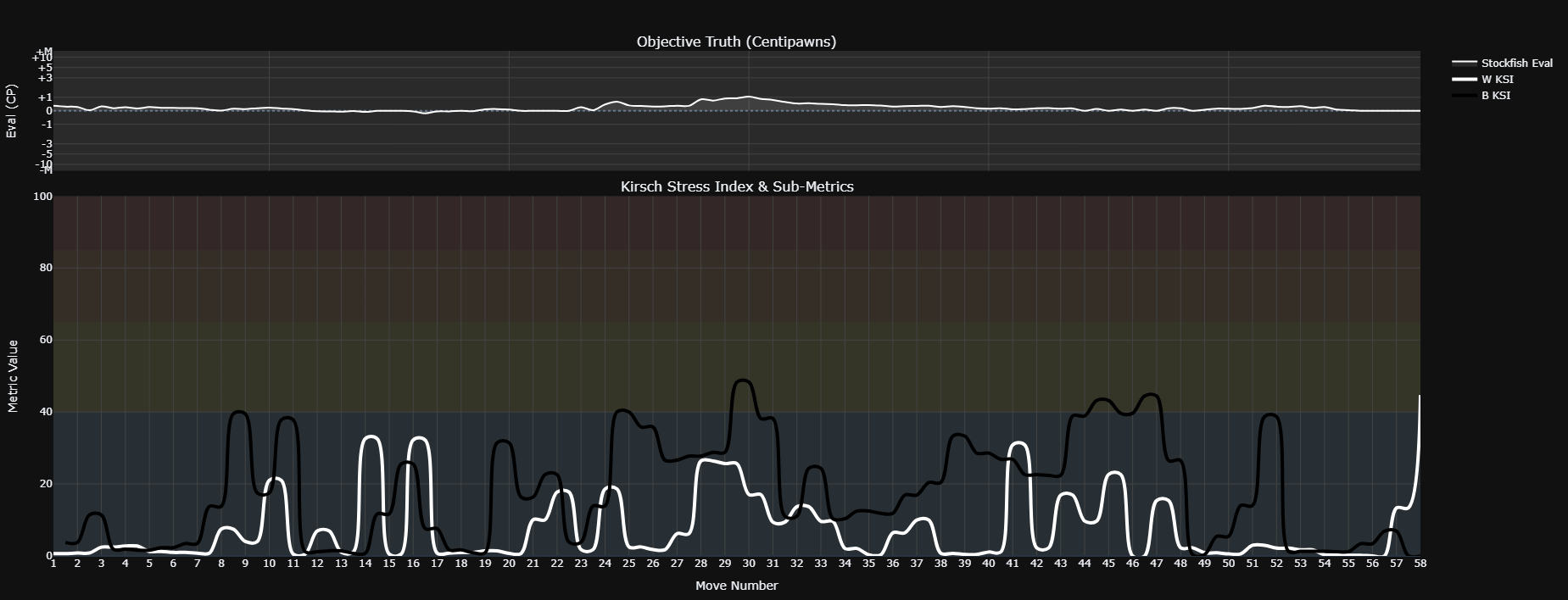
[OC] I plotted the “Psychological Stress” of a chess player by comparing a Neural Network’s human predictions against a Supercomputer’s absolute truth.
[OC] I plotted the “Psychological Stress” of a chess player by comparing a Neural Network’s human predictions against a Supercomputer’s absolute truth.
Source: I designed the metrics and built this custom pipeline using Python (with AI assistance for the syntax and deep math), Pandas, and Plotly/Dash. It compares the Stockfish 16.1 engine against the Maia Neural Network to measure human error and stress.
If anyone wants to see the code, I put the GitHub link in my Reddit profile bio!
qchisq on
I don’t know enough about chess to know if the data is correct, but why is black under so much more pressure in the entire game? Like, sure, at the start of the game, you are a move behind. That makes sense. But after 10 or 20 rounds, that 1 move should mean less, but it doesn’t
_SilentHunter on
I don’t understand what the title is saying. Are you plotting a neural network’s *prediction* of how stressed a player would be based on the game state? Or is this actual data using biological measurements?

![[OC] I plotted the "Psychological Stress" of a chess player by comparing a Neural Network's human predictions against a Supercomputer's absolute truth.](https://www.byteseu.com/wp-content/uploads/2026/04/odojoktiiyug1-1536x588.png "[OC] I plotted the “Psychological Stress” of a chess player by comparing a Neural Network’s human predictions against a Supercomputer’s absolute truth.")
3 Comments
Source: I designed the metrics and built this custom pipeline using Python (with AI assistance for the syntax and deep math), Pandas, and Plotly/Dash. It compares the Stockfish 16.1 engine against the Maia Neural Network to measure human error and stress.
If anyone wants to see the code, I put the GitHub link in my Reddit profile bio!
I don’t know enough about chess to know if the data is correct, but why is black under so much more pressure in the entire game? Like, sure, at the start of the game, you are a move behind. That makes sense. But after 10 or 20 rounds, that 1 move should mean less, but it doesn’t
I don’t understand what the title is saying. Are you plotting a neural network’s *prediction* of how stressed a player would be based on the game state? Or is this actual data using biological measurements?