
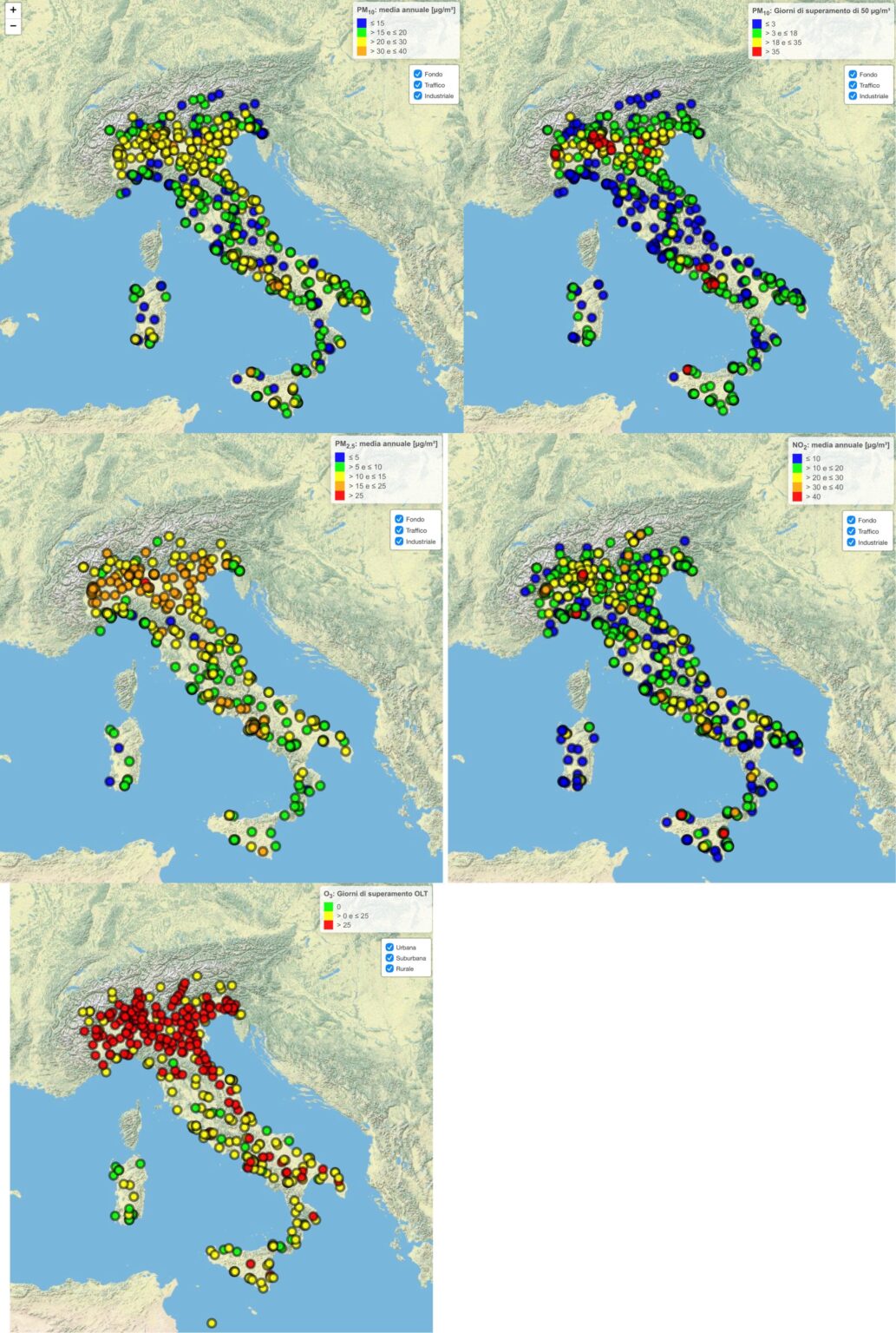
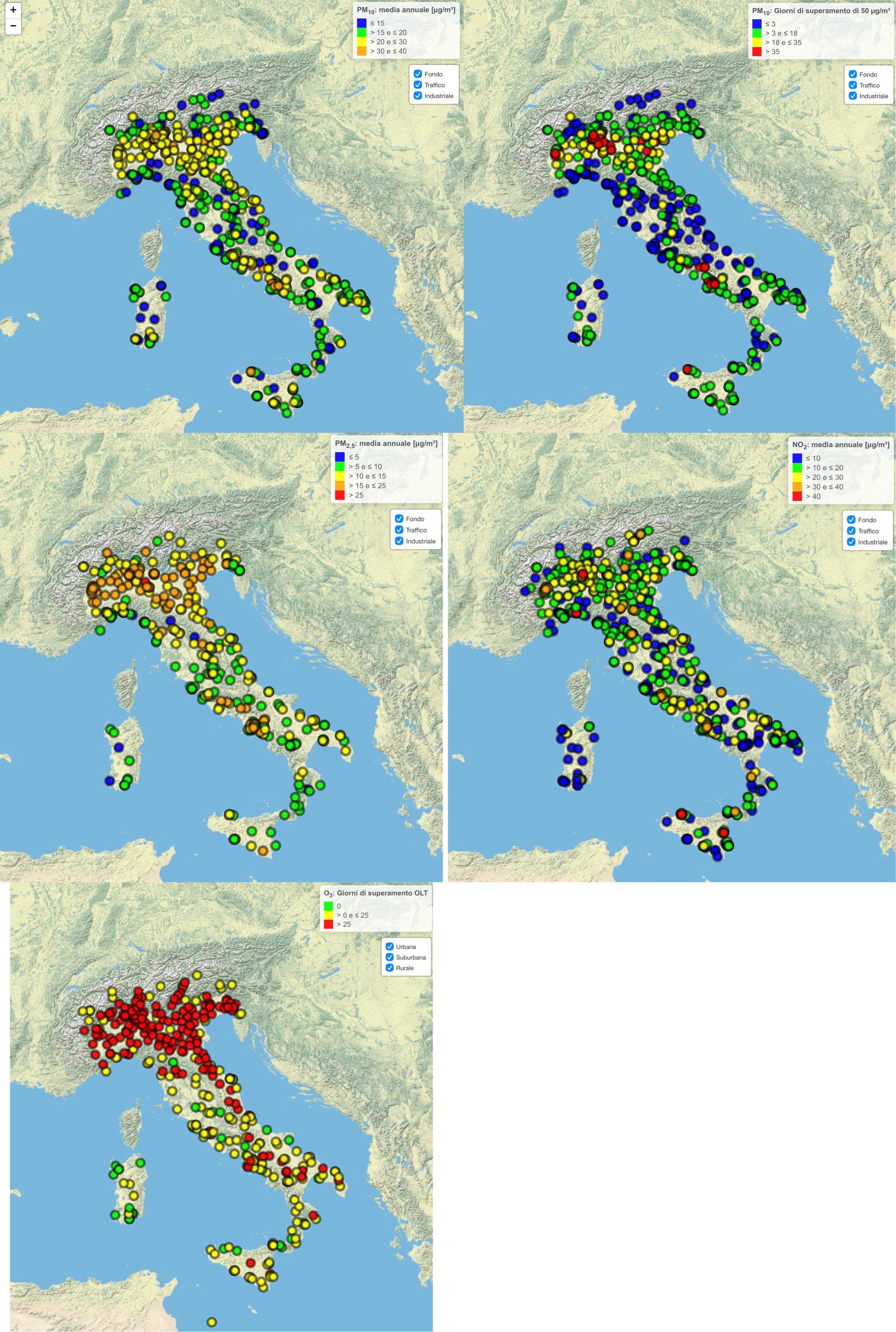
Here are the navigable maps and all the data, I put together 5 screenshots quickly so as to avoid having to navigate through each entry: Air quality in Italy: stable values in 2025 – SNPA – National environmental protection system
Extract:
The limit values for PM10 and PM2.5 are respected across almost the entire territory, but situations where they are exceeded remain in several areas. Nitrogen dioxide is reduced. Extreme heat and lack of precipitation do not improve the ozone situation in summer. The new European Directive imposes more stringent limits to be reached by 1 January 2030, for which additional strategies are necessary
Compliance with the annual limit value (40 μg/m³ – micrograms per cubic meter) of PM10 is recorded in all regions; in 92% of the stations the daily limit value is also respected (50 μg/m³ for the daily average, not to be exceeded for more than 35 days in a year). Critical issues in various areas of the country: in the Po basin, in the Naples-Caserta agglomeration, in the Valle del Sacco area (in the province of Frosinone). Isolated cases of violations were also recorded in the Venafran plain (in the province of Isernia) and in Palermo. In general, the statistical analysis of the decade 2015-2024 shows a significant decrease in the first five years and then a situation of stability.
The annual limit value for PM2.5 (25 μg/m³) is respected throughout almost the entire national territory. For this pollutant, an average reduction of approximately 14% is observed in the annual levels recorded in 2025 compared to the average for the decade 2015-2024.
The annual limit value for nitrogen dioxide is also respected in the large majority of monitoring stations (99%), although it has been exceeded in a limited number of stations, located in large urban areas near important road arteries, in the Milan agglomeration, in Genoa, Naples, Catania and Palermo. However, the hourly limit value is respected everywhere.
The first data seem to confirm the trend observed in the period 2015-2024, with a marked and progressive reduction for nitrogen dioxide, extending to most stations.
In summary, it can be said that 2025 confirmed the trend of improvement in air quality at a national level.
https://i.redd.it/vfpk8bgsehvg1.jpeg
Posted by sr_local
11 Comments
Wild how Italy’s air is cleaning up while my city still smells like a mix of espresso and car exhaust every morning.
Facessero i controlli sui Diesel che rimuovono il filtro e la situazione migliorerebbe drasticamente in molto meno tempo. 1000 regole e poi come sempre 4 idioti rovinano l’aria come 4000 persone per bene.
Bhe buono
Considerando le varie norme sulle ZZTL e l’obbligo di vendita di auto euro 6, mi sorprenderei del contrario.
Anche la progressiva elettrificazione dei riscaldamenti probabilmente sta dando una mano (e credo sia il punto su cui il governo dovrebbe battere di più)
Siam messi molto male sul piano delle polveri sottili…
Il sesto riquadro in basso a destra,é dopo l’esplosione nucleare del mese prossimo?
Certo che pure in pianura in inverno c’è gente che accende camini e brucia legna di brutto, quando cazzo metteranno fuorilegge i camini stappo quello buono
Mi salvo il post per quando devo rispondere agli allarmisti che dicono che respirare è la prima causa di morte nel nord Italia.
cosa c’è nella *zona della Valle del Sacco* che causa rilevamenti sopra la media?
Napoli-Caserta e bacino padano sono abbastanza spiegabili ma di questo non so niente.
Le due strategie veramente valide sarebbero spostare i riscaldamenti da combustione a elettrico e ove possibile, farlo con l’industria. L’elettricità costa un botto e quindi non si puo fare.
Se ci fossero degli impianti energetici, con energia pulita h24, che danno stabilita a rete e prezzi … . In realtà ci sono nel mix, solo che sono pochi (15%) e arrivano dall’estero.
La verità è che fino a che non avremo anche il nucleare, la transizione non sarà sostenibile economicamente e si reggerà solo sulla pioggia di incentivi (come con le rinnovabili). Lo stato dovrebbe dare l’indirizzo e favorire la transizione, non regalare soldi
Ed ecco perché in Pianura Padana gli incentivi dovrebbero essere doppi, tripli, rispetto al resto d’Italia.
E invece alzano solo le tasse e rendono più stretto il cappio.