
![[OC] Relative Risk Ratios In War](https://www.byteseu.com/wp-content/uploads/2026/04/ga0dw16ecsvg1-622x1536.png "[OC] Relative Risk Ratios In War")
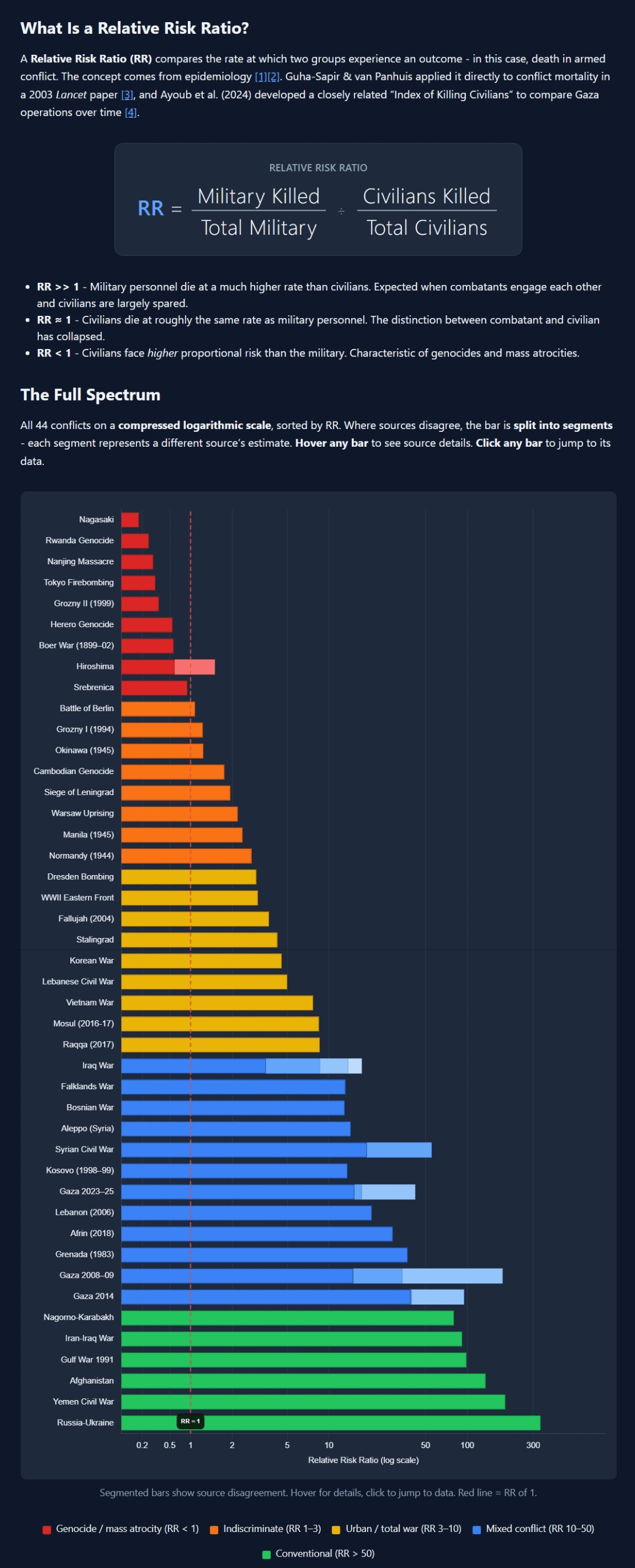
Every legally recognized genocide – Rwanda, Srebrenica, Cambodia – clusters at or below RR = 1. The atomic bombings and Nanjing sit in the same zone.
- Nagasaki (0.18) has the lowest RR on the chart. Unlike Hiroshima – which housed the Second General Army headquarters – Nagasaki’s bomb detonated over the Urakami Valley, an industrial district and its residential population. The military garrison of ~9,000 was largely outside the blast zone; of ~74,000 dead, only ~150 were soldiers killed at ground zero.
- Hiroshima’s RR is itself disputed (0.59–1.5) depending on which garrison estimate you use. With ~14,000 military personnel in the blast zone, RR ≈ 0.59. But if the full Second Army garrison of ~43,000 is included, more military deaths push the RR up to ~1.5 – crossing the threshold from “mass atrocity” into “indiscriminate.”
Military vs civilian death rates in urban battles
- Grozny II is the standout – the only urban battle where the civilian death rate (14.4%) exceeds the military rate (5.0%). Russia flattened the city while a mostly elderly civilian population remained trapped in a warzone. The RR of 0.35 puts it in the same category as other recognized genocides.
- Manila (1945) shows what happens when a garrison fights to the last man in a dense city: the Japanese garrison was nearly annihilated (31.7%), but ~100,000 civilians died. Mosul and Raqqa (~8.5) show higher RRs – the attacking coalitions used more targeted strikes while ISIS defenders took catastrophic losses.
- Gaza shows the widest gap between military and civilian death rates on the chart – 20.5% vs 1.28%. The civilian rate is low because the denominator is so large (2.2MM), while the military rate is high because militant forces are small(30-50K), skewing the RR lower.
Posted by JoshuaJosephson
11 Comments
Do you have a link to the original? It says “hover over …” implying there is an interactive version out there?
Sources –
[Principles of Epidemiology | Lesson 3 – Section 5](https://archive.cdc.gov/www_cdc_gov/csels/dsepd/ss1978/lesson3/section5.html)
[The importance of conflict-related mortality in civilian populations – PubMed](https://pubmed.ncbi.nlm.nih.gov/12826439/)
[Frontiers | Comparative analysis and evolution of civilian versus combatant mortality ratios in Israel-Gaza conflicts, 2008–2023](https://www.frontiersin.org/journals/public-health/articles/10.3389/fpubh.2024.1359189/full)
[Fifty years of violent war deaths from Vietnam to Bosnia: analysis of data from the world health survey programme – PMC](https://pmc.ncbi.nlm.nih.gov/articles/PMC2440905/)
[Violence-Related Mortality in Iraq from 2002 to 2006 | New England Journal of Medicine](https://www.nejm.org/doi/full/10.1056/NEJMsa0707782)
[Iraq Body Count](https://www.iraqbodycount.org/)[Appendix – Iraqi Death Toll | The Gulf War | FRONTLINE | PBS](https://www.pbs.org/wgbh/pages/frontline/gulf/appendix/death.html)
[Korean War | Dates, Countries, Summary, Map, Casualties, & Facts | Britannica](https://www.britannica.com/event/Korean-War)
[Turkey’s PKK Conflict: The Death Toll | International Crisis Group](https://www.crisisgroup.org/cmt/europe-central-asia/turkiye/turkeys-pkk-conflict-death-toll)
[Assessing the Impact of War in Yemen: Pathways for Recovery | United Nations Development Programme](https://www.undp.org/publications/assessing-impact-war-yemen-pathways-recovery)
[GENOCIDE IN IRAQ: The Anfal Campaign Against the Kurds (Human Rights Watch Report, 1993)](https://www.hrw.org/reports/1993/iraqanfal/)
[Death Tolls of the Iran-Iraq War | Charles Kurzman](https://kurzman.unc.edu/death-tolls-of-the-iran-iraq-war/)
[Lebanese Civil War | Summary, History, Casualties, & Religious factions | Britannica](https://www.britannica.com/event/Lebanese-Civil-War)
[UN Human Rights Office estimates more than 306,000 civilians were killed over 10 years in Syria conflict | OHCHR](https://www.ohchr.org/en/press-releases/2022/06/un-human-rights-office-estimates-more-306000-civilians-were-killed-over-10)
[الرئيسية – المرصد السوري لحقوق الإنسان](https://www.syriahr.com/)
[https://www.britannica.com/event/2020-Nagorno-Karabakh-war](https://www.britannica.com/event/2020-Nagorno-Karabakh-war)
[U.S. invasion of Grenada | Facts, Map, Outcome, Casualties, & Significance | Britannica](https://www.britannica.com/event/U-S-invasion-of-Grenada)
[UNDER ORDERS: War Crimes in Kosovo](https://www.hrw.org/reports/2001/kosovo/)
[Warsaw Uprising | Summary, Dates, & Monument | Britannica](https://www.britannica.com/event/Warsaw-Uprising)
[German-Herero conflict of 1904–07 | Genocide, Imperialism, Colonialism, Reparations, & South West Africa | Britannica](https://www.britannica.com/topic/German-Herero-conflict-of-1904-1907)
[International Criminal Tribunal for the former Yugoslavia | United Nations<br /> International Criminal Tribunal for the former Yugoslavia](https://www.icty.org/)
[Falkland Islands War | Summary, Casualties, Facts, & Map | Britannica](https://www.britannica.com/event/Falkland-Islands-War)
[Battle of Stalingrad | History, Summary, Location, Deaths, & Facts | Britannica](https://www.britannica.com/event/Battle-of-Stalingrad)
There seems to be a lot of misconceptions out there about the Ukraine war based on propaganda, the actual statistics like this tell a different story https://www.statista.com/statistics/1293492/ukraine-war-casualties/?srsltid=AfmBOopbvOosJ_-6SFwcHBz_L4G7_tMcZ-wbuyXQQhGZIHf1ykJ17d58
Every life lost is of course a tragedy regardless :/
This is a very informative chart. Nice work OP
I can think of one genocide you forgot to include
wasn’t ww2 japan under total war?
I imagine the numbers have very high variation depending upon your source for each conflict. Nonetheless great plot, would like to see it sorted by time as well
I’m surprised that Normandy (which I’m assuming means the D-Day landing) had such a high civilian casualty rate! What’s going on?
The Gaza label is deceiving considering the source cuts off before 2024/2025
Wow this really puts the modern world into perspective. And the trends make sense: state-actors/interventions less dangerous than independent actors/total wat
It would be cool to see this plotted over time and see a trend. I assume (and it seems like from this) that there is a trend to less civilian deaths in conflict. But obviously there are always outliers.