In German the word used to be Kur and the verb was küren, while Wahl meant choice. But Im guessing Kur fell out of use because its a homonym to the latin-derived German word Kur, which means cure.
Anyways, Im pretty sure the dutch word is related to the old German word.
GuruVII on
“Volim te” in Slovene = I’m voting for you
“Volim te” in Croatian = I love you
hkotek on
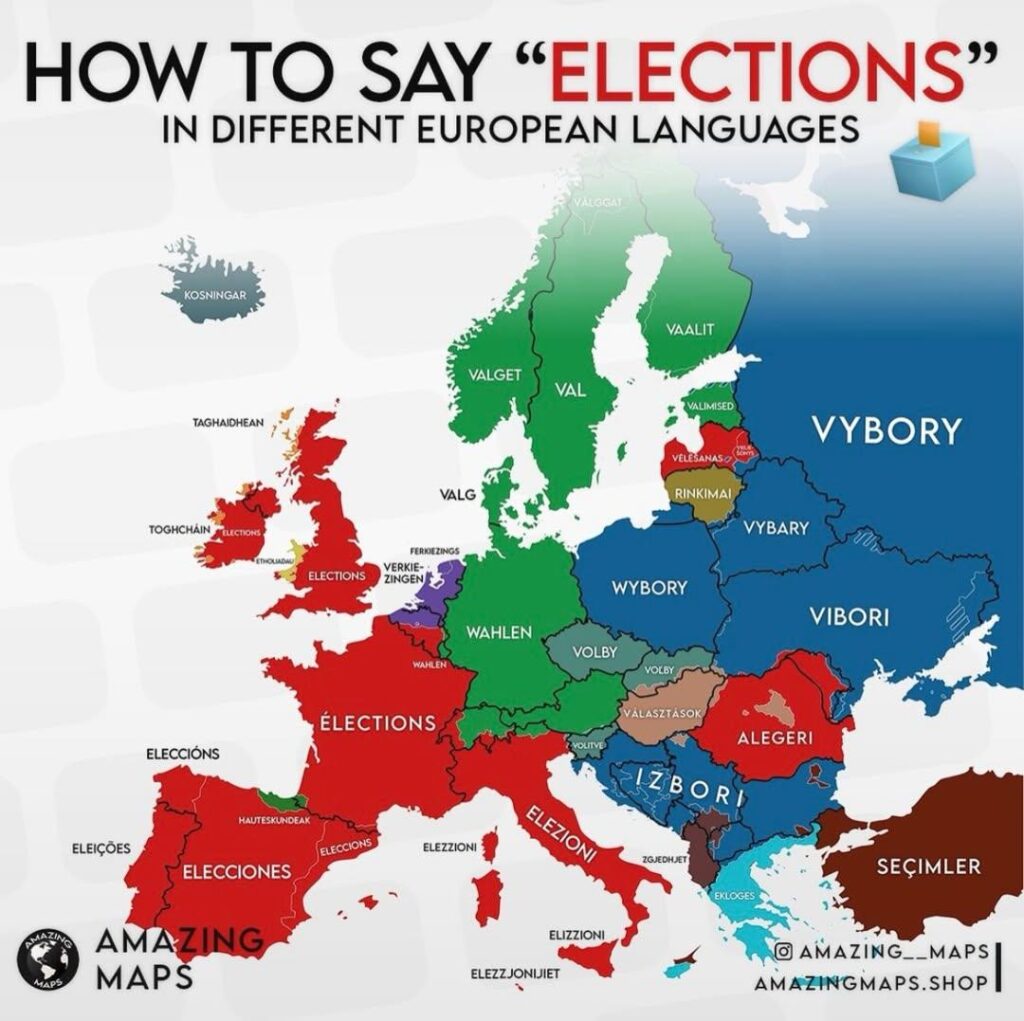
What are the literal meanings? Turkish “seçim” means selection or choosing rather than election. (- ler is for plural).
SalSomer on
“Valget” means “the election”, not “elections”, in Norwegian Bokmål. It is not a word in Norwegian Nynorsk.
“Elections” is either “valg” (Norwegian Bokmål) or “val” (Norwegian Nynorsk).
IoIoIoYoIoIoI on
“-bor” in Slavonic, regardless if with the praefix “vi-“/”vy-” or praefix “iz-” has the same Indo-European root as the English “to bear” ie consequences.
Also related to Slavonic “BERem” = “I pick fruit off” and “razaBERem” = “I get the hold of something”, “finally get an understanding”.
uwu_01101000 on
Thèse maps hardly never put the words in the French dialects like Occitan, Breton, Alsatian (and more)
I know that they are sadly being forgotten, but putting the words is still important imo 🙁
vivaervis on
Probably I might have become daltonic but is Albania and Turkey in the same colour scheme?
HazukiAmane on
Italian Cyprus
CanaDavid1 on
The Norwegian is “the election”, not “elections” (valg)
alex_dark on
vybory vybory, kandidaty – pidory
gergobergo69 on
i love hungary
Lumornys on
Bonus points: find Cyprus.
Extra bonus points: find the Isle of Man.
szczur_nadodrza on
Polish uses *wybory* for most elections and *elekcja*, a derivative of the Latin *eligere*, for historical royal elections. Having two words for the same legal or political concept is surprisingly similar in Polish, usually one is native and the other comes from Latin.
Hareholeowner on
Seçimler
Kraj_the_Conqueror on
Sneaky Cyprus.
Fair_Composer_7351 on
ukrainian are little bit wong
MrEdonio on
Latvian and Latgalian should be green, not red.
milanorlovszki on
Latvian “velesanas” sounds much more like the hungarian “választások” then “elections”
GenerolMajorJust on
Hungary and Lithuania are really different from others
ateiveri on
In Ukrainian it’s Vybory not Vibori
skrott404 on
What’s written for Norway means THE election. Election normally is written as Danish, valg.

25 Comments
Today it’s election day in Bulgaria.
In ukrainian correct “vybory”, not “vibori”
Netherlands and Iceland should be the same color
In German the word used to be Kur and the verb was küren, while Wahl meant choice. But Im guessing Kur fell out of use because its a homonym to the latin-derived German word Kur, which means cure.
Anyways, Im pretty sure the dutch word is related to the old German word.
“Volim te” in Slovene = I’m voting for you
“Volim te” in Croatian = I love you
What are the literal meanings? Turkish “seçim” means selection or choosing rather than election. (- ler is for plural).
“Valget” means “the election”, not “elections”, in Norwegian Bokmål. It is not a word in Norwegian Nynorsk.
“Elections” is either “valg” (Norwegian Bokmål) or “val” (Norwegian Nynorsk).
“-bor” in Slavonic, regardless if with the praefix “vi-“/”vy-” or praefix “iz-” has the same Indo-European root as the English “to bear” ie consequences.
Also related to Slavonic “BERem” = “I pick fruit off” and “razaBERem” = “I get the hold of something”, “finally get an understanding”.
Thèse maps hardly never put the words in the French dialects like Occitan, Breton, Alsatian (and more)
I know that they are sadly being forgotten, but putting the words is still important imo 🙁
Probably I might have become daltonic but is Albania and Turkey in the same colour scheme?
Italian Cyprus
The Norwegian is “the election”, not “elections” (valg)
vybory vybory, kandidaty – pidory
i love hungary
Bonus points: find Cyprus.
Extra bonus points: find the Isle of Man.
Polish uses *wybory* for most elections and *elekcja*, a derivative of the Latin *eligere*, for historical royal elections. Having two words for the same legal or political concept is surprisingly similar in Polish, usually one is native and the other comes from Latin.
Seçimler
Sneaky Cyprus.
ukrainian are little bit wong
Latvian and Latgalian should be green, not red.
Latvian “velesanas” sounds much more like the hungarian “választások” then “elections”
Hungary and Lithuania are really different from others
In Ukrainian it’s Vybory not Vibori
What’s written for Norway means THE election. Election normally is written as Danish, valg.
Elections here in germany:
