
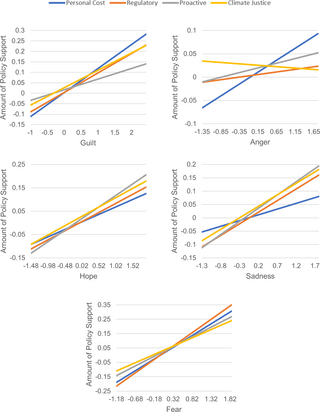
An analysis of the influence of emotion on support for climate policy shows each discrete emotion is more strongly associated with support for a specific type of climate policy than for other types, suggesting climate activists should tailor the emotionality of their message by policy advocated
https://journals.plos.org/climate/article?id=10.1371/journal.pclm.0000381
1 Comment
> Results show promising support for our core argument–that each discrete emotion is more strongly associated with support for a specific type of climate policy than for other types. Specifically, as predicted, guilt was most strongly related to personally costly policy support, and hope to proactive policy support. Also, as predicted, fear was most strongly related to regulatory policy support, suggesting that regulatory policies may be viewed as more self-protective than other forms of policies, including those that are proactive. Contrary to our predictions, anger was more strongly related to support for personally costly policies (rather than regulatory policies; which may be because we did not measure the target of anger, see limitations section), and sadness was most strongly related to support for proactive policies (rather than climate justice policies).
[Millions of people have already died from climate change](http://rdcu.be/eFrD).
There are still over [half a billion people living in extreme poverty](https://ourworldindata.org/new-international-poverty-line-3-dollars-per-day).
That said, [~60% of the American public would receive more in carbon dividend than they paid in carbon tax](http://journals.plos.org/plosone/article?id=10.1371/journal.pone.0081648#s7), were we to institute such a policy, meaning most of us come out ahead even before the benefits of averted climate change and local air pollution are taken into account.
https://www.environmentalvoter.org/get-involved