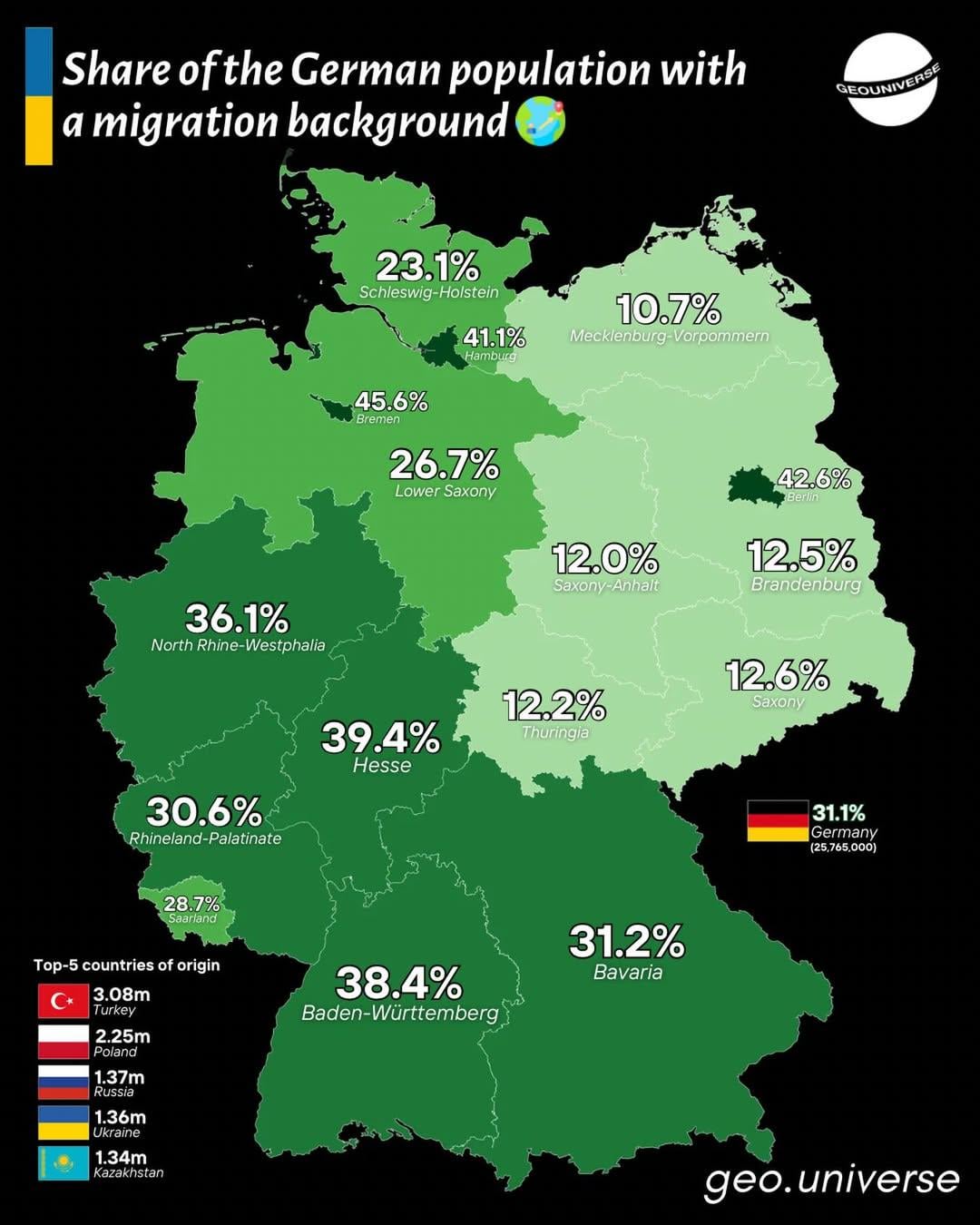
Nearly 1 in 3 people in Germany has a migration background.
That’s 31.1% of the population — over 25.7 million people — making Germany one of Europe’s most diverse nations.
NetHistorical5113 on
I’m guessing that people from Kazakhstan are mostly ethnic Germans who came after World War 2, right?
[deleted] on
[deleted]
dungngyen1 on
why is east germany less immigrants
tcsreject on
Almost every map of Germany indirectly points the old map of East and West Germany
Grzechoooo on
Interesting how the most anti-migrant places have the least migrants.
sebesbal on
12 million Germans were expelled from Eastern Europe to Germany after WWII. Also, millions of Germans migrated from East Germany to the West. So, depending on how you define the term, a large share of this “migration background” can refer to Germans.
Edit: “The office defines people with a migrant background as those who were not born with German citizenship themselves or who have at least one parent who was not born with German citizenship.”
[https://tuenews.de/en/25-2-million-people-in-germany-with-a-migrant-background/](https://tuenews.de/en/25-2-million-people-in-germany-with-a-migrant-background/)
IMHO, this number is not much affected by the migration after WW2, and I guess the East German migration is also not included in this.
Adventurous-Pen-813 on
Goodbye Germany. I’m glad I got to see you before the fall.
Deepfire_DM on
And still the east is the most racist. Russian propaganda is a dangerous tool.
pocoboco on
„Migration background“ is the worst metric ever. Why is someone who is born to one German parent not considered a full-fledged German in every sense of the word? I believe in Austrian statistics they have a bit of a stricter/ better definition, i.e. you are only considered to have migration background if both parents were born in another country and not just one.
AiWoTaskede on
So the least Land with immigration are the most against it, logic
Nosmokingintheparlor on
Well I can’t think of a single reason or timeline that could explain this
Beans2177 on
Mecklenburg West Pommerania got something going on

13 Comments
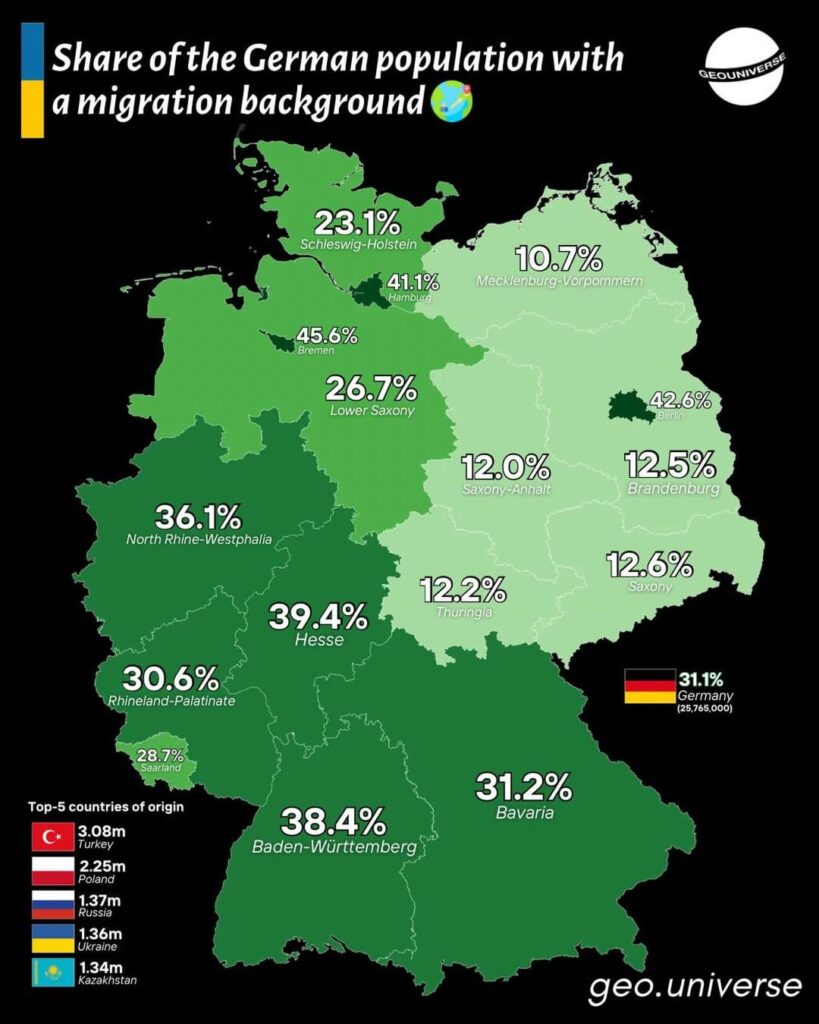
Nearly 1 in 3 people in Germany has a migration background.
That’s 31.1% of the population — over 25.7 million people — making Germany one of Europe’s most diverse nations.
I’m guessing that people from Kazakhstan are mostly ethnic Germans who came after World War 2, right?
[deleted]
why is east germany less immigrants
Almost every map of Germany indirectly points the old map of East and West Germany
Interesting how the most anti-migrant places have the least migrants.
12 million Germans were expelled from Eastern Europe to Germany after WWII. Also, millions of Germans migrated from East Germany to the West. So, depending on how you define the term, a large share of this “migration background” can refer to Germans.
Edit: “The office defines people with a migrant background as those who were not born with German citizenship themselves or who have at least one parent who was not born with German citizenship.”
[https://tuenews.de/en/25-2-million-people-in-germany-with-a-migrant-background/](https://tuenews.de/en/25-2-million-people-in-germany-with-a-migrant-background/)
IMHO, this number is not much affected by the migration after WW2, and I guess the East German migration is also not included in this.
Goodbye Germany. I’m glad I got to see you before the fall.
And still the east is the most racist. Russian propaganda is a dangerous tool.
„Migration background“ is the worst metric ever. Why is someone who is born to one German parent not considered a full-fledged German in every sense of the word? I believe in Austrian statistics they have a bit of a stricter/ better definition, i.e. you are only considered to have migration background if both parents were born in another country and not just one.
So the least Land with immigration are the most against it, logic
Well I can’t think of a single reason or timeline that could explain this
Mecklenburg West Pommerania got something going on