A lot of dutch people get triggered when I say I installed AC
Gloomy-Error212 on
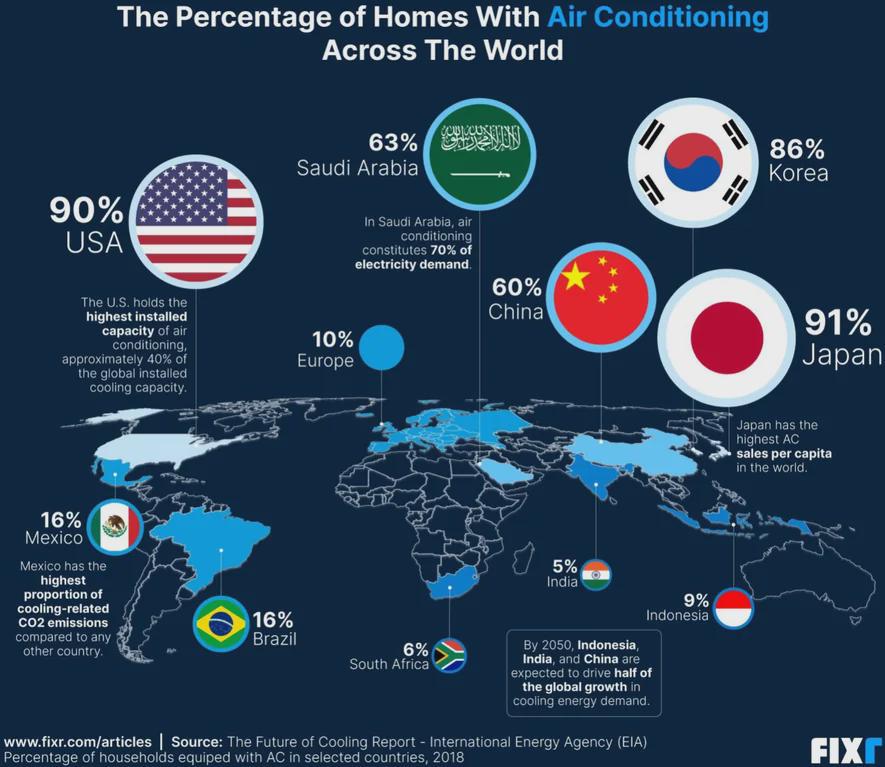
Didnt realise the US was so high.
diggi923diggi on
It’s an 8 year old data
33TLWD on
Keep in mind that many / most major European cities sit much higher, latitudinally, than most US cities. Many would sit close or over the Canadian border.
Korean and Japanese wall units also double as heaters via heat pumps. Last I was in the States, This functionality seemed absent though I believe many American homes use HVAC instead.
911silver on
Saudi feels too low
Knute5 on
Here in Canada, heat pumps are being installed everywhere. On a particularly hot day, those heat pumps are used for the 5% of their other functionality as air conditioners.
smorkoid on
That 9% without it in Japan is Hokkaido lol
No A/C in Kanto is like a death sentence
Facuk_ on
I don’t know how much % of houses does have AC here in Croatia, but I’m sure summers can be brutal, in inland Croatia we can have 38-40°C for weeks. If it’s not so high, then you have humidity which kinda makes thing even worse. All in all, AC is a life saver
Rice cooker 97%
Microwave 95%
Kimchi fridge 85%
water purifier 78%
air fryer 73%
air purifier 66%
bidet 55%
coffee machine 50%
electric stove 44%
dehumidifier 42%
humidifier 39%
massage chair 28%
air circulator 26%
dishwasher 24%
oven 21%
multicooker 17%
home care / beauty 10%
cbawiththismalarky on
it’s currently 17 degrees where i am in Northern England and I’ve got the heating on, not sure what use air conditioning would be
Rafxtt on
That’s from 2018.
It’s outdated for EU data, at least for newer homes and buildings.
Starting from 2020-2022 because of new building codes and also energy (gas, oil) price hikes – because of Russia invading Ukraine – the % of heat pumps/AC both in new buildings and in renovations in older houses skyrocketed.
Technoir1999 on
Before a/c, a diplomatic post to Washington, DC, was a hardship post in the summer. I don’t know why Europeans don’t understand that half of the U.S. has a subtropical climate.
zcpibm3 on
This info is so current.
make43 on
On average, Finland experiences fewer than five days per year with temperatures exceeding 30°C.
FantasticFungiiii on
Do you how hot it can get in Australia? It exists.
lilwayne168 on
Europelets with no ac get btfo
AnonomousWolf on
South Africa again beating New Zealand 💪
Mufflonfaret on
In Sweden we do care more about heating the houses than chilling them. So no clear statistics. Most houses (not apts) do have an air heat pump though which can double as an AC summertime of needed.
PeaOk5697 on
Most Norwegian homes have heat pumps which also works for cooling
cozidgaf on
Does this only include AC installed in the house like an HVAC system? Not like portable ones or window AC, split AC etc? Coz a lot of places may be doing that – NYC comes to mind and also older places or places that were not built with that infrastructure in mind – Europe, India, Brazil etc that maybe the case?
xennial_scum on
Percentage that the Saudi number is correct: 0
Aggressive-Cut5836 on
New Zealand would like a word with this map…
Remote-Cow5867 on
My friend in China just replaced an aircon for her studio. It costs $300 including installation. The installation takes 1 hour to complete. The aircon comes with 10 years warranty. If it breaks down in 10 years, she will get a new one free of charge.
KieranJalucian on
90% in usa? that seems high
Neo_luigi on
How are those 36% people of Saudi able to survive in the desert without ac ?
HASMAD1 on
Oh yes, the great country of Europe where Sweden and Spain share their air conditionings.
localelore_official on
What this map is also showing, if you look at the US specifically, is the demographic shift that completely reshaped American politics.
Before widespread air conditioning, the American South and Southwest were brutal to live in year-round. Phoenix had about 5,500 people in 1900. Houston had roughly 45,000. Las Vegas didn’t really exist as a city.
Willis Carrier solved the puzzle accidentally. He was hired in 1902 to fix a humidity problem at a Brooklyn printing company — paper kept warping, ink kept bleeding. His solution was to control the dew point by chilling the air. He had no idea he’d just made the Sunbelt livable.
By the 1950s, window units were cheap enough for middle-class homes. Then central AC spread through new construction in the South and Southwest. People moved in enormous numbers — not just for jobs, but because summers were survivable for the first time.
Phoenix: 65,000 in 1940, over a million by 1980. The Florida peninsula, the Texas Triangle, Las Vegas — all transformed. The US Census Bureau coined “Sunbelt” in the 1970s partly to describe what was happening.
That shift rerouted where Americans chose to live, which changed House apportionment, the Electoral College balance, and eventually the national political center of gravity. The low AC rate in the UK despite high income is a different story — mostly Victorian and Edwardian housing stock that’s expensive to retrofit, plus a climate that hasn’t historically required it. That’s starting to change.
Voidjumper_ZA on
> 70% of their electricity demand
Jesus fucking Christ.
khoawala on
the hottest country in the world only has 5%? Holy shit
AngryPB on
is Brazil really that low?? I live here and doesn’t feel like it

31 Comments
A lot of dutch people get triggered when I say I installed AC
Didnt realise the US was so high.
It’s an 8 year old data
Keep in mind that many / most major European cities sit much higher, latitudinally, than most US cities. Many would sit close or over the Canadian border.
https://brilliantmaps.com/cities-transposed-latitude/
Korean and Japanese wall units also double as heaters via heat pumps. Last I was in the States, This functionality seemed absent though I believe many American homes use HVAC instead.
Saudi feels too low
Here in Canada, heat pumps are being installed everywhere. On a particularly hot day, those heat pumps are used for the 5% of their other functionality as air conditioners.
That 9% without it in Japan is Hokkaido lol
No A/C in Kanto is like a death sentence
I don’t know how much % of houses does have AC here in Croatia, but I’m sure summers can be brutal, in inland Croatia we can have 38-40°C for weeks. If it’s not so high, then you have humidity which kinda makes thing even worse. All in all, AC is a life saver
Gallup poll from 2025 ([report in Korean](https://www.gallup.co.kr/gallupdb/reportContent.asp?seqNo=1595)) finds that 98% of Korean households have AC.
Other appliances for good measure:
Rice cooker 97%
Microwave 95%
Kimchi fridge 85%
water purifier 78%
air fryer 73%
air purifier 66%
bidet 55%
coffee machine 50%
electric stove 44%
dehumidifier 42%
humidifier 39%
massage chair 28%
air circulator 26%
dishwasher 24%
oven 21%
multicooker 17%
home care / beauty 10%
it’s currently 17 degrees where i am in Northern England and I’ve got the heating on, not sure what use air conditioning would be
That’s from 2018.
It’s outdated for EU data, at least for newer homes and buildings.
Starting from 2020-2022 because of new building codes and also energy (gas, oil) price hikes – because of Russia invading Ukraine – the % of heat pumps/AC both in new buildings and in renovations in older houses skyrocketed.
Before a/c, a diplomatic post to Washington, DC, was a hardship post in the summer. I don’t know why Europeans don’t understand that half of the U.S. has a subtropical climate.
This info is so current.
On average, Finland experiences fewer than five days per year with temperatures exceeding 30°C.
Do you how hot it can get in Australia? It exists.
Europelets with no ac get btfo
South Africa again beating New Zealand 💪
In Sweden we do care more about heating the houses than chilling them. So no clear statistics. Most houses (not apts) do have an air heat pump though which can double as an AC summertime of needed.
Most Norwegian homes have heat pumps which also works for cooling
Does this only include AC installed in the house like an HVAC system? Not like portable ones or window AC, split AC etc? Coz a lot of places may be doing that – NYC comes to mind and also older places or places that were not built with that infrastructure in mind – Europe, India, Brazil etc that maybe the case?
Percentage that the Saudi number is correct: 0
New Zealand would like a word with this map…
My friend in China just replaced an aircon for her studio. It costs $300 including installation. The installation takes 1 hour to complete. The aircon comes with 10 years warranty. If it breaks down in 10 years, she will get a new one free of charge.
90% in usa? that seems high
How are those 36% people of Saudi able to survive in the desert without ac ?
Oh yes, the great country of Europe where Sweden and Spain share their air conditionings.
What this map is also showing, if you look at the US specifically, is the demographic shift that completely reshaped American politics.
Before widespread air conditioning, the American South and Southwest were brutal to live in year-round. Phoenix had about 5,500 people in 1900. Houston had roughly 45,000. Las Vegas didn’t really exist as a city.
Willis Carrier solved the puzzle accidentally. He was hired in 1902 to fix a humidity problem at a Brooklyn printing company — paper kept warping, ink kept bleeding. His solution was to control the dew point by chilling the air. He had no idea he’d just made the Sunbelt livable.
By the 1950s, window units were cheap enough for middle-class homes. Then central AC spread through new construction in the South and Southwest. People moved in enormous numbers — not just for jobs, but because summers were survivable for the first time.
Phoenix: 65,000 in 1940, over a million by 1980. The Florida peninsula, the Texas Triangle, Las Vegas — all transformed. The US Census Bureau coined “Sunbelt” in the 1970s partly to describe what was happening.
That shift rerouted where Americans chose to live, which changed House apportionment, the Electoral College balance, and eventually the national political center of gravity. The low AC rate in the UK despite high income is a different story — mostly Victorian and Edwardian housing stock that’s expensive to retrofit, plus a climate that hasn’t historically required it. That’s starting to change.
> 70% of their electricity demand
Jesus fucking Christ.
the hottest country in the world only has 5%? Holy shit
is Brazil really that low?? I live here and doesn’t feel like it