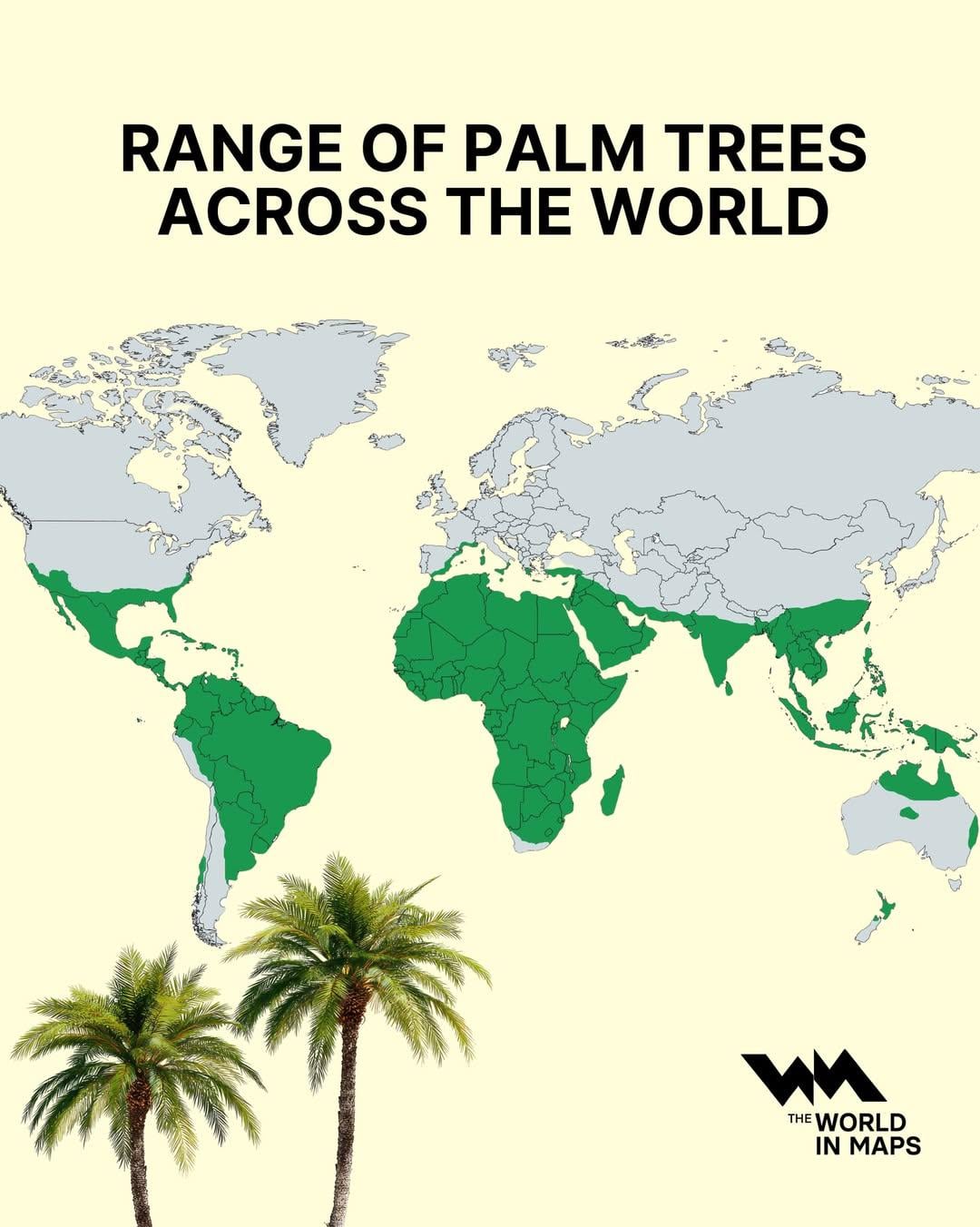
Is this where they naturally occur. Because I’ve seen some in parts of England so I know they can survive here.
Responsible_Crew2321 on
The Himalayas doesn’t have palm trees kind of trees???
sverik25 on
What on earth are the palm trees around Alice Springs supposed to be?
CautiousPreprinter on
What clever trees.
bad_take_ on
What’s that island south of Australia?
Creepy-Client-4059 on
I believe the Isle of Man also has palm trees
RetiredApostle on
Japan suddenly lost its palms.
k-phi on
Sahara is famous for it’s palm trees
ApprehensivePrice566 on
I believe all of Italy has palm trees as well as most balkan countries
Glad-Hurry-9410 on
Japan, Croatia, Montenegro, Albania and Italy all have palm trees too. This could be where they naturally occur or do so more frequently.
cristaline-pivoine on
I thought they were more of them in Europe
Adventurous-Big-6195 on
There are even palm trees in Switzerland, also growing naturally.
tigro7 on
Liguria has palms, but I don’t know how naturally (though is the same for Provence)
TheYellowFringe on
The distribution of palms in Australia are interesting.
I’m wondering if the patchs from the centre and east might have connected at one time to the north?
RoadHazard on
I loved palm trees as a kid, they felt very exotic to me as a Swede. The first time I went to a country where they grow naturally I was in heaven.
(I still love them at 40+)
1orodrigo on
Something bonkers happened in Turkey on this map!
WillingnessFun2907 on
Why do these maps keep doing NZ dirty?
Jabal-Sawda on
I love the palm trees that give us dates

SadButWithCats on
Dublin,Ireland is lousy with palms. This map is garbage.
Significant-Ant8132 on
CALIFORNIA 🌴🌴🔥🎆🐦🔥
SideAgitated4661 on
Why Canada has none?
dkg224 on
About 24 years ago my buddies mom was starting a palm tree nursery in N California and was gonna be selling them down to Vegas with all the new construction going on. Then she got arrested for growing and selling weed across the country.
Desperate_Camel8599 on
Not even a pixel for Seychelles.
SharkeyGeorge on
How about the scene in the 2006 movie Hoot when the teacher (played by Jimmy Buffet) asks the class “*So why are there palm trees in Ireland?”* to teach the kids about the Gulf Stream? 😹
PleasantTrust522 on
There are a lot of palm trees in Kyushu, southern Japan.
silencefog on
I saw palm trees in Sochi
aanl01 on
The chilean wine palm is an endangered species because we used to cut them to produce palm syrup 🥲 Nowadays it’s illegal to cut this tree and there are lots of conservation efforts
BixbysTree on
I’ve collected three coconuts off of Nova Scotia beaches after tropical storms over the years, so their seeds can get here, but they can’t grow!
curt_schilli on
Palm trees can survive in the Sahara?
OMyGaard on
Ireland is full of palm trees. Not native but they are in many gardens.
SugarMiracle-58 on
I’ve seen some part of England so I know they can survive here haha
Val2K21 on
I’ve seen quite a few in Georgia (country) both planted in the parks as well as growing randomly in rural areas (near Batumi, close to Türkiye)
Username___5 on
What about Cornwall 😢
virkendi on
It’s very wrong for Australia, the entirety of eastern Queensland is populated with native palms and the range stretches all the way down to Victoria in the far south east with Livistona Australis
NZ too has the native Nikau growing until halfway down the west and east coast of the south island
buckrode0 on
Forgot the south west of England
Myrialle on
Why aren’t the Canaries green? They have palm trees, native ones.
ResidentIwen on
I know of some palm trees on the dublin coast that might want to have a word with you as to why they’re not represented here
MartiniPolice21 on
Missing Plockton in Scotland
PeaOk5697 on
There are palm trees in England and even in parts of Scandinavia
ruinrunner on
That can’t be right for Africa? what about the sahara? what about the swamps of the congo? what about the highlands of Ethiopia?
Easy-Reporter4685 on
Canary Islands should be highlighted because we have our own endemic date palm ‘Phoenix canariensis’ which is easily the most iconic and beautiful of them all.
shtern0007 on
pfff BS – i live in Finland i have 3 at home!
SEA_Executive on
Hawaii’s turn to be left off the map 😂 and NZ showing up in the wrong location to be included on every map now is the 🧑🍳💋
Similar_hilter on
What about Palm Beach Pete
OkAir1143 on
r/mapswithnewzealandbut
Iwasjustryingtologin on
In the case of Chile the map is incorrect. The natural range of the Chilean wine palm, [_Jubaea chilensis_](https://en.wikipedia.org/wiki/Jubaea), which is endemic to the country and our only native palm species, extends from the Coquimbo Region to the Maule Region or roughly between 30° and 35° south latitude. It inhabits mountainous areas near the coast characterized by a Mediterranean climate and is one of the most iconic trees of the Chilean sclerophyllous forest.
On the map, however, the marked area extends from the Maule region to the island of Chiloé, roughly between 35° and 43° south latitude, which encompasses a transitional zone between a Mediterranean and an oceanic climate, characterized by the Valdivian temperate rainforest, an environment that is far too humid and cold for the natural growth of this species.
And needless to say, the map is completely wrong in northern Chile. That area covers the Andean altiplano and part of the Atacama Desert. It should be quite obvious that no palm tree is going to grow in such a dry, high-altitude environment (the same applies to the marked areas of the Bolivian, Argentine and Peruvian altiplano).
kemonkey1 on
There are palm trees in Switzerland too
Elskyflyio on
There are non-native palm trees growing by the north-eastern Italian coast too btw

48 Comments
Is this where they naturally occur. Because I’ve seen some in parts of England so I know they can survive here.
The Himalayas doesn’t have palm trees kind of trees???
What on earth are the palm trees around Alice Springs supposed to be?
What clever trees.
What’s that island south of Australia?
I believe the Isle of Man also has palm trees
Japan suddenly lost its palms.
Sahara is famous for it’s palm trees
I believe all of Italy has palm trees as well as most balkan countries
Japan, Croatia, Montenegro, Albania and Italy all have palm trees too. This could be where they naturally occur or do so more frequently.
I thought they were more of them in Europe
There are even palm trees in Switzerland, also growing naturally.
Liguria has palms, but I don’t know how naturally (though is the same for Provence)
The distribution of palms in Australia are interesting.
I’m wondering if the patchs from the centre and east might have connected at one time to the north?
I loved palm trees as a kid, they felt very exotic to me as a Swede. The first time I went to a country where they grow naturally I was in heaven.
(I still love them at 40+)
Something bonkers happened in Turkey on this map!
Why do these maps keep doing NZ dirty?
I love the palm trees that give us dates

Dublin,Ireland is lousy with palms. This map is garbage.
CALIFORNIA 🌴🌴🔥🎆🐦🔥
Why Canada has none?
About 24 years ago my buddies mom was starting a palm tree nursery in N California and was gonna be selling them down to Vegas with all the new construction going on. Then she got arrested for growing and selling weed across the country.
Not even a pixel for Seychelles.
How about the scene in the 2006 movie Hoot when the teacher (played by Jimmy Buffet) asks the class “*So why are there palm trees in Ireland?”* to teach the kids about the Gulf Stream? 😹
There are a lot of palm trees in Kyushu, southern Japan.
I saw palm trees in Sochi
The chilean wine palm is an endangered species because we used to cut them to produce palm syrup 🥲 Nowadays it’s illegal to cut this tree and there are lots of conservation efforts
I’ve collected three coconuts off of Nova Scotia beaches after tropical storms over the years, so their seeds can get here, but they can’t grow!
Palm trees can survive in the Sahara?
Ireland is full of palm trees. Not native but they are in many gardens.
I’ve seen some part of England so I know they can survive here haha
I’ve seen quite a few in Georgia (country) both planted in the parks as well as growing randomly in rural areas (near Batumi, close to Türkiye)
What about Cornwall 😢
It’s very wrong for Australia, the entirety of eastern Queensland is populated with native palms and the range stretches all the way down to Victoria in the far south east with Livistona Australis
NZ too has the native Nikau growing until halfway down the west and east coast of the south island
Forgot the south west of England
Why aren’t the Canaries green? They have palm trees, native ones.
I know of some palm trees on the dublin coast that might want to have a word with you as to why they’re not represented here
Missing Plockton in Scotland
There are palm trees in England and even in parts of Scandinavia
That can’t be right for Africa? what about the sahara? what about the swamps of the congo? what about the highlands of Ethiopia?
Canary Islands should be highlighted because we have our own endemic date palm ‘Phoenix canariensis’ which is easily the most iconic and beautiful of them all.
pfff BS – i live in Finland i have 3 at home!
Hawaii’s turn to be left off the map 😂 and NZ showing up in the wrong location to be included on every map now is the 🧑🍳💋
What about Palm Beach Pete
r/mapswithnewzealandbut
In the case of Chile the map is incorrect. The natural range of the Chilean wine palm, [_Jubaea chilensis_](https://en.wikipedia.org/wiki/Jubaea), which is endemic to the country and our only native palm species, extends from the Coquimbo Region to the Maule Region or roughly between 30° and 35° south latitude. It inhabits mountainous areas near the coast characterized by a Mediterranean climate and is one of the most iconic trees of the Chilean sclerophyllous forest.
On the map, however, the marked area extends from the Maule region to the island of Chiloé, roughly between 35° and 43° south latitude, which encompasses a transitional zone between a Mediterranean and an oceanic climate, characterized by the Valdivian temperate rainforest, an environment that is far too humid and cold for the natural growth of this species.
And needless to say, the map is completely wrong in northern Chile. That area covers the Andean altiplano and part of the Atacama Desert. It should be quite obvious that no palm tree is going to grow in such a dry, high-altitude environment (the same applies to the marked areas of the Bolivian, Argentine and Peruvian altiplano).
There are palm trees in Switzerland too
There are non-native palm trees growing by the north-eastern Italian coast too btw