
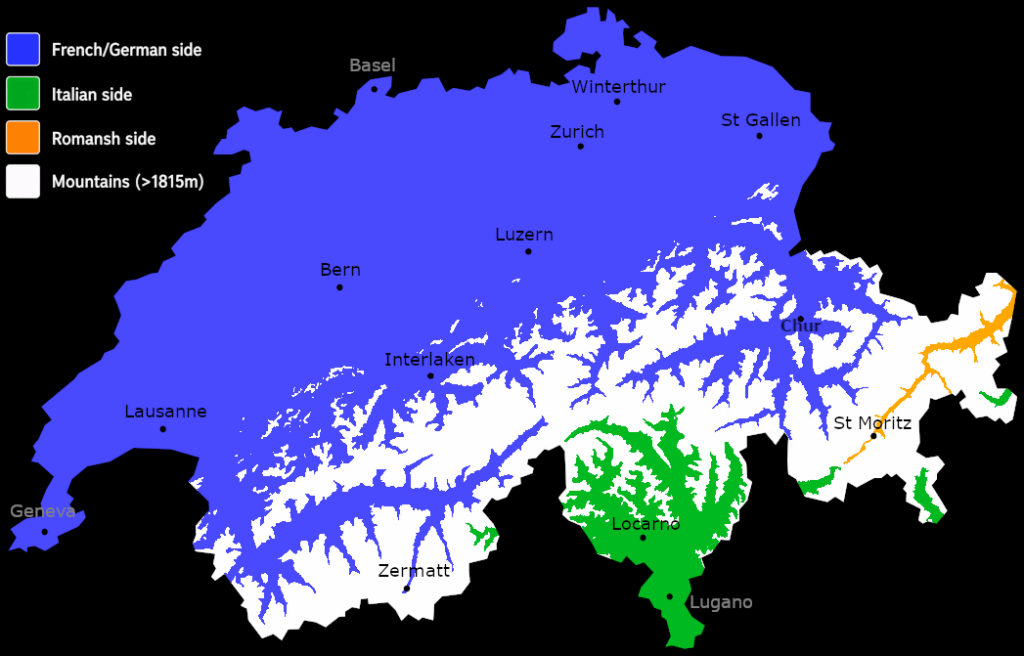
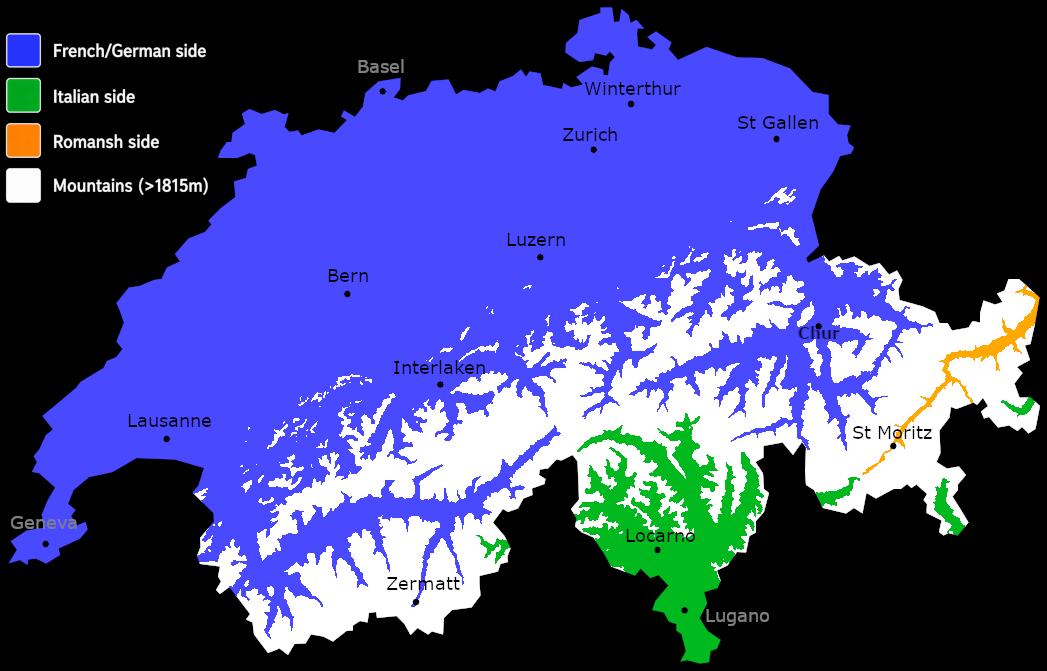
I noticed swiss linguistic boundaries correlate very strongly with mountain boundaries, so I created this map. I chose the 1815m threshold since that is the highest threshold that still formed a tight seal between the north and south (=altitude of the Maloja pass near St Moritz). This threshold happens to coincide pretty closely to the inhabitable boundary; many iconic cities/villages like Zermatt and St Moritz are located just below this treshold. For all intents and purposes, regions above the threshold can be considered uninhabited land.
I found that outside the French/German and Italian areas, there is a third area that corresponds closely to the Romansh language, in the Engadin valley. This valley is fully separated by mountains from the French/German part of Switzerland. Though to be accurate, both German and Romansh are spoken in that valley and another variety of Romansh is spoken outside that valley, near Disentis (blue area just north of the Italian part).
Disclaimer: the names of the regions here are just the closest matching ones. The main point of this map is to show how Switzerland is topologically divided by mountains. So its possible to see exceptions if you look closely.
Anyway, enjoy the map!
Posted by Evilgrandma03
10 Comments
Wow never heard of a language called “Mountains” what does it sound like? /s
“I’ll just merge all the languages on the same side of the mountains so I can say the linguistic boundaries correlates with them”
This map doesn’t show the nuance of languages in Switzerland across the mountain range and around
I can see my home valley from here
Not really that simple.
* The upper Rhine West of Chur also speak majority Romansch not German/French
* The “Italian side” spur in the far west (Val Müstair) speak Romansch
* Gondo & Simplon (the “Italian” bits in the East) speak majority German… As do some folks over the Italian border, such as in the Lys Valley.
mostly just by the Alps
the Jura mountains didn’t create a linguistic boundary, just one with France
So how do you explain the French/German divide? Is there some kind of middle ground dialects with grammar from one and vocabulary more heavily influenced by the other, kind of forming a continuum?
Would be even better if it showed the French and German languages seperately
That’s not accurate. St Moritz is german speaking. The only romansh-majority is that small valley area west of Chur
It says here that they speak Italian in Val Müstair; too bad they border the Italian town of Tubre (BZ), where 99.1% of the population are native German speakers.
In the whole of South Tyrol (Italy), the main language is German.
Thats garbage