
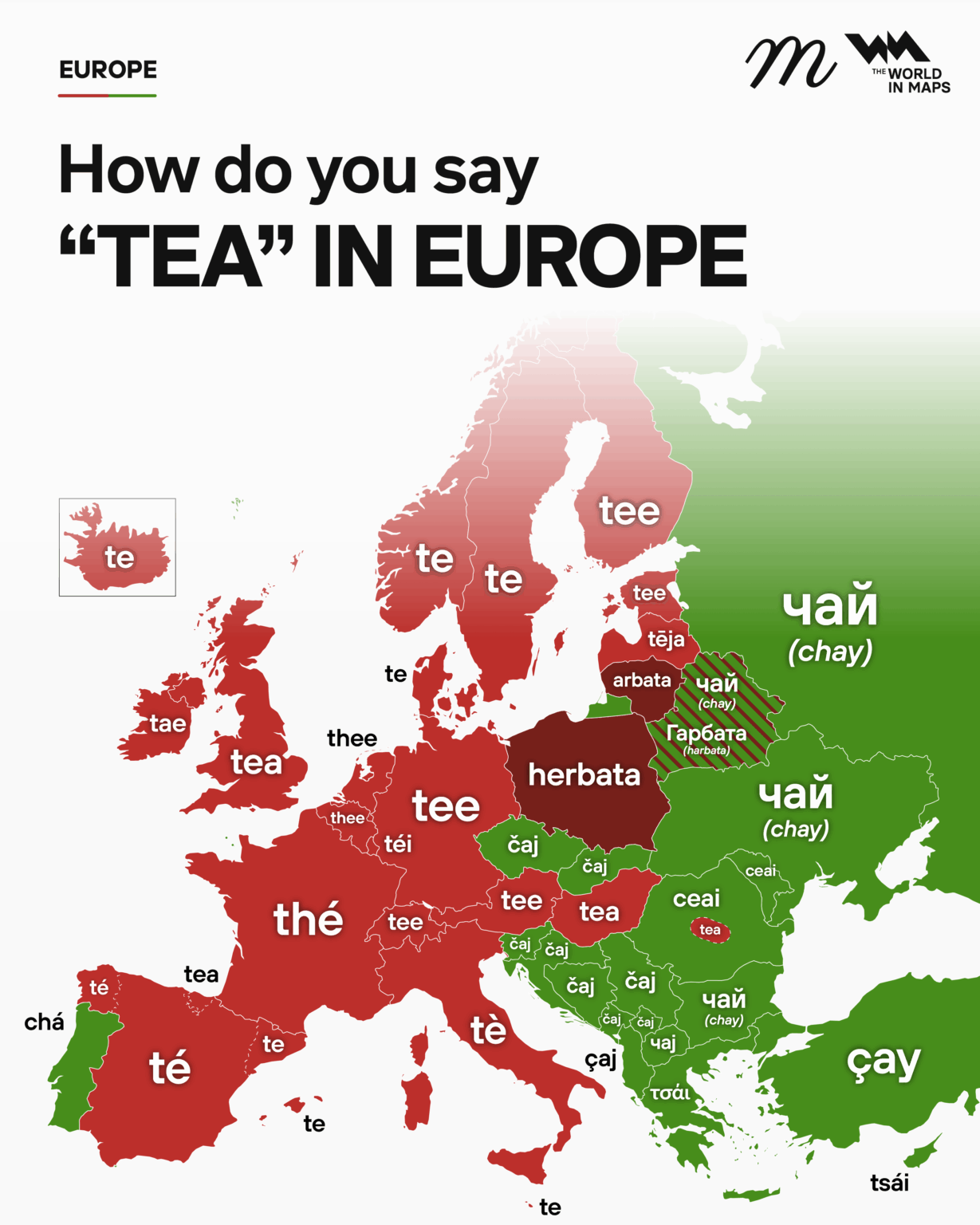
The continent is broadly divided into three main etymological groups based on the vocabulary used in different regions. The first group covers most of Western and Northern Europe, where countries use short words derived from the root "te", such as tea, thé, té, tee, and tè. The second large group spans Eastern and Southeastern Europe, including Russia, the Balkans, Turkey, and Greece, utilizing variations of the root "chay" or "čaj", such as чай, çay, and tsái. Notably, Portugal acts as an isolated western outlier that also belongs to this specific linguistic family with the word chá. The third distinct group forms a localized cluster in Central-Eastern Europe, consisting exclusively of Poland, Belarus, and Lithuania, where the word is based on the "herbata" root, appearing as herbata, harbata, and arbata respectively.
⋯⋯⋯⋯⋯⋯⋯⋯⋯⋯⋯⋯
Author: u/maven.mapping
Partner: u/the.world.in.maps
⋯⋯⋯⋯⋯⋯⋯⋯⋯⋯⋯⋯
MAVEN MAPPING © 2026
Posted by maven_mapping
49 Comments
I would suggest that for linguistic maps you used linguistic borders instead of political ones, would be more fitting
Wales is Te not tea!
r/PORTUGALCYKABLYAT
r/PORTUGALCYKABLYAT
How did Hungarian manage to get it letter-by-letter correct from English?
r/PORTUGALCYKABLYAT
I believe the difference is – did they get tea by sea or by land.
Why didn’t Czech and Slovak use “Tee” like German and Hungarian? Does anyone know?
Chai by land, tea by sea
In the UK tea is also known as “char”
Belgium has three official languages Nederlands, French and German. This map is fucking shit!
How do you *write* tea…
Why is there a red patch in the center of Romania?
The Irish chose tae to fuck with the English?
Herbata 🗣️🔥🔥🔥
Meanwhile 🇺🇸: “One Herbal Chai Tea please 😊”
PLC legacy still there.
Herbata is literally herb+ta herbal tea
*herba + ta*
Aka, “tea herb”, romanized form of the *ta variant
Because tea and chai arent that far sound wise it always suprised me that they didnt fuse back together somewhere
A cuppa cha is slang in Ireland too, not sure why
SOMEONE CALL AN AMBULANCE!!!! ROBMANIA GOT SHOT!!!!
Northern Cyprus is Turkish speaking, not Greek.
I am Polish, and Poland is always marked as different color but frankly it should be red. The root of the word is virtually the same as in red countries, simply with adding that this is a herb.
Polish-Lithuanian commonwealth spotted.
Even in this Portugal is with Eastern Europe
Saw this map 64859385 times
Poland really looked at the rest of the continent and decided to pick the most difficult word possible.
another proof that Portugal belongs to Balkan
Csn alsonsay “tsaikka/saikka” in Finnish, if you’ve got any Katelian background in the fanily.
r/PORTUGALCYKABLYAT
And btw – these “čaj” and “чаи”s are all pronounced like Chai – in case they look weird to foreigners.
And it all comes down to whether you got your tea by land or by sea.
[https://qz.com/1176962/map-how-the-word-tea-spread-over-land-and-sea-to-conquer-the-world](https://qz.com/1176962/map-how-the-word-tea-spread-over-land-and-sea-to-conquer-the-world)
ARBATA!!!1 on all lungs during break time
In German you write it „Tee“ because nouns are always capitalised. Also téi is luxembourghish.
It’s “te” in Welsh.
In Czech it’s both “čaj” and “té”
By sea or by land.
Visible Poland-Lithuania commonwealth
This has been posted 1000 times
T.E.A – Transporte de Ervas Aromáticas
Poland is the pineapple of tea.
Is it like they got Tea from Asians, so they call it chay
We Bangalis also say ‘চা’ cha
*Tee
🇩🇪
Portugal “Fxck you guys 🖕🏻”
There’s three official languages in Belgium
Poland be like:

In Portugal it’s called “chá” but the “Tea” name also came from Portugal, kinda. When Portugal exported “chá” to England they stored it in crates labeled “TEA” which stands for “Transporte de Ervas Aromáticas” (Aromatic Herb Transport), so the English people started calling it by the word in the crates
Fun aside: In Gaelic, it can be called either “tì”, or “cupa”. As in “cupa-tì”, “cup of tea”.