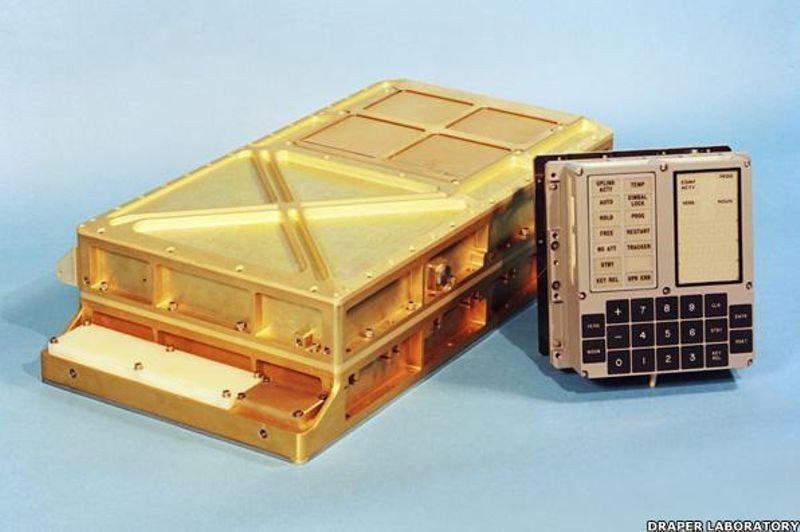
Apollo 11 Landed on the Moon with a Computer That Had Only 4KB of RAM
https://hive.blog/hive-196387/@theworldaroundme/apollo-11-landed-on-the

Apollo 11 Landed on the Moon with a Computer That Had Only 4KB of RAM
https://hive.blog/hive-196387/@theworldaroundme/apollo-11-landed-on-the
29 Comments
And today we need 2 GB of memory to display hello in a browser…
When something gets cheap, here memory, consumption of it becomes irrational.
Not only that, it was pretty much the first desktop-sized general purpose real-time embedded computer based on silicon integrated circuits. It is the spiritual grandfather to pretty much every modern computing device.
…and an astronaut with a notepad and calculator on their lap
In 1978, I maintained the Burroughs D84M with 16K of core memory used to launch a nuclear missile.
Yes, but did it have two versions of Outlook?
My first ‘computer’ in the 80s was an Atari, and I was jealous of the Commodore 64 kids.
*The Commodore 64 shipped with a massive* ***\(64\text{ KB}\) of RAM****, a standard-setting capacity that outshone earlier Atari 8-bit computers* *(like the Atari 400 and 800), which typically came with just* ***\(16\text{ KB}\)*** *to* ***\(48\text{ KB}\)****. This larger memory pool gave the C64 a major edge in running complex software. [*[*1*](https://paleotronic.com/2018/06/30/atari-800-vs-commodore-64-the-brief-tale-of-two-8-bit-home-computers/)*,* [*2*](https://www.quora.com/Why-was-the-Commodore-64-such-a-popular-choice-for-gaming-in-the-1980s-compared-to-other-computers-like-the-Atari-8-bit)*]*
[YouTubes series on restoring a real AGC to working order.](https://youtube.com/playlist?list=PL-_93BVApb59FWrLZfdlisi_x7-Ut_-w7&si=Tewk4E6btvVHKVUd)
I’m an absolute sucker for early space computing.
https://m.youtube.com/@CuriousMarc are restoring a whole bunch of Apollo tech to working order including the flight computers. The Saturn computer is more impressive then the Apollo computer IMHO, Apollo is interesting because of what they achieved with weight and space requirements while Saturn was stacked breakthroughs by IBM.
Also shout out to the Voyager computers which I still argue are not really computers which is why they are so cool. Hopefully Caltech open sources the software eventually.
I re-read lost moon recently, and man alive, the things this computer could do is just astounding. How it could orient itself to stars and the sun, how it just automatically could perfectly position the spacecraft for firing the engine so you hit this narrow window for entry. all from strings that a bunch of women in Boston literally sewed together. just remarkable engineering.
Could someone eli5 the significance of this and help a layperson understand it? I get that a computer less powerful than my phone got them there but what benefit would they have had with more memory/computing power? Do we see significant leaps in space travel today based on how these values have scaled up?
Looks like a solid gold gpu tho
Today, we’d land there with AI.
“OK AI, now land the shuttle safely on the moon”
“You got it captain!”
Proceeds to crash land.
“AI, I said safely!”
“Oh, good catch, let me fix that for you”
And 60 years later we STILL haven’t done it again.
Hmmmmm.
I highly recommend the book Digital Apollo if you are interested in Apollo computers. These computers were incredible, not just for the use of cutting edge ICs, but just how far the designers went to ensure extreme reliability.
I heard an engineer describe it as as much computing power as you have in your pocket. But not your phone—Your key fob!
And even with that limited computing power they had to allocate resources for converting metric to imperial so that the astronauts can read the displays.
The bulk of the calculations for the space flights were done beforehand by [different looking computers](https://www.nasa.gov/centers-and-facilities/jpl/when-computers-were-human/). Back at the time, computer was a job title.
And the software was handwoven by little old ladies
People like to say “the phone in your pocket has more computing power than the computer that took us to the moon”. While that’s correct, it’s also correct to say “the charger you plug in to the wall to charge your phone has more computing power than the computer that took us to the moon”.
“Tell them how much GBytes your notebook needs to run Win 10 first”
Really, what does that mean? Because in 1969 it was exactly what was needed for the lunar excursion module….. it didn’t need layers and layers of complicated user interface code…. And in fact any software developer who may think they’re really shit hot. Would really struggle the same application code used in the Apollo guidance computer…. Because there’s too much fucking float in software today, demonstrated by what the Apollo guidance computer achieved with its limited memory…
It’s wild to think my washing machine has more processing power than the guidance computer that took humans to another world.
Wanna know what was more impressive?
Literally everything else involved in the Moon Landing. The computer not having the modern equivalent of RAM is the least impressive thing about that entire mission.
And now, you cannot open notepad in win11 with 32gb of ram
same price per gigabyte as the current ram prices lol
what’s even more impressive is that the software had to be hand-woven into core rope memory by literal textile workers threading wires through magnetic cores. if you needed to change the code you had to physically reweave it. the women who did this work were called ‘little old ladies’ by the engineers, and they were so precise that the error rate was essentially zero. modern programmers complain about merge conflicts.
Looks imprecive but It doesn’t take much memory to ignite the engines and control the trajectory
Better hope Azure and it’s datacenters stay up for Artimis moon landing.
I always enjoy telling people they have more memory in their pockets than we sent to the moon. People pull out their phones and go “yeah, amazing!” Then I go “no, keep digging. Find your car key…”