
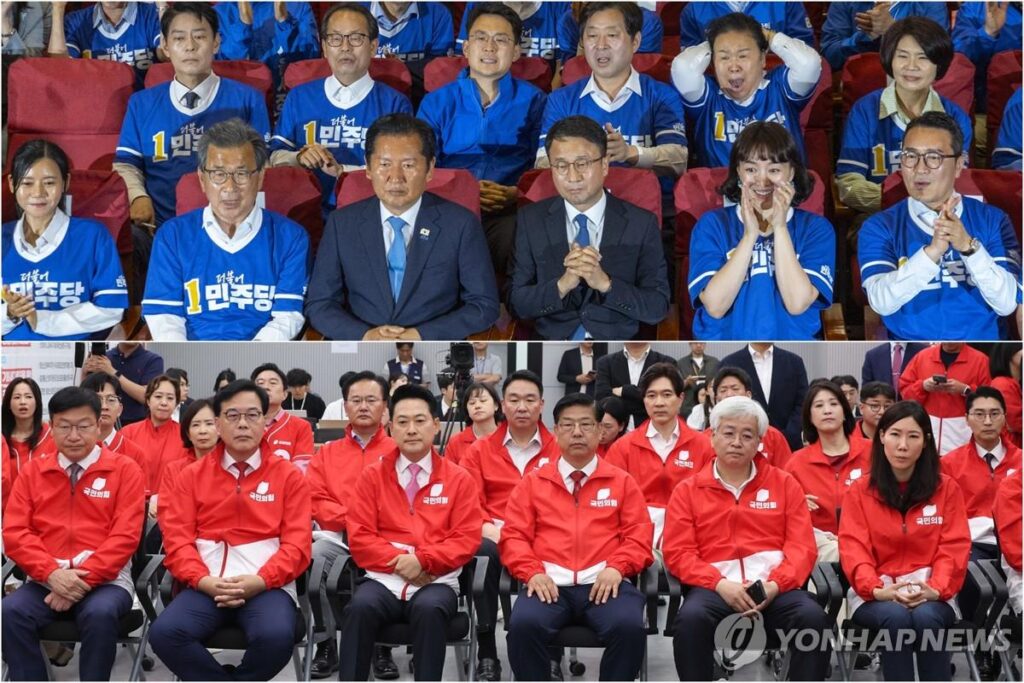
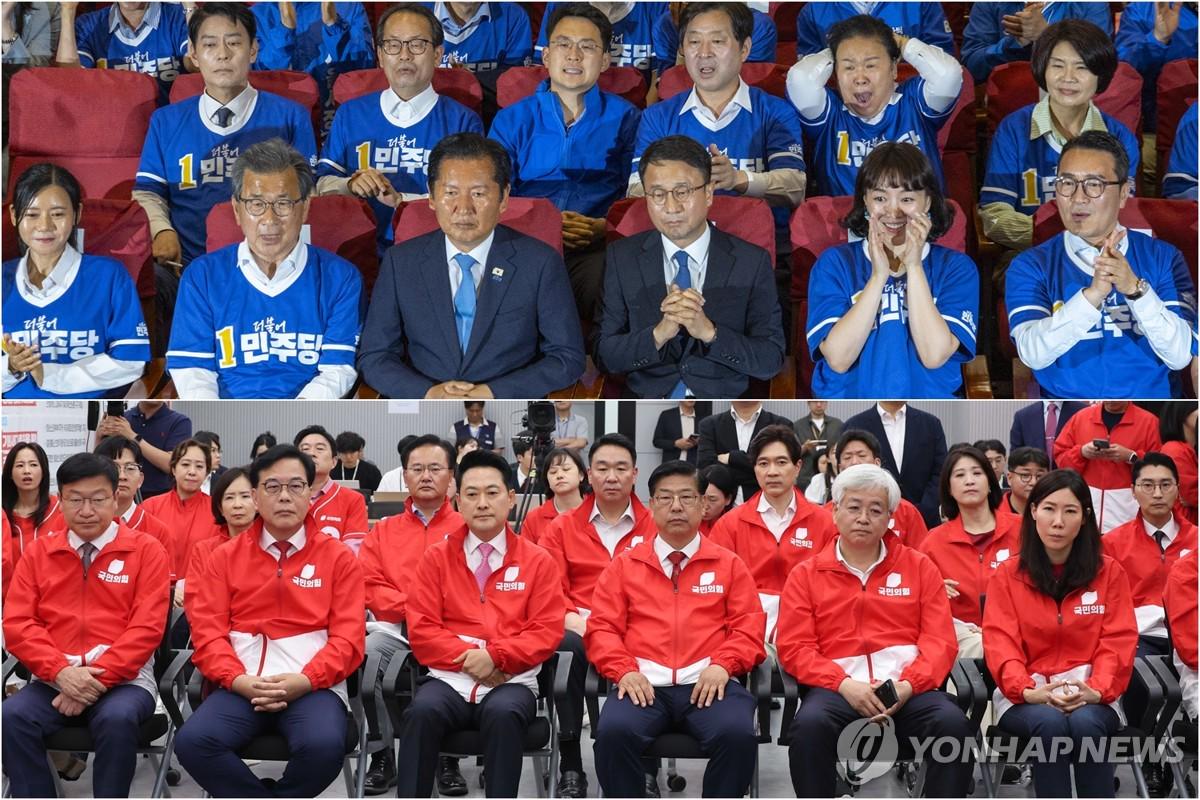
SEOUL, June 4 (Yonhap) — The ruling Democratic Party (DP) clinched a resounding victory in the local elections and parliamentary by-elections, winning the key mayoralty in the traditional conservative stronghold of Busan, while the main opposition party retained the Seoul mayoral seat.
The DP won 12 out of the 16 key mayoral and gubernatorial seats up for grabs, including in Busan where Jeon Jae-soo was elected mayor, while the main opposition People Power Party (PPP) took four seats, including Seoul, where incumbent Mayor Oh Se-hoon was elected to a fifth term, according to the final vote count.
Of the total 14 seats contested in the parliamentary by-elections, which were held concurrently with the local elections, the DP clinched nine, followed by the PPP with four seats, while the remaining seat was won by an independent.
Thirteen of the 14 parliamentary seats were previously held by the ruling party, but its loss of four seats was seen as a minor dent to its dominance in the 300-member National Assembly where it already controls a majority.
Wednesday's elections were held exactly one year after the Lee administration took office on June 4.
The victory for the ruling party is widely expected to solidify the government's mandate to push forward with its reform measures while dealing a blow to the embattled PPP as it struggles to rebuild conservative support following former President Yoon Suk Yeol's ouster.
The election outcome marked a sharp turnaround in voter sentiment from four years earlier, when the then ruling PPP had claimed 12 out of 17 major gubernatorial and mayoral positions in the last local elections. The 2022 local elections were held a month after Yoon took office.
In Gyeonggi Province, veteran DP lawmaker Choo Mi-ae won by a wide margin against the PPP's Yang Hyang-ja, becoming the country's first female head of a provincial government.
The capital region — home to roughly half of the country's population — is often considered a key, if not the most important, battleground.
In the southeastern city of Busan, DP candidate Jeon was declared the winner against the PPP's Park Heong-joon by a slim margin.
The results for the parliamentary by-elections marked sharply different political fates for two heavyweights — former PPP leader Han Dong-hoon and Cho Kuk, leader of the liberal Rebuilding Korea Party — with only Han, who ran as an independent, securing a seat in the National Assembly.
Cho, on the other hand, narrowly lost to Yu Eui-dong of the PPP in the closely watched race of the Pyeongtaek-B constituency, which also included Kim Yong-nam of the DP in a tight three-way competition.
The elections were widely seen as the first nationwide test for Lee, who was elected in a snap presidential election following the ouster of Yoon over his botched martial law bid in December 2024.
Throughout its election campaign, the DP had urged the public to make a stern judgment on what it called the "remnants" of Yoon's "insurrectionist forces."
Yoon was sentenced to life imprisonment by a district court in February for his failed martial law bid.
Also at stake in this year's local elections were 16 education superintendent seats, along with 227 heads of local governments and some 4,000 members of local councils.
In Seoul, the DP won 17 of the city's total 25 district chief posts, a solid improvement from the previous 2022 local elections, when the party secured only eight seats while the PPP captured the remaining 17 seats.
Of the 227 district chief posts nationwide, including those in Seoul, the DP won 119 seats while the PPP secured 95, with the remainder going to independents and a minor party.
This year's elections were partly marred by an unprecedented shortage of ballots at 14 polling stations in parts of Seoul, prompting the temporary suspension of voting there, with some voters said to have left without voting.
The PPP was quick to raise issues over poor election management, calling on the NEC to immediately stop the vote counting and hold a revote if necessary.
Voting took place from 6 a.m. to 6 p.m. at 14,288 polling centers nationwide, with the exception of one of the affected polling stations in Songpa Ward, which extended the voting hours to 10 p.m.
https://en.yna.co.kr/view/AEN20260602008360315?section=national/politics
Posted by coinfwip4
2 Comments
To be honest, most people in Korea will judge that the DP lost the election because they lost Seoul.
Both sides lost the election. There was no real winner, and the leadership of both parties is likely to face judgment from within. The most important point is that winning candidates from both the left and the right stated that the results were not a victory for their respective party leaderships. While they could not openly challenge their leaders due to the leadership’s considerable influence, many implicitly expressed a desire to see the current leadership held accountable.
The left entered the election from a highly advantageous position. The most important factor in this election was the president’s approval rating, which was relatively high at the outset. As a result, the left became overly confident. Many within the party appeared to assume that victory was already secured and repeatedly relied on ineffective campaign strategies. Furthermore, pushing controversial legislation and organizing contentious political activities even shortly before the election reflected a degree of arrogance. At the same time, warning signs were dismissed as false or insignificant.
Although the expansion of welfare programs generally benefits the Democratic Party politically, the elected mayor of Seoul is a conservative who has also implemented a variety of welfare policies. While the Democrats won in the aggregate vote, they lost in Seoul, the nation’s capital. Another significant result was that approximately 80% of men in their twenties supported conservative candidates.
The right, by contrast, began the election from a highly disadvantaged position. The party leader belonged to the “Yoon Again” faction, which defended a former president facing charges related to an attempted imposition of martial law and alleged insurrection. He referred critics of his leadership to the party’s ethics committee and sought disciplinary action against them. In effect, he devoted substantial effort to marginalizing moderate conservatives within the party.
The figures who succeeded on the right were the mayor of Seoul and one of the politicians who had been pushed out by the party leadership. Both were widely viewed as symbols of moderate conservatism. Notably, they were among those who openly criticized the party leader and even told him not to participate in their campaign events. The fact that the only successful conservative candidates were those who opposed the party leadership suggests that internal conflict within the conservative camp is likely to intensify.
However, moderate conservatives have already lost the internal power struggle within the party and were largely sidelined. Although they may attempt to regain influence, doing so will be extremely difficult. As a result, the internal battle for control of the conservative movement is likely to become even more severe. The Mayor of Seoul secured a narrow victory by capitalizing on the Democratic Party’s perceived reluctance toward redevelopment and by addressing welfare concerns that had played a significant role in his defeat a long time ago.
Finally, the fact that a majority of voters have consistently chosen left-wing parties in parliamentary elections represents a serious long-term problem for the right. Even when conservatives achieve success in individual races, their broader difficulty in winning sustained national legislative support remains unresolved.