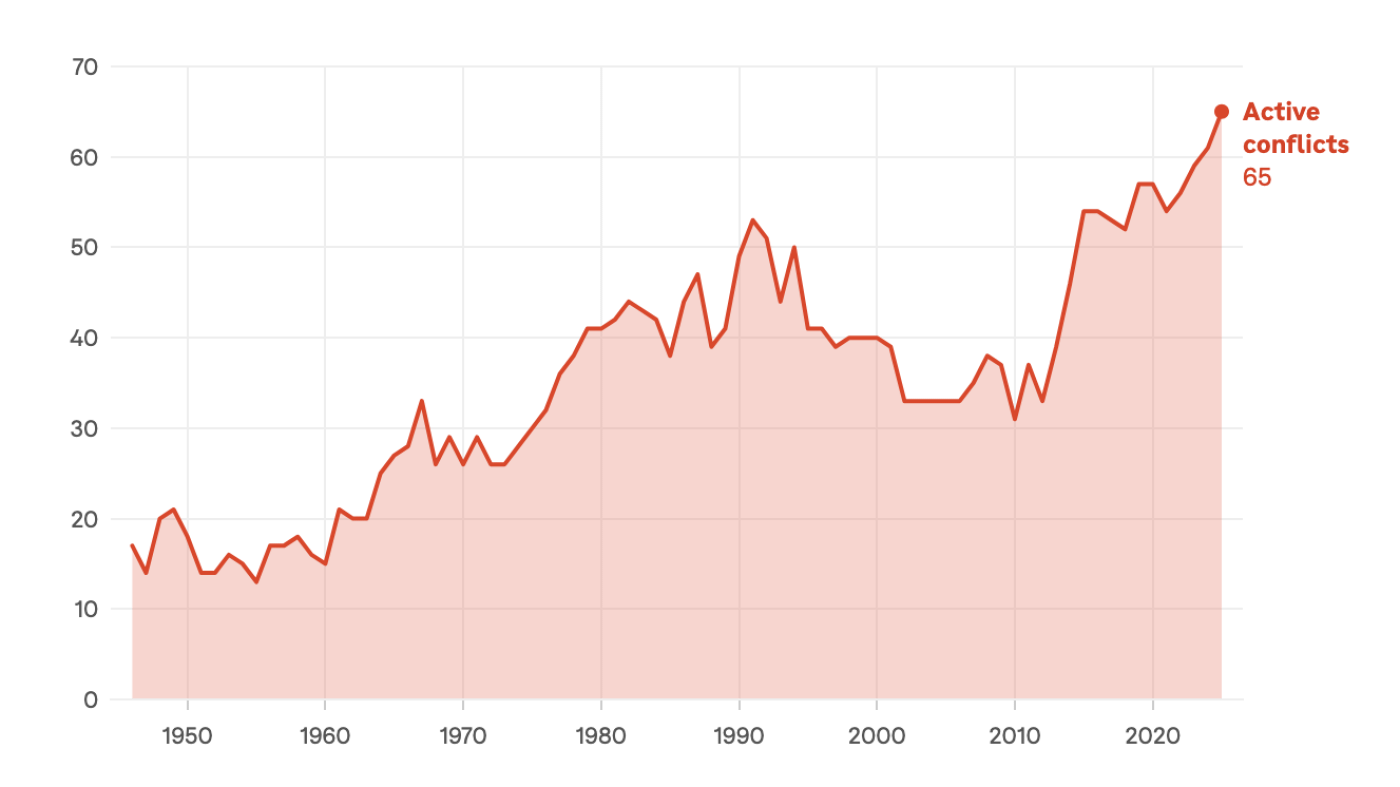
Conflicts on rise globally, highest level since WWII, data shows | Organized violence 1989–2025, and violent political protests
https://www.npr.org/2026/06/09/nx-s1-5850355/data-highest-conflicts-iran-israel-ukraine-russia-world-war-ii

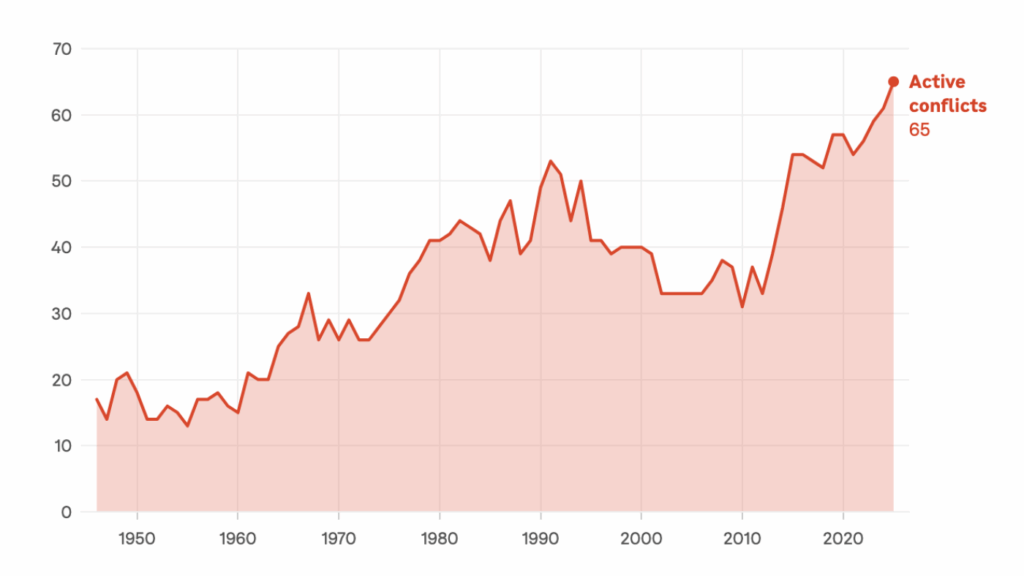
Conflicts on rise globally, highest level since WWII, data shows | Organized violence 1989–2025, and violent political protests
https://www.npr.org/2026/06/09/nx-s1-5850355/data-highest-conflicts-iran-israel-ukraine-russia-world-war-ii
9 Comments
Article details:
>A new study by researchers at a university in Sweden recorded the highest number of conflicts between states in 2025 since World War II, and the highest number of fatalities recorded since the Rwandan genocide.
>
>There were 65 active conflicts in 2025, according to researchers at the Uppsala Conflict Data Program (UCDP) at Uppsala University, regarded as a leading source of information on violence worldwide.
>
>Out of that total, the number of direct conflicts between individual states doubled from the previous year to eight in 2025 — the highest number of such conflicts since UCDP began collecting data in 1946.
>
>…
>
>”We are seeing a clear increase in conflicts between states. For a long time, interstate wars were relatively rare, but developments in recent years point to growing international tensions and a changing global security order,” said Shawn Davies, a senior analyst at UCDP.
>
>…
>
>The researchers break down the data into several categories. One is “state-based violence,” which includes both internal, civil wars and “interstate wars,” meaning wars between nations. Either way this grouping means one or both parties to a conflict are a government: for example Ukraine, Sudan and Gaza.
>
>Then there is “non-state violence,” which encompasses clashes between two groups, neither of which is a state: for example sectarian fighting in Pakistan or cartel violence in Mexico.
>
>A third category is “one-sided violence,” which targets civilians, for example last year’s government crackdowns on protests in Tanzania or rebel group attacks on civilians in the Democratic Republic of Congo.
>
>Of last year’s 65 conflicts, 13 of them rose to the level of war — as defined by over 1,000 battlefield deaths a year.
>
>…
>
>Whatever the causes, 2026 doesn’t look like it will be any more peaceful than last year, the researchers warn. Data this year so far shows the rise in conflicts globally is a trend that’s likely to continue.
—
Link to research:
[Organized violence 1989–2025, and violent political protests](https://academic.oup.com/jpr/advance-article/doi/10.1093/jopres/xjag046/8703754)
Abstract:
>This article examines global trends in organized violence from 1989 to 2025 using new data from the Uppsala Conflict Data Program (UCDP). In 2025, fatalities increased sharply to 244,600, up from approximately 187,000 in 2024. This marked a significant rise, with one-sided violence seeing a fivefold increase, largely driven by large-scale violence against civilians in Sudan, resulting in the highest fatality levels since the Rwandan genocide in 1994. The number of state-based conflicts reached a record high of 65, with interstate conflicts doubling for the second consecutive year, highlighting an increasing trend in international tensions. State-based fatalities, though slightly lower than in previous years, remained high at 153,600, reflecting the intensity of ongoing armed conflicts, particularly in Ukraine, Israel, and Sudan. Non-state violence, on the other hand, continued its decline, with fatalities dropping to their lowest level since 2013. These developments take place in a broader context of mass mobilization, where some events escalate into violence or are met with repression, sometimes overlapping with patterns of organized violence. To capture this dynamic, the article also presents updated data on violent political protests, an established but intermittently published UCDP category, extended here to 2025.
Born too late for WW2, born just in time for WW3 D:
Interesting. Historically, the world has been at peace in times of economic prosperity. People don’t fight when they are happy.
There’s no money in peace.
Property damage is not violence.
This is fairly predictable given historical patterns around “Great Power” dynamics and rising/declining relative geopolitical dominance.
The cold war, while incredibly dangerous, was nonetheless relatively stable given the dominance of the two power blocs (USA/NATO vs USSR/Eastern Bloc) and desire by both to limit any serious conflict.
The 20ish years after the end of the cold war saw russia greatly diminished, china not yet feeling it’s economic/military power fully, and the US in a position of unquestioned supremacy militarily.
Now, things are in flux, the global order is shifting and uncertain, the US is no long the unquestionable hegemon, china is rising and offers true peer level competition, middle powers are playing one side against the other while jockeying for advantage against their neighbors.
It’s unstable, it’s unpredictable, and that leads to actions by smaller players that would have been unthinkable in a world where the United Global Order (read: US power bloc) could annihilate you in an afternoon if you misbehaved too badly.
> Fatalities were the highest on record since 1994, with approximately 244,600 people killed in conflict in 2025, the data shows. That’s up from 187,000 deaths in 2024.
This doesn’t make sense to me. The second congo war ran between 1998 and 2003 and killed ~6 million people
Granted most of these are excess deaths rather than from direct conflict, but I would expect that to be included for casualties of war?
I honestly think the main reason wars havent broken out earlier is only because western countries know men are not buying the narratives anymore. Majority are not willing to put their lives on the line for corporations and greed.
If you think youre not winning a war, youre probably not gonna fight.
Yup Color of Change is at it globally.