
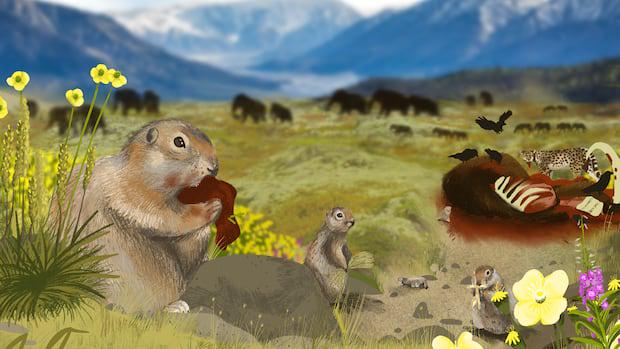
Animal, plant, fungal DNA in squirrel latrine paints picture of Arctic grasslands in Age of Mammoths | Ground squirrel coprolites preserve complex archives of ancient environmental DNA over 700,000 years
https://www.cbc.ca/news/science/frozen-squirrel-poop-9.7230087
1 Comment
Sections of interest from the news article:
>Scientists have reconstructed genomes of woolly mammoths, horses, steppe bison and ground squirrels that roamed the grasslands of the Canadian Arctic during the last ice age using DNA found in frozen squirrel poop from the Yukon.
>
>In fact, the fossil (though not turned to stone) feces or coprolites were full of DNA from animals, including wolves, predatory cats, mammoths, horses, birds, bats, grasshoppers and parasitic worms and 200 kinds of plants ranging from sages to sedges, reports the new study published Tuesday in Nature Communications.
>
>”We were able to really kind of capture the whole ecosystem from megafauna and plants, fungi and insects and a whole variety of microbes,” said Tyler Murchie, a scientist at the Hakai Institute in Campbell River, B.C., and lead author of the new study.
>
>…
>
>At first, he was surprised by the amount of mammoth and horse DNA in the squirrel poop, but little research revealed that even modern squirrels will eat just about anything, from nuts to roadkill to smaller rodents, and clearly their prehistoric cousins weren’t picky.
>
>”If there happened to be nuts and seeds and their favorite plants, that was great. If there happened to be a dead mammoth over there or a dead horse or whatever else, they ate that. Or if there happened to be some poop of a horse over there, they ate that.”
>
>…
>
>Overall, the study showed that the kinds of plants and animals found on the dry mammoth steppe grasslands in eastern Beringia were relatively stable over 700,000 years, during the Pleistocene epoch — but completely different from plants and animals found in the wetter boreal forest ecosystem of of the area today.
>
>The researchers verified this by looking at the DNA found in a snowshoe hare coprolite from our current Holocene epoch, which included trees such as spruce and alder and none of the big mammals found in the ground squirrel poop.
>
>Murchie said studying the way ecosystems evolved with climatic changes like this in the past could help scientists figure out what will happen to animals living in the Arctic as the climate changes today.
>
>But climate change also means scientists are running out of time to preserve these ancient archives — one site where researchers collected squirrel poop for this study has now thawed, slumped and washed into the river, Murchie said. “These sites are thawing so fast.”
>
>…
>
>Prof. Kurt Kjær is a researcher at the University of Copenhagen who previously used DNA in sediments to paint a picture of a two-million-year-old ecosystem in Greenland, full of mastodons, reindeer, geese, poplar, birch and thuja trees.
>
>He said in an email that a decade ago, coprolites were considered an unlikely source of DNA. He thinks it’s exciting that some much information can now come from them.
>
>”Who would have imagined that ground squirrel droppings preserved in Yukon permafrost could provide such detailed insights into ecosystems and evolutionary history stretching back hundreds of thousands of years? It is both scientifically important and genuinely fascinating.”
—
Link to research: [Ground squirrel coprolites preserve complex archives of ancient environmental DNA over 700,000 years](https://www.nature.com/articles/s41467-026-72977-6)
Abstract:
>Permafrost-preserved ground squirrel (Urocitellus) burrows in Yukon, Canada contain coprolites (palaeofaeces) that span from the Holocene to at least the Middle Pleistocene (~700 kya). Using shotgun metagenomics and targeted enrichment, we recover a rich, multi-taxon spectrum of ancient environmental DNA from these pellets, including: plants, insects, microbes, and megafauna consistent with eastern Beringian ecosystems. These coprolites consistently preserve an abundance of eukaryotic DNA, enabling the assembly of >18 mitochondrial genomes (ground squirrel, snowshoe hare, steppe bison, horse, and mammoth), and revealing previously unrecognized diversity within Arctic Urocitellus, including a ~700 kya lineage that predates divergence among several extant clades. Characteristic damage patterns, positive/negative controls, and in silico taxon validations strongly support aDNA authenticity, and comparisons with regional permafrost datasets indicate minimal post-depositional leaching. These results show that permafrost coprolites can yield high-resolution records of Quaternary ecosystems and multi-organism population histories, providing a powerful complement to sedimentary and skeletal ancient DNA.