Decades of stagnation will do that. But I also think the US is misleading here due to the vast wealth inequality. The average person prob had an experience like someone in Japan.
redsterXVI on
Notably, 1995 is already after the Japanese economic bubble burst.
DM_Me_Your_aaBoobs on
Is this ppp data? Otherwise this graph is just wrong.
[deleted] on
[deleted]
Spice_and_Fox on
I don’t think that it is a fair comparison. Japan wants to keep yen stable and it is one of the few currencies that don’t have inflation. 100 yen in 1995 is worth 101 yen now. A $100 in 1995 is worth $220 now. Yeah, there are problems with the japanese economy, but this graph is pretty misleading
isweartogodchris on
A comparison like this should always be in real dollars.
joan_bdm on
🥱 Economy
🤓 Economy, Japan
jake6501 on
How exactly is the EU numbers counted? There has been a lot of change in member nations within this period, so it’s not really comparable in this way.
acdgf on
OP what does “current US dollars” mean? Is it 2026 USD for both 2025 and 1995 entries? Or 1995 USD in 1995 and 2025 USD in 2025?
32lib on
Nominal doesn’t give much usable information.
slowmoE30 on
If Japan has figured out how to live a life that is not dependent on infinite growth, they might be way ahead of us.
ShampooChii on
I mean quality of life in Japan is pretty good so what does that tell you about GDP measure and growth.
bambarby on
Somehow Japan is a billion times better than anybody in standard of living
rebornultra on
I think GDP being used everywhere is lowkey American propaganda since they have the highest GDP, but how does this actually translate to people’s lives? Would Americans say their life quality has 3x’d since 1995, or would Europeans say theirs 2.5x’d? If GDP isn’t a measure of quality of life then what does it measure and how does it actually impact the people. Whats the point of this metric if you’re middle class?
Riptide360 on
Japan finally got cheap enough for tourism to take off. Sad we don’t get so many Japanese tourists here anymore.
tripping_on_phonics on
By using nominal GDP you’re showcasing exchange rate fluctuations, not changes in the areas that we typically associate with GDP per capita (economic prosperity, human development, etc.).
Edit: Japan in particular had a very strong currency during its “lost decades”, in which it had near-zero or subzero interest rates, with either near-zero inflation or deflation.
Alzucard on
This is bad comparison. Japan has a very different approach to these type of stuff. Same for the EU actually, but less.
Also GDP Comparisons are nonsense.
luke-ms on
If this is not adjusted to inflation it really doesn’t mean much, specially when it comes to Japan.
Very mild inflation and deflation periods throughout the past 30 years means that 100 yen in 1995 and 100 yen today have almost the same purchasing power.
Brilliant_Salad7863 on
It’s funny to see how many people on Reddit really don’t like America and want to make it seem like everywhere else is doing better than they actually are. It also shows deep lack of understanding probably due to lack of living anywhere else besides America so the grass must be greener on the other side, but it isn’t. I don’t care how you measure the economics, in essentially every metric America is ahead.
Medical-Potato5920 on
What proportion of Japan’s population is above 65 and retired? I’d think it was a lot higher in 2025 than 1995.
ClaroStar on
Yet, the US homeless population just grows and grows. Go figure.
yue665 on
Gdp is a terrible measurement of quality of life if you have any clue what it represents
grhhull on
Anyone else bored of tedious GDP posts? Can we ban them, or at least limit them to a Wednesday only or something?
Discobastard on
But in ‘Murrrica you all work twice as long with no holidays so it’s not a fair and true comparison 😂
discussatron on
What do we attribute the US’ current position to? AI bubble?
skildert on
Guess I need to up my spending when in Japan.
alkrk on
The US has been taming the Japanese economy for the past 4 decades since early 80s. Diversified semiconductor building countries, robotics, engineering firms etc. It’s doing it to other countries atm. The Japanese economy also built resilience during the time but not recovering as much.
Method__Man on
I see that we still obsessed more about economy and GDP then actual quality of life, healthcare access, education, etc. That’s why the usa will always be behind
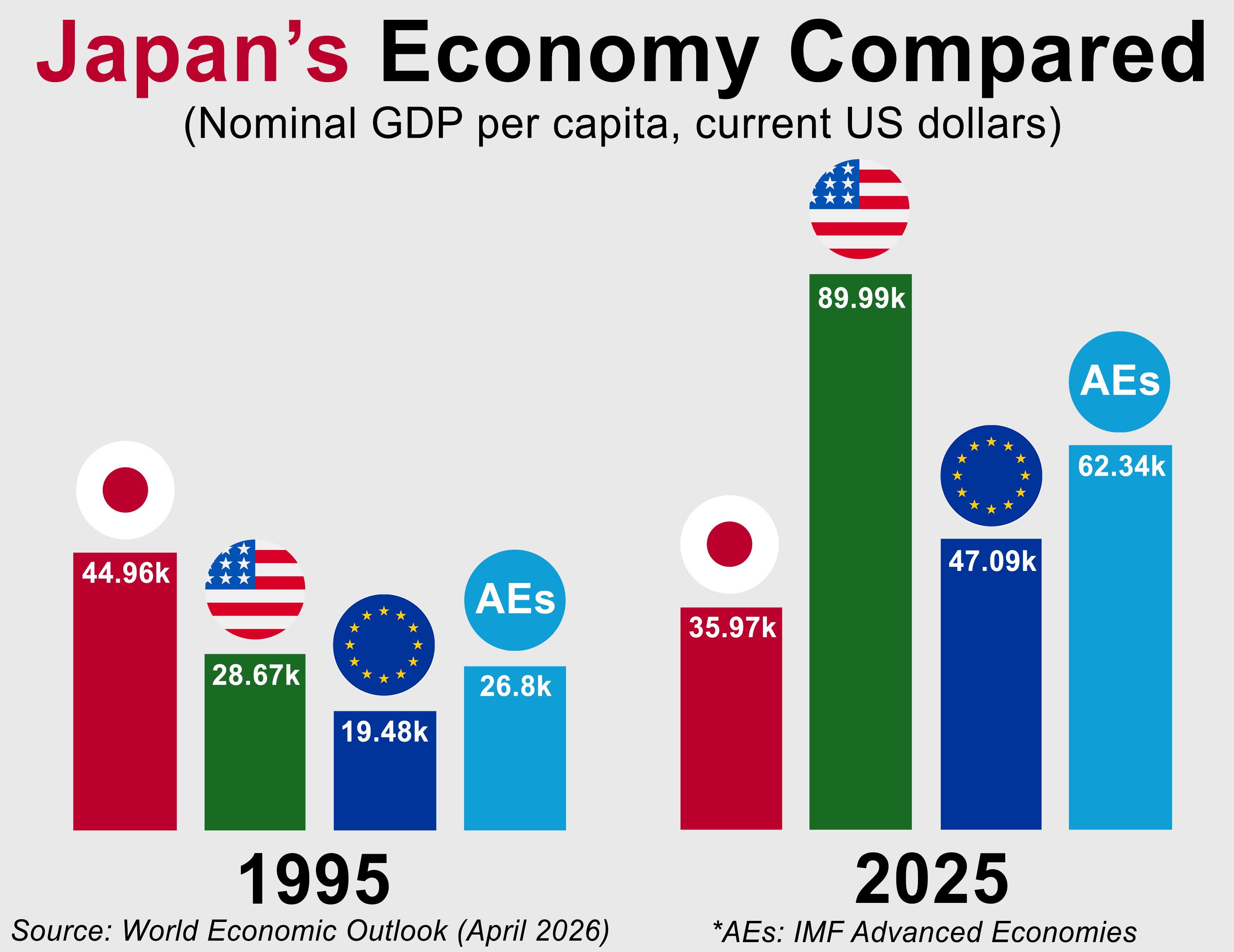

![[OC] Japan's Economy Compared, 1995 vs 2025](https://www.byteseu.com/wp-content/uploads/2026/07/cg3q1kz93efh1-1536x1186.png "[OC] Japan’s Economy Compared, 1995 vs 2025")
28 Comments
Decades of stagnation will do that. But I also think the US is misleading here due to the vast wealth inequality. The average person prob had an experience like someone in Japan.
Notably, 1995 is already after the Japanese economic bubble burst.
Is this ppp data? Otherwise this graph is just wrong.
[deleted]
I don’t think that it is a fair comparison. Japan wants to keep yen stable and it is one of the few currencies that don’t have inflation. 100 yen in 1995 is worth 101 yen now. A $100 in 1995 is worth $220 now. Yeah, there are problems with the japanese economy, but this graph is pretty misleading
A comparison like this should always be in real dollars.
🥱 Economy
🤓 Economy, Japan
How exactly is the EU numbers counted? There has been a lot of change in member nations within this period, so it’s not really comparable in this way.
OP what does “current US dollars” mean? Is it 2026 USD for both 2025 and 1995 entries? Or 1995 USD in 1995 and 2025 USD in 2025?
Nominal doesn’t give much usable information.
If Japan has figured out how to live a life that is not dependent on infinite growth, they might be way ahead of us.
I mean quality of life in Japan is pretty good so what does that tell you about GDP measure and growth.
Somehow Japan is a billion times better than anybody in standard of living
I think GDP being used everywhere is lowkey American propaganda since they have the highest GDP, but how does this actually translate to people’s lives? Would Americans say their life quality has 3x’d since 1995, or would Europeans say theirs 2.5x’d? If GDP isn’t a measure of quality of life then what does it measure and how does it actually impact the people. Whats the point of this metric if you’re middle class?
Japan finally got cheap enough for tourism to take off. Sad we don’t get so many Japanese tourists here anymore.
By using nominal GDP you’re showcasing exchange rate fluctuations, not changes in the areas that we typically associate with GDP per capita (economic prosperity, human development, etc.).
Edit: Japan in particular had a very strong currency during its “lost decades”, in which it had near-zero or subzero interest rates, with either near-zero inflation or deflation.
This is bad comparison. Japan has a very different approach to these type of stuff. Same for the EU actually, but less.
Also GDP Comparisons are nonsense.
If this is not adjusted to inflation it really doesn’t mean much, specially when it comes to Japan.
Very mild inflation and deflation periods throughout the past 30 years means that 100 yen in 1995 and 100 yen today have almost the same purchasing power.
It’s funny to see how many people on Reddit really don’t like America and want to make it seem like everywhere else is doing better than they actually are. It also shows deep lack of understanding probably due to lack of living anywhere else besides America so the grass must be greener on the other side, but it isn’t. I don’t care how you measure the economics, in essentially every metric America is ahead.
What proportion of Japan’s population is above 65 and retired? I’d think it was a lot higher in 2025 than 1995.
Yet, the US homeless population just grows and grows. Go figure.
Gdp is a terrible measurement of quality of life if you have any clue what it represents
Anyone else bored of tedious GDP posts? Can we ban them, or at least limit them to a Wednesday only or something?
But in ‘Murrrica you all work twice as long with no holidays so it’s not a fair and true comparison 😂
What do we attribute the US’ current position to? AI bubble?
Guess I need to up my spending when in Japan.
The US has been taming the Japanese economy for the past 4 decades since early 80s. Diversified semiconductor building countries, robotics, engineering firms etc. It’s doing it to other countries atm. The Japanese economy also built resilience during the time but not recovering as much.
I see that we still obsessed more about economy and GDP then actual quality of life, healthcare access, education, etc. That’s why the usa will always be behind