
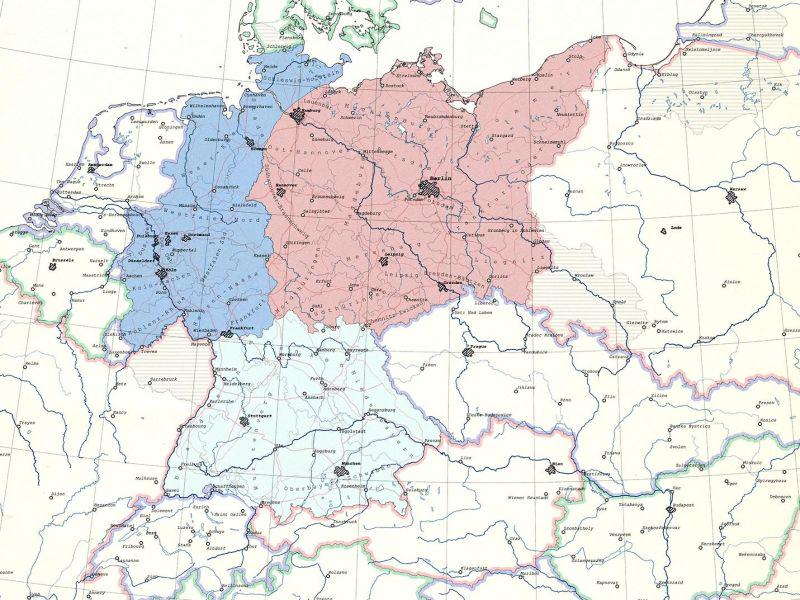
- Deindustrialization: The dismantling or destruction of Germany’s heavy industry, especially coal, steel, and chemical facilities in regions such as the Ruhr and Saar.
- Territorial fragmentation: The division of Germany into several independent states, with some territories transferred to neighboring countries such as France and Poland.
- Economic decline: Reducing Germany to an economy based mainly on agriculture, ensuring that it could never rebuild a military-industrial capacity capable of supporting another war.
- Goal: To permanently prevent Germany from possessing the industrial and military potential to start another major conflict.
The plan was provisionally accepted by Churchill and Roosevelt at the Quebec Conference in September 1944. However, when details of the proposal leaked to the public, it caused major controversy. Critics in the United States and among the Allies argued that the plan would condemn millions of Germans to poverty and hunger, while also damaging Europe’s economic recovery and, consequently, American export markets. Some observers also feared that such a harsh policy could create conditions for a new extremist movement, similar to the resentment created by the Treaty of Versailles after World War I.
As a result, the plan was never fully implemented. After Roosevelt’s death, the Truman administration moved away from this approach. By 1947, the Marshall Plan adopted a completely different strategy, supporting the reconstruction and reindustrialization of Germany and Western Europe as a whole. This also aligned with the emerging Cold War strategy of turning Germany into a strong ally against communism.
Posted by Battlefleet_Sol
15 Comments
Many people don’t realise the level of hatred and revenge against Germany that existed at the end of WW2. There were many other terrible plans to wipe out Germany from the face of the Earth or turn it into a Holy Roman Empire 2.0 with separate identities.
Thankfully rational minds prevailed.
XD
Honestly I don’t think it would’ve been viable later in the war anyways, because all the major powers knew the Cold War was coming and Germany would be the frontline.
It was never “almost accepted”.
It would have backfired so badly. Germany would then have had a fertility rate like in agrarian societies and 80 years later there would be 200-300 million Germans demographically dominating Europe. And most likely the ‘no industry’ rule would have needed to be dropped anyway since the united nations pushed for de-colonialization after world war II and such a rule could hardly be reconciled with a free nation. So a much larger and definetily non-western aligned German nation would have been industrializing quickly while already dominating Europe demographically.
Booooo low effort AI slop boooo 🍅
Starting the next war in 3… 2… 1…
The good ending /s
they really asked themselves how do we make nazism even worst, nothing more than a magnum opus of the punitivism ingrained in protestant society
The self inflicted de industrialization is happening today in Germany planned and executed by German politicians.
Ah, yes, the dreadful Morgenthau Plan. Courtesy of Mr. Harry Dexter White playing behind the scenes, himself being heavily suspected of being a Soviet agent. This wasn’t simply revanchism, it had a clear purpose.
Well, the industry in Germany is currently going down… so this might still happen.
„Marshall Plan“ did not help Eastern Germany sowjet zone. Everything was dismantled (machines, rails) and moved to Russia for reparations.
Personally i would have love it. living in a medieval village so american tourists can take pictures with me in my traditonal fisherman attire. and ofc we would be the model nation on how to counter climate crisis.
Looking at a map, ironically despite being in every other respect far harsher to Germany it was actually slightly more generous to Germany on her eastern borders than the actual eventual borders.