Yuriy survived the attack, but suffered concussion and shrapnel wounds. “I only just put up the umbrella and started unloading the boxes,” he said in an interview from hospital released by Ukrainian officials. “My wife was there, too. Then we heard it buzzing.” His wife managed to run to safety.
In an [interview with a journalist in Kherson](https://x.com/ZarinaZabrisky/status/2084633284621836694?s=20), Yuriy said: “I don’t know where the drone came from. It flew out from behind the market. I had no phone, nothing. Two garlic cloves. I got up and I started asking [it], ‘can you see? It’s garlic, that’s all!’ It started chasing me.”
Andrii Sybiha, Ukraine’s foreign minister, said the “barbaric Russian war crime” had occurred on Tuesday. The video has been geolocated to Kherson.
The sight of a drone hunting an unarmed civilian has prompted outrage in [Ukraine](https://inews.co.uk/topic/ukraine?ico=in-line_link) and beyond. The operator of an FPV drone is able to watch a live camera feed from the drone – the Russian soldier would have known who it was targeting.
“A Russian drone deliberately hunted down a man selling vegetables and detonated right next to him,” said Ukrainian President, [Volodymyr Zelensky](https://inews.co.uk/topic/volodymyr-zelensky?ico=in-line_link). “The Russians even admitted to the crime, showing zero regret and openly boasting about tormenting people.
“The world must see this. It must see every piece of evidence that Russia has gone mad and that its soldiers take pleasure in killing and abusing civilians.”
While soldiers were seen crowing over the attack on social media, Russia’s defence ministry did not immediately respond to requests for comment.
# Russia revels in ‘human safari’
The attack was the latest in Russia’s years-long “human safari” campaign, in which operators send FPV drones into Ukrainian cities to inflict terror and reportedly test their skills on civilians, hunting them down before dropping explosives or hurtling into them.
In the first six months of this year, the [UN documented](https://ukraine.ohchr.org/en/Protection-of-Civilians-in-Armed-Conflict-June-2026) 1,396 civilians killed in Ukraine – 37 per cent more than the same period last year. At least 293 were killed in June, the highest number of civilians killed and injured since April 2022. The rise was down to missile strikes and long-range drones targeting cities far from the front lines. FPV drones are one of the biggest threats to civilians in Kherson, along with glide bombs, artillery and long-range strike drones.
Kherson city, which was liberated from a brutal Russian occupation in November 2022, has borne the [brunt of Moscow’s safari attacks](https://inews.co.uk/news/russias-meat-grinder-attacks-are-suicide-missions-what-happens-to-refusers-3566734?ico=in-line_link). The city and surrounding areas are well within range of drones launched from the opposite bank of the Dnipro River, where Russia still controls territory. Signs warn citizens of the drone danger, while anti-drone netting is suspended over major roads.
“Since the summer of 2024, Russia has dramatically intensified its campaign of drone terror,” Oleksandr Tolokonnikov, deputy head of the Kherson regional military administration, said in a statement to *The i Paper*.
“The enemy deliberately targets pensioners walking to the market, children playing outside, people riding bicycles, civilian vehicles, public transport and ambulances rushing to emergencies. The occupiers themselves refer to these war crimes as ‘safari’. They openly post videos on social media showing the hunting of civilians and mock their victims.
“Last month alone, Russian drones killed 26 people in the Kherson region. Overall, nearly 80 per cent of all civilian casualties in July were caused by Russian drone attacks.”
# Safari is just part of Russian terror
Olha Polishchuk, a research manager at the armed conflict monitor ACLED, pointed out that despite the shocking nature of the video, extreme violence against the Ukrainian population was not rare.
“Graphic videos like this sometimes go viral, but targeted violence against civilians and other non-combatants is very common, though much of it remains invisible,” she told *The i Paper*. “This includes not only the ‘human safari’ with FPV drones, but also executions of civilians and surrendering soldiers, abductions and torture of civilians in occupied areas, and long-range attacks on population centres.
“Causing terror among the civilian population is one tool used to compel Ukraine to give up the fight and accept Russia’s demands.”
In May 2025, the [UN’s Independent International Commission of Inquiry on Ukraine](https://www.ohchr.org/sites/default/files/documents/hrbodies/hrcouncil/coiukraine/a-hrc-59-crp2-en.pdf) determined that Russia was engaged in the deliberate targeting of civilians in Kherson city and across 16 localities in southern Ukraine. Drone attacks were “widespread, systematic, and conducted as part of a co-ordinated state policy”, it said.
A woman from the Kherson suburb of Antonivka told the commission her husband, 67, had been killed by a drone barely 100 metres from their home. “I stayed with my husband’s body from 9.30am until 4pm, where he was killed. He was lying face down with a hole to his head,” she said. At least twice in that time, she said, she had to shelter from other nearby drones.
Russian Telegram channels routinely post video game-style footage of the attacks, often accompanied by background music and captioned with murderous threats. Many of the videos are from the FPV drones, and therefore appear to be provided by the military units perpetrating the attacks or people close to them, the UN said.
Russia positions itself above the agreed-upon rules of international law, said Polishchuk, and does not punish its soldiers when they violate the laws of war, “tacitly or explicitly encouraging such violations at the level of individual soldiers or military units”.
In an environment like the Russian military’s, where effectiveness and brutality are rewarded, “it can bring out the worst in both those willing and unwilling to commit atrocities”, she said.
“The logistics of the drone operation also play a role. Drone operators must dodge significant interference and find a target before the drone’s battery runs out. It appears many choose to strike anything they encounter, even if it is a civilian target, rather than losing the weapon – likely under the military leadership’s encouragement.”
However, Polishchuk cautioned: “Russia’s brutality against civilians in Ukraine persisted through all stages of the war, even when Russia had the momentum.
“So while Russia does retaliate, Ukraine’s caution and restraint do not meaningfully protect civilians from Russian attacks.”
UskyldigeX on
This has been going on for years.
YuzbasiPusat on
Could be revenge on alot of civilians being targeted in Russia nowadays
1HappyIsland on
What does it take for the world to realize this has to end? Maybe this is it.
Luv2022Understanding on
No, I’m telling you, russia has been targeting civilians like this since the war started. They’d run and try to hide behind trees or in buildings but when the drone dropped its grenades or whatever it was armed with, they really had little chance because the shrapnel would scatter and hit them.

6 Comments
Full article: A viral video of a Ukrainian street vendor being hunted by [drone](https://inews.co.uk/topic/drones?ico=in-line_link) in what has been dubbed [Russia’s](https://inews.co.uk/topic/russia?ico=in-line_link) “human safari” has sparked a firestorm of revulsion.
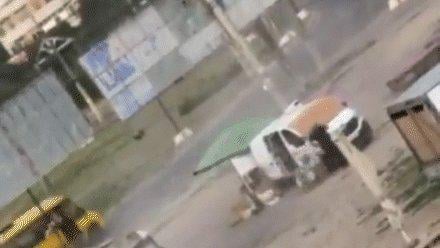
The footage released by Ukrainian police shows a man identified by authorities as Yuriy, a vegetable seller in the [southern city of Kherson](https://inews.co.uk/news/world/battle-for-kherson-ukraine-fallujah-another-case-mind-games-1935777?ico=in-line_link). The 52-year-old spots a [Russian first-person-view (FPV) drone](https://inews.co.uk/news/world/russia-advantage-first-person-drones-ukraine-catch-up-2769987?ico=in-line_link) buzzing overhead and runs to hide behind his van. The drone flies after him, chasing him around the vehicle, before diving at him and exploding.
The calculated attack is the latest example of a [campaign of terror](https://inews.co.uk/news/russia-ukraine-war-mines-rags-disguise-4424588?ico=in-line_link) that has drawn condemnation, during a [conflict](https://inews.co.uk/topic/russia-ukraine-war?ico=in-line_link) in which Russia regularly commits [war crimes](https://inews.co.uk/topic/war-crimes?ico=in-line_link) against civilians.
Yuriy survived the attack, but suffered concussion and shrapnel wounds. “I only just put up the umbrella and started unloading the boxes,” he said in an interview from hospital released by Ukrainian officials. “My wife was there, too. Then we heard it buzzing.” His wife managed to run to safety.
In an [interview with a journalist in Kherson](https://x.com/ZarinaZabrisky/status/2084633284621836694?s=20), Yuriy said: “I don’t know where the drone came from. It flew out from behind the market. I had no phone, nothing. Two garlic cloves. I got up and I started asking [it], ‘can you see? It’s garlic, that’s all!’ It started chasing me.”
Andrii Sybiha, Ukraine’s foreign minister, said the “barbaric Russian war crime” had occurred on Tuesday. The video has been geolocated to Kherson.
The sight of a drone hunting an unarmed civilian has prompted outrage in [Ukraine](https://inews.co.uk/topic/ukraine?ico=in-line_link) and beyond. The operator of an FPV drone is able to watch a live camera feed from the drone – the Russian soldier would have known who it was targeting.
“A Russian drone deliberately hunted down a man selling vegetables and detonated right next to him,” said Ukrainian President, [Volodymyr Zelensky](https://inews.co.uk/topic/volodymyr-zelensky?ico=in-line_link). “The Russians even admitted to the crime, showing zero regret and openly boasting about tormenting people.
“The world must see this. It must see every piece of evidence that Russia has gone mad and that its soldiers take pleasure in killing and abusing civilians.”
While soldiers were seen crowing over the attack on social media, Russia’s defence ministry did not immediately respond to requests for comment.
# Russia revels in ‘human safari’
The attack was the latest in Russia’s years-long “human safari” campaign, in which operators send FPV drones into Ukrainian cities to inflict terror and reportedly test their skills on civilians, hunting them down before dropping explosives or hurtling into them.
In the first six months of this year, the [UN documented](https://ukraine.ohchr.org/en/Protection-of-Civilians-in-Armed-Conflict-June-2026) 1,396 civilians killed in Ukraine – 37 per cent more than the same period last year. At least 293 were killed in June, the highest number of civilians killed and injured since April 2022. The rise was down to missile strikes and long-range drones targeting cities far from the front lines. FPV drones are one of the biggest threats to civilians in Kherson, along with glide bombs, artillery and long-range strike drones.
Kherson city, which was liberated from a brutal Russian occupation in November 2022, has borne the [brunt of Moscow’s safari attacks](https://inews.co.uk/news/russias-meat-grinder-attacks-are-suicide-missions-what-happens-to-refusers-3566734?ico=in-line_link). The city and surrounding areas are well within range of drones launched from the opposite bank of the Dnipro River, where Russia still controls territory. Signs warn citizens of the drone danger, while anti-drone netting is suspended over major roads.
“Since the summer of 2024, Russia has dramatically intensified its campaign of drone terror,” Oleksandr Tolokonnikov, deputy head of the Kherson regional military administration, said in a statement to *The i Paper*.
“The enemy deliberately targets pensioners walking to the market, children playing outside, people riding bicycles, civilian vehicles, public transport and ambulances rushing to emergencies. The occupiers themselves refer to these war crimes as ‘safari’. They openly post videos on social media showing the hunting of civilians and mock their victims.
“Last month alone, Russian drones killed 26 people in the Kherson region. Overall, nearly 80 per cent of all civilian casualties in July were caused by Russian drone attacks.”
# Safari is just part of Russian terror
Olha Polishchuk, a research manager at the armed conflict monitor ACLED, pointed out that despite the shocking nature of the video, extreme violence against the Ukrainian population was not rare.
“Graphic videos like this sometimes go viral, but targeted violence against civilians and other non-combatants is very common, though much of it remains invisible,” she told *The i Paper*. “This includes not only the ‘human safari’ with FPV drones, but also executions of civilians and surrendering soldiers, abductions and torture of civilians in occupied areas, and long-range attacks on population centres.
“Causing terror among the civilian population is one tool used to compel Ukraine to give up the fight and accept Russia’s demands.”
In May 2025, the [UN’s Independent International Commission of Inquiry on Ukraine](https://www.ohchr.org/sites/default/files/documents/hrbodies/hrcouncil/coiukraine/a-hrc-59-crp2-en.pdf) determined that Russia was engaged in the deliberate targeting of civilians in Kherson city and across 16 localities in southern Ukraine. Drone attacks were “widespread, systematic, and conducted as part of a co-ordinated state policy”, it said.
A woman from the Kherson suburb of Antonivka told the commission her husband, 67, had been killed by a drone barely 100 metres from their home. “I stayed with my husband’s body from 9.30am until 4pm, where he was killed. He was lying face down with a hole to his head,” she said. At least twice in that time, she said, she had to shelter from other nearby drones.
Russian Telegram channels routinely post video game-style footage of the attacks, often accompanied by background music and captioned with murderous threats. Many of the videos are from the FPV drones, and therefore appear to be provided by the military units perpetrating the attacks or people close to them, the UN said.
Russia positions itself above the agreed-upon rules of international law, said Polishchuk, and does not punish its soldiers when they violate the laws of war, “tacitly or explicitly encouraging such violations at the level of individual soldiers or military units”.
In an environment like the Russian military’s, where effectiveness and brutality are rewarded, “it can bring out the worst in both those willing and unwilling to commit atrocities”, she said.
“The logistics of the drone operation also play a role. Drone operators must dodge significant interference and find a target before the drone’s battery runs out. It appears many choose to strike anything they encounter, even if it is a civilian target, rather than losing the weapon – likely under the military leadership’s encouragement.”
As Ukraine reaps successes [striking back at Russia’s war machine](https://inews.co.uk/news/ukraine-set-russia-ablaze-putins-humiliation-complete-4481787?ico=in-line_link), Moscow often escalates in response.
However, Polishchuk cautioned: “Russia’s brutality against civilians in Ukraine persisted through all stages of the war, even when Russia had the momentum.
“So while Russia does retaliate, Ukraine’s caution and restraint do not meaningfully protect civilians from Russian attacks.”
This has been going on for years.
Could be revenge on alot of civilians being targeted in Russia nowadays
What does it take for the world to realize this has to end? Maybe this is it.
No, I’m telling you, russia has been targeting civilians like this since the war started. They’d run and try to hide behind trees or in buildings but when the drone dropped its grenades or whatever it was armed with, they really had little chance because the shrapnel would scatter and hit them.
They’ll be eating each other soon.