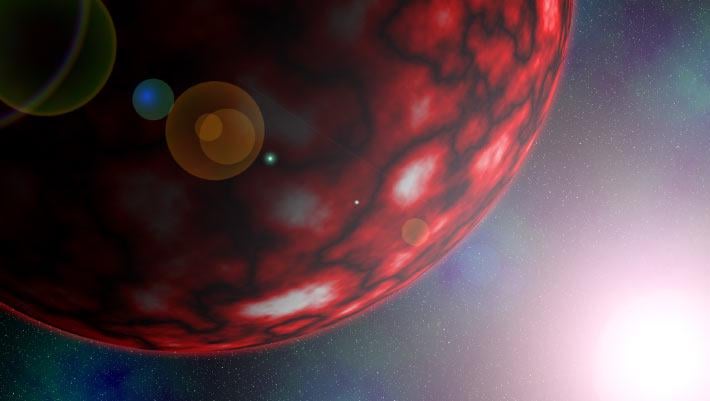
Astronomers Discover ‘Mega-Earth’ Exoplanet Gliese 523b. Gliese 523b (GJ 523b) is a young, ultra-dense planet that orbits almost perpendicular to its star’s spin.
Astronomers Discover Rare ‘Mega-Earth’ Exoplanet: Gliese 523b

Astronomers Discover ‘Mega-Earth’ Exoplanet Gliese 523b. Gliese 523b (GJ 523b) is a young, ultra-dense planet that orbits almost perpendicular to its star’s spin.
Astronomers Discover Rare ‘Mega-Earth’ Exoplanet: Gliese 523b
2 Comments
I didn’t really know what the definition of a Mega-Earth was before reading this article, so if this is new to you too here’s an explanation. Apparently there are also Super-Earths which are smaller than Mega-Earths. A Mega-Earth is roughly 10+ Earth masses and dense enough to be composed mainly of rock/metal rather than gas.
This is strange or weird or amazing because classic planet-formation theory suggests that any core that massive should have accreted a thick hydrogen/helium envelope and become a Jupiter-like gas giant. So finding these planets is I think pretty rare?
Someone please add to this definition or correct me if I’m wrong.
It is out of reach… and the temperature is very hot. I would not call it a ‘mega-earth’ in the strict sense of the word.