Jevons Paradox proven wrong as UK’s last coal power station receives final coal delivery
https://www.bbc.co.uk/news/articles/ckkg0wl7dkro

Jevons Paradox proven wrong as UK’s last coal power station receives final coal delivery
https://www.bbc.co.uk/news/articles/ckkg0wl7dkro
5 Comments
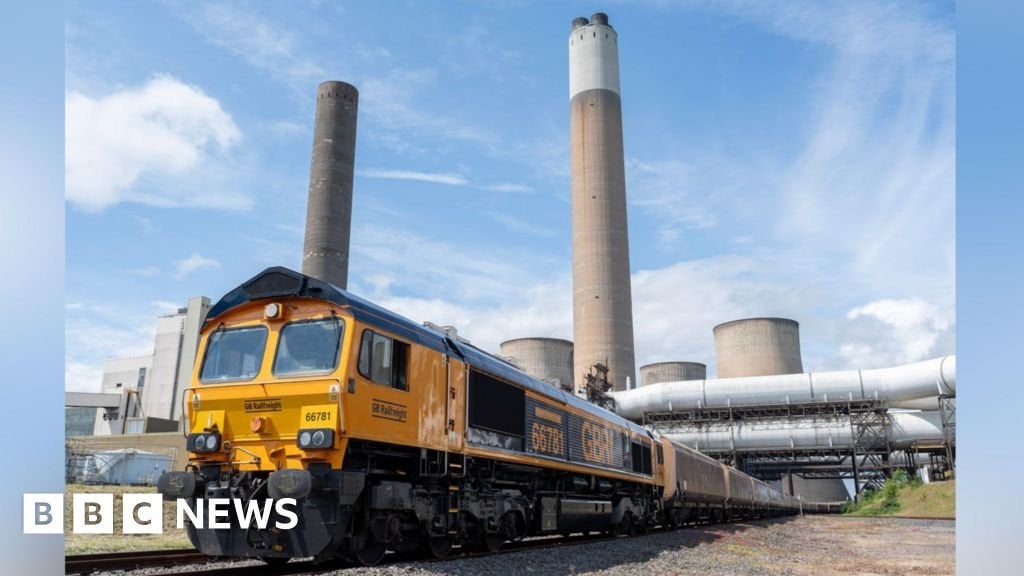
A power station’s final order of coal has arrived by rail, marking the end of an era for the site, and bringing a new name to the locomotive pulling the load.
Ratcliffe-on-Soar in Nottinghamshire is home to the UK’s last remaining coal-fired power station, which is set to shut at the end of September.
The 1,650 tonnes of coal delivered on Friday is expected to be the last ever fuel shipment sent there.
The site, operated by international energy firm Uniper, has produced electricity for 57 years.
Its final delivery of fuel is enough to generate power for approximately 500,000 homes over eight hours.
Mike Lockett, of Uniper, said: “[This] is a significant moment and one that heralds the end of the story for the power station.
“However, it’s not the end for the site as we look towards a future where it could become a zero-carbon technology and energy hub for the East Midlands.”
Uniper says it is exploring the potential for hydrogen production.
John Smith, of GBRf, said: “Coal and rail have been pivotal in driving British prosperity for centuries. GBRf has been transporting coal to the station for many years.”
During its lifetime, Ratcliffe – commissioned in 1967 – has generated enough power to make more than a billion cups of tea every day.
**At the turn of the 20th Century, coal was used to generate more than 95% of the UK’s energy, but last year it had fallen to 1%.**
—————-
This is for the Jevons Paradox people who claim we will never leave any energy in the ground, even when alternatives exist.
https://i.imgur.com/9d873Qa.png
Clearly increased efficiency can result in lower usage.
This does not prove Jevon’s Paradox wrong, if anything it supports it. Cheaper sources of electricity are replacing coal. Electricity use is not going down.
Maybe with carbon capture they can capture the carbon and reinject it into the boiler burner, creating a perpetuum mobile
Jevons paradox is irrelevant to this situation. It only applies when the efficiency has gone up. Coal power plants have not become more efficient.
Jevon’s Paradox states that technological advancements that increase the efficiency with which a resource is used tend to increase the overall consumption of that resource, rather than decrease it.
The paradox specifically addresses the relationship between efficiency improvements and overall resource consumption.
When a coal plant shuts down, it’s typically due to reasons such as regulatory changes, economic factors, shifts to alternative energy sources, or environmental concerns, rather than changes in the efficiency of coal usage.
In the case of the Ratcliffe-on-Soar coal plant, other more efficient power sources replaced it…just like coal replaced burning wood. So no…this 1 plant shutting down doesn’t prove anything. 🤷🏽♂️