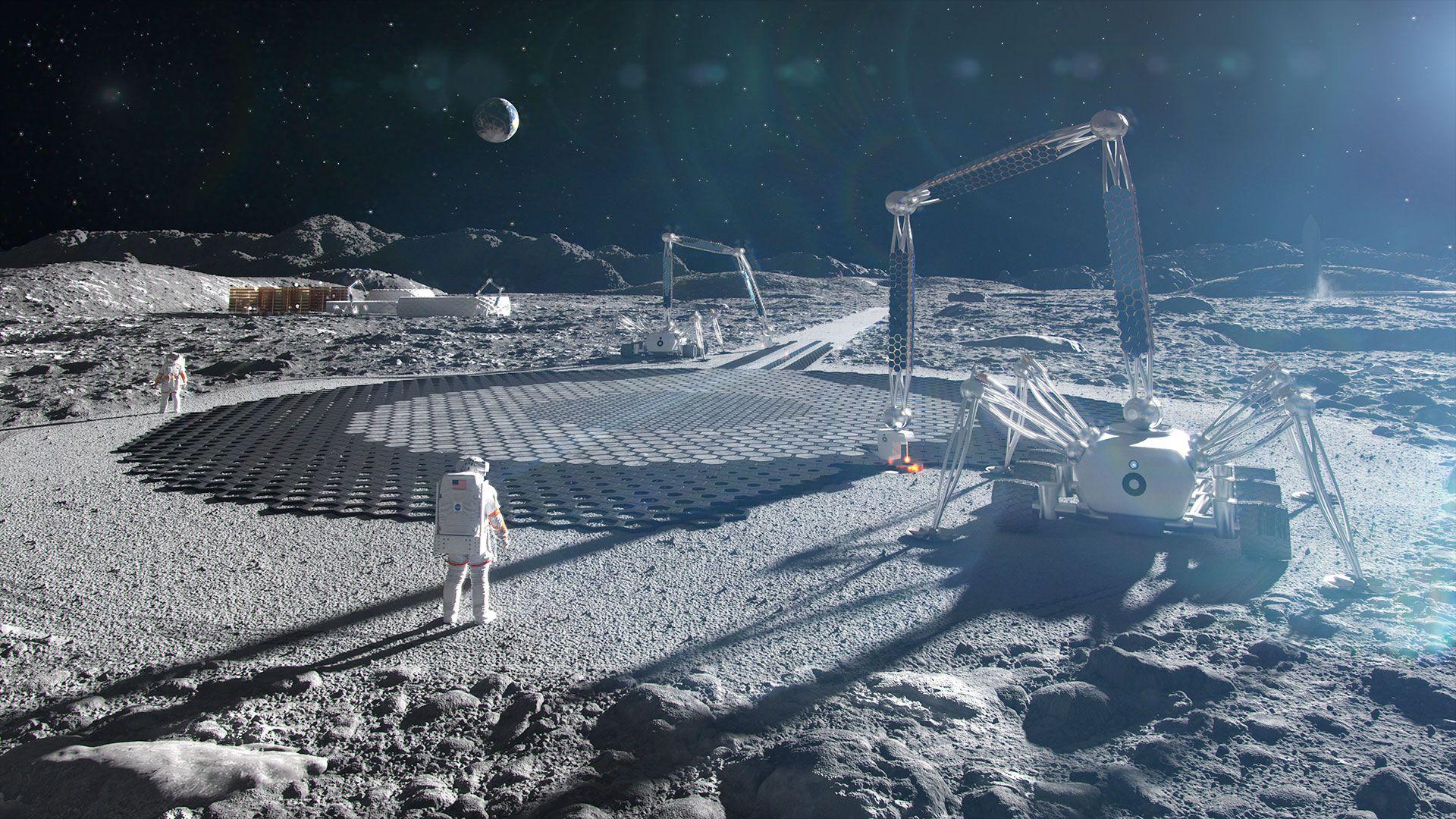
Even a small city would run dry after just a decade or so.
https://www.space.com/astronomy/moon/no-cities-on-the-moon-there-isnt-enough-water-scientists-say-op-ed


Even a small city would run dry after just a decade or so.
https://www.space.com/astronomy/moon/no-cities-on-the-moon-there-isnt-enough-water-scientists-say-op-ed
15 Comments
From the article
The good news is that power, even without nuclear reactors, is not a problem. That’s because the rims of the craters containing the pits of eternal darkness are in almost permanent sunlight. (That’s why they are sometimes, slightly incorrectly, referred to as the “peaks of eternal light.”) Up on those highly illuminated rims it would be possible to generate three gigawatts of electricity using kilometer-tall towers covered with photovoltaic arrays. It should be possible to manufacture solar panels on the moon. There’s certainly plenty of silicon. This could even make [AI data centers](https://www.space.com/space-exploration/satellites/spacexs-1-million-orbiting-ai-data-centers-could-ruin-astronomy-scientists-say) on the moon possible, by placing them near these sunny peaks. That would be the start of a true lunar economy.
The bad news is that, even assuming a generous one billion tons of water to start with, without recycling the answer to our question of sustainability is that the city would last only a few years. Even in the best-case scenario, with 98% efficient recycling of water — the same as achieved on the ISS — a one-million-person city will run out of water in just over a century. That is a problem for sustainable moon settlement. And today’s best estimates of the amount of water on the moon are about 30 times less than a billion tons, shortening the time to water exhaustion by the same factor. This means that even a small city would run dry after just a decade or so. A moon village with a thousand people, or even a town with 10,000 people, would instead be sustainable for several centuries or more.
There are potential solutions. We could improve the efficiency of water recycling by a factor of five or more; lower water usage from new techniques such as vertical farming; import water, probably from accessible asteroids; or, simply, find more water. Of these it may be this last hope that is most promising. Current water surveying techniques do not reach below the surface more than a few meters, while the rubble-like rocks of the surface regolith typically extend tens of meters down and may contain water in the cold traps. If the ambitious plans of the space billionaires are to be realized, then finding more water will be the first step.
Good, one less place billionaires can use to escape from the consequences of their actions
Advances in automation and robotics have given us no reason to send humans to any other worlds. We can still fully explore them, much more cheaply, than shipping live people there.
edit: phrasing
Read the article – it’s not “impossible”, there’s just technical challenges as with everything.
No water, radiation exposure, morphological changes due to low gravity, & impossible travel distances throughout the cosmos. It’s almost as if humans are stuck with this planet, & space exploration should be left to robots.
oxygen is a waste product of smelting. import hydrogen for fuel and voila: water.
There’s 100 years of water for 1 million people is what I read in the article.
How is that not enough for a start?
might as well claim the earth is not habitle with a 100 billion people.
I wish people understood how delicate they are and how they are only built to survive in this tiny little 10,000ft high layer of this planet.
Even in space on the ISS? Their bodies start to de-construct themselves. Your body realizes it doesn’t need muscle anymore so it goes.. including heart muscle.
We aren’t leaving this planet on any meaningful way. If that’s your hope? It’s not gonna happen. You have way more incentive to clean your neighborhood and protect the spot we have, cause that’s it.
Engines and power generation could be done with modular/interchangeable equipment.
Imagine landing on the moon or Mars, then we use a reactor or two from that ship to generate energy.
We’re going to be moving material to the moon and Mars. The cargo loads on the ships away from Earth will weigh much more and need more power to break atmosphere. On a return journey some of the reactors are potentially surplus to requirements and could be left behind on Mars/the moon to power things.
The lack of gravity already makes the Moon insufficient for permanent human settlement.
This is the dumbest article talking about a hypothetical 1 million person city on the moon, which would only last 100 years. I love the conversations it’s spurred, but the article itself is ridiculous.
> If the ambitious plans of the space billionaires are to be realized
This is a sentence that has no possible positive conclusion.
“Out to Saturn, get the ice, back to Ceres. Out to Saturn, get the ice, back to Ceres. Out to Saturn, get the ice, back to Ceres. Out to Saturn, stop at Phoebe, get the ice…”
Oh yeah boys, it’s almost time to remember the Cant!
Simply redirect water-rich asteroids towards moon, and BAM, problem solved!