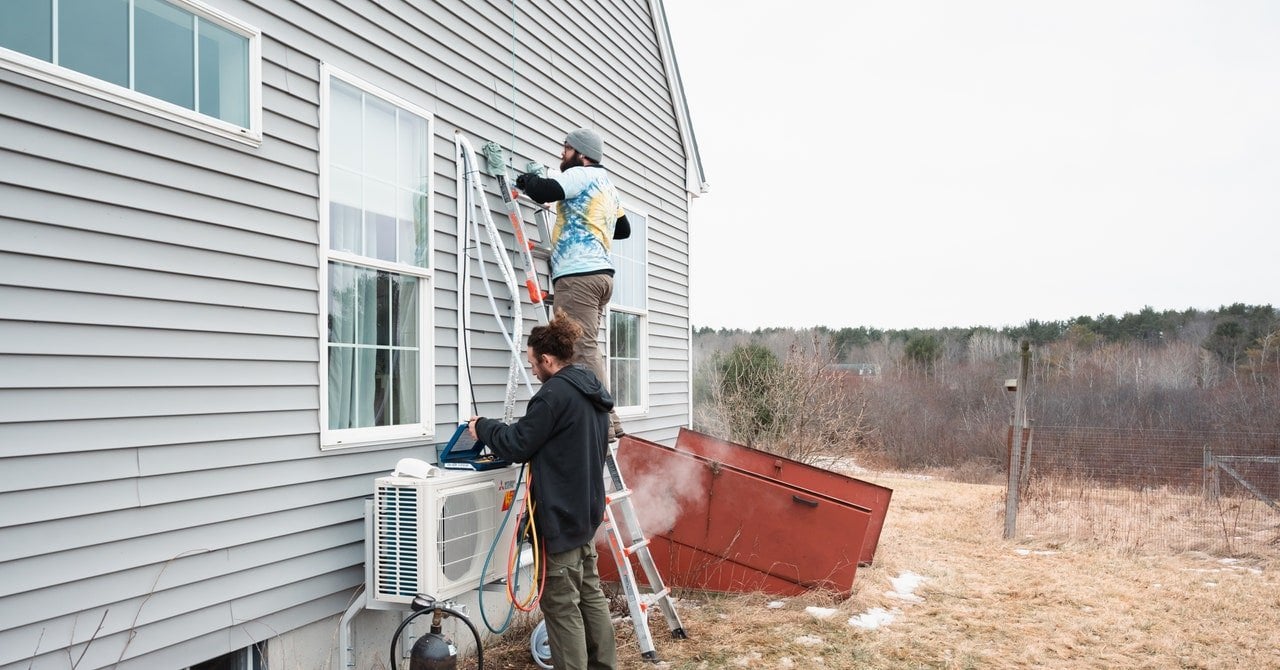
Extreme Weather Poses a Challenge for Heat Pumps
https://www.wired.com/story/how-heat-pumps-are-affected-by-climate-change/

Extreme Weather Poses a Challenge for Heat Pumps
https://www.wired.com/story/how-heat-pumps-are-affected-by-climate-change/
5 Comments
Mountain winds can be warm but still cool enough to bother heat pumps, says Bangheri. Cold, windy storms, potentially exacerbated by climate change, are problematic too. This spring Bangheri noticed the effect windy weather had on his own air source heat pumps, installed at his mountainside home: “We had more of the wind-chill effect,” he says, estimating that the machines needed 10 to 15 percent more defrosting than usual.
Air source heat pumps capture heat from the outdoor air and move it indoors. However, when it is sufficiently cold and damp, some components of the heat pump can gradually ice up and must be defrosted and dried off in order to continue working efficiently. Strong winds, even if not especially cold, hamper this defrosting process, and Heliotherm, which regularly monitors thousands of its devices around Europe, has observed this effect in windy areas. “We have a lot of installations in Hamburg in north Germany—they always have strong winds,” says Bangheri.
Read the full article: [https://www.wired.com/story/how-heat-pumps-are-affected-by-climate-change/](https://www.wired.com/story/how-heat-pumps-are-affected-by-climate-change/)
Aren’t there more advanced pumps that use a tank of water to stabilize the temperatures?
In Canada we (I personally) have those. It doesn’t work when it’s too hot and doesn’t work when it’s too cold. So for about 3/12 months a year it’s useless; I have to use electric baseboard heat and electric fans/ac units.
global arming when its hot, global warming when its cold , global warming when its just right
Um. Where i live it regularly drops below -10 c° during the winter but the heat pumps work just fine.
Maybe they have different specifications.