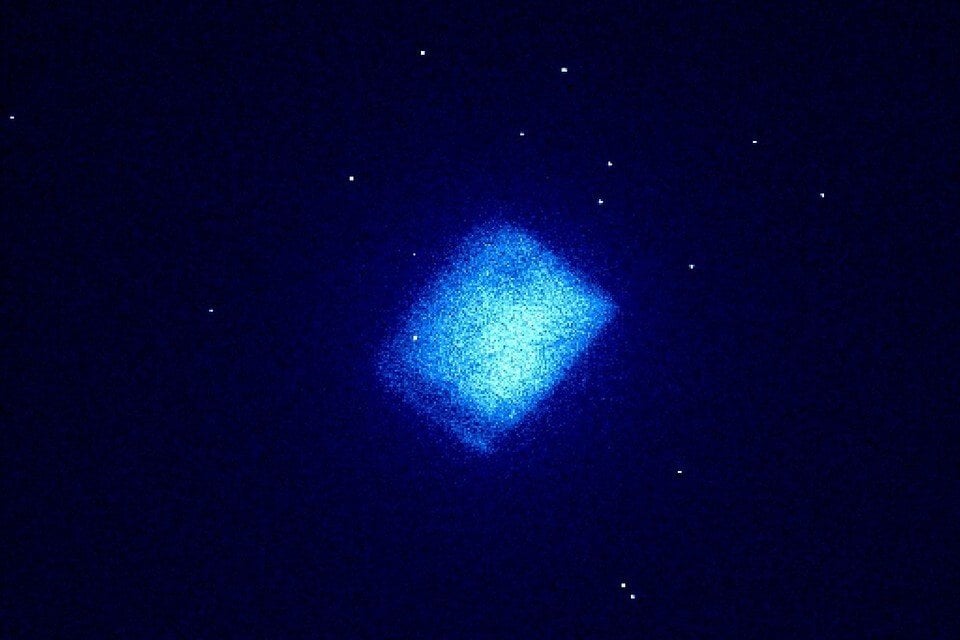
The world’s first carbon-14 diamond has been produced with the potential to provide power for thousands of years – UK Atomic Energy Authority
https://www.gov.uk/government/news/diamonds-are-forever-world-first-carbon-14-diamond-battery-made

The world’s first carbon-14 diamond has been produced with the potential to provide power for thousands of years – UK Atomic Energy Authority
https://www.gov.uk/government/news/diamonds-are-forever-world-first-carbon-14-diamond-battery-made
7 Comments
Submission statement : Scientists and engineers from the UK Atomic Energy Authority (UKAEA) and the University of Bristol have successfully created the world’s first carbon-14 diamond battery.
The battery leverages the radioactive isotope, carbon-14, known for its use in radiocarbon dating, to produce a diamond battery.
This development is the result, in part, of UKAEA’s work on fusion energy.
Safety is predicated on the percentage of beta rays which are captured.
Let me guess – *picowatts* of electricity for thousands of years?
Finally, a battery I can accurately tell how long it has been sitting unused in my drawer.
this seems very promising! why are there only 138 votes and 10 comments 😀 I’m impressed anyway, go bristol uni!
Haha bla bla bla.
Utter nonsense misleading headline which won’t make a jot of difference to current energy hierarchies or our bills.
So, let’s think 1 watt, assuming 1 microwatt.. we need 1000 , resulting in roughly 50000 cubic mm to make a milliwatt. An AA battery is 8.1 cubic centimeters = 8100 cubic mm.
A battery the size of 6 AA batterys that can output (whatever the voltage X amperage = 1 milliwatt) for 5000 years.
1 liter = 1000000 cubic mL … so 20 of these battery packs = 20mW.
50 liters would result in 1 watt of power continuously for 5000 years.
For Americans, this is a little less than three 5 gallon buckets.
Let’s run our house on 1000 Watts continuous:
A 50,000 liter tank typically has dimensions around a diameter of 2.5 meters (around 8.2 feet) and a height of around 3.2 meters (around 10.5 feet)
This could easily be in the ground outside or under your house.
Yes please. Assuming it doesn’t irradiate the neighborhood.
>The battery is the size of a conventional wrist watch battery at **10mm across and just 0.5mm thick**. “Diamond batteries offer a safe, sustainable way to provide continuous microwatt levels of power,” said Sarah Clark, director of tritium fuel cycle at UKAEA
[https://www.telegraph.co.uk/news/2024/12/03/scientists-invent-battery-never-dies-diamond-radioactive/](https://www.telegraph.co.uk/news/2024/12/03/scientists-invent-battery-never-dies-diamond-radioactive/)