
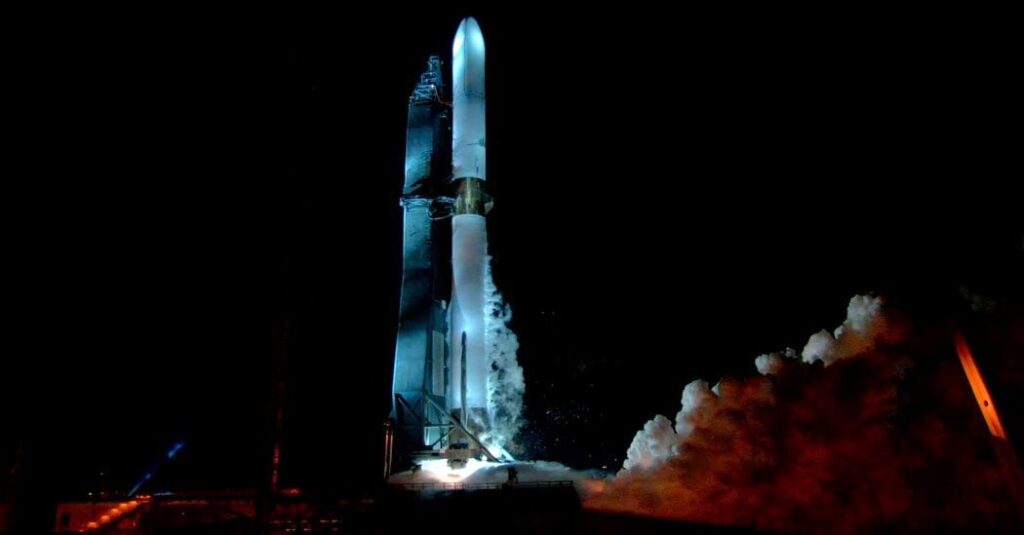
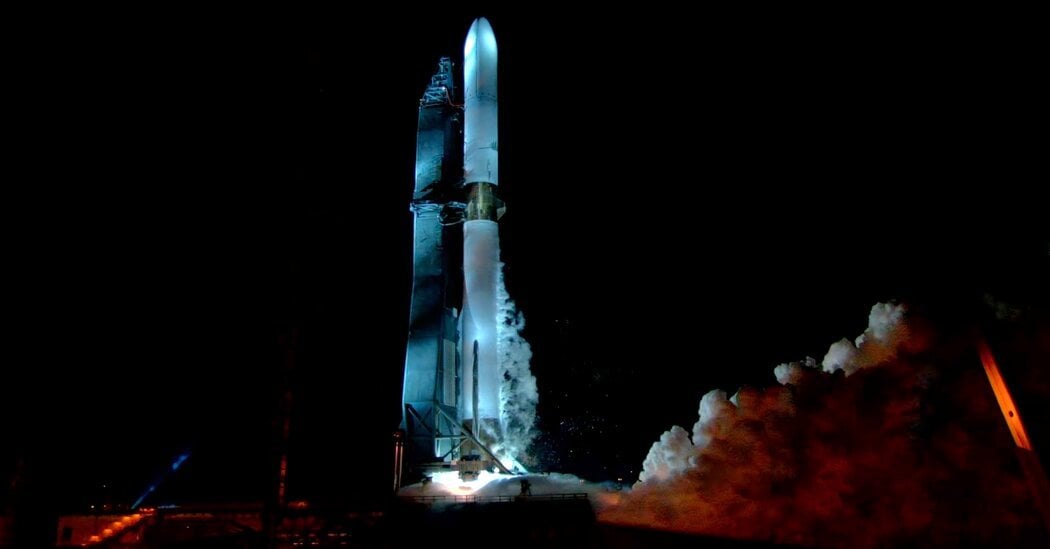
Blue Origin is just about to launch its reusable heavy-lift 'New Glenn' rocket in a few days. Are we about to see a version of Aesop's tale of 'The Hare & the Tortoise' play out, with SpaceX playing the role of the hare?
This Sabine Hossenfelder video does a good job of laying out the argument – Jeff Bezos’ Space Plans Make More Sense Than Elon Musk's.
In summary, Blue Origin's plans are built around space stations in near earth orbit, while SpaceX's plans are for Mars colonization. It's far more likely Blue Origin's plans can be realized in the 2030s and 2040s. Apart from China, no one else will have a space station by around 2030 when the ISS goes – there will be no other choice but to look to commercial providers.
Blue Origin's plans for space stations designed as O'Neill cylinders with artificial gravity are the obvious technological next step on from ISS-type space stations.
Is Jeff Bezos' Blue Origin about to pull ahead in the space race? Some think its long-term plans are more commercially feasible than those of its rivals.
byu/lughnasadh inFuturology
13 Comments
The most commercially feasible way for spaceX to do space exploration is by not doing space exploration and just focusing on starlink instead.
I don’t think thats the point.
Yes, building a space station is more feasible than going to mars.
But I don’t think doing something that has been done before is necessarily “pulling ahead in the space race”.
Betteridge’s law of headlines is an adage that states: “Any headline that ends in a question mark can be answered by the word no.”
The physicist Gerard O’Neill advocated for space stations as human habitats rather than planetary colonization from the 1960s until his death in 1992.
The O’Neill Cylinder that he describes in his book *The High Frontier* is an excellent model for what is possible through building habitats rather than trying to survive on planets that are particularly unsuited for human survival.
Blue Origin’s plans seem to be rooted in actual science and economically feasible goals, whereas Space X seems to be basing their strategy on Elon Musk’s teenage fantasies.
[https://www.youtube.com/watch?v=Z2d_0l5ycRM](https://www.youtube.com/watch?v=Z2d_0l5ycRM)
No.
SpaceX currently sits at a total of 416 Falcon 9/Falcon Heavy launches, with another launch scheduled early Tuesday morning. So far in 2024, there have been 133 Falcon 9/Falcon Heavy launches. This averages out to one launch every 2.74 days or one launch every 65.86 hours. There have also been 4 Starship/Super Heavy launches in 2024.
[https://en.wikipedia.org/wiki/List_of_Falcon_9_and_Falcon_Heavy_launches](https://en.wikipedia.org/wiki/List_of_Falcon_9_and_Falcon_Heavy_launches)
I predict that Spacex will come around to going to the moon and asteroids first. They will view it as a temporary concession – a waypoint on the way to colonizing Mars. As the reality (and scientific/economic/political/military utility) of moon colonization and industrialization is fully understood, they will develop a new plan to use LEO and Moon infrastructure to build and test the MANY novel technological capabilities required to actually make the trip to Mars safely and in any numbers.
What SpaceX says its long-term plans are now, in my mind, are largely irrelevant. The fact that its general purpose launch frequency, lift capacity, reuseability, association with NASA, technological supremacy and the rest are established and growing leads me to believe that they will be staged to respond leaps and bounds ahead of any competition in most domains, even if they merely act as a workhorse for other companies to get stations or other infrastructure to the moon or LEO.
Will they have competition? Sure. Are they in danger of being replaced in any domain that matters to their bottom line or success as a company? I’d say not. But I’m open to discussion – this is just the situation as I see it.
Space is not going to be a priority for the US moving forward, unfortunately. Once Musk gets Starlink up and running, the only manned efforts will be from other countries. (Unless the US military sees a way to use Starship for troop deployments.)
I suspect Blue Origin is going to slowly dwindle, because the coming global interconnected financial crisis is going to drastically reduce the value of Amazon. (Tariffs will start trade wars. That could lead to real, hot wars.)
Barring a new World War, one in which nukes are off the table (unlikely), BO is going to either get subsumed by or merge with Boeing or Lockheed Martin.
Which will do nothing for manned space flight, in the near term.
Musk to Mars will need to develop tech, and lunar expeditions could do that, using robots at first. Then off to Mars. But that is decades into the future.
That’s just fantastic news. So that’s another space cruise I won’t be going on, and for bonus points on killing the planet faster n sooner.
Har har har I’ll believe it when I see it. Competition is grand but Bezzy hasn’t launched an ounce into orbit yet, let alone land an orbital class booster. TBH I hope they can but their pace is not impressive.
That’s a pretty limited view that seems like it doesn’t fairly compare the two companies. You’re comparing Blue Origins short term goals with SpaceX’s long term goals. A better comparison would be between commercial viability of each company as a third party launch provider, a government launch provider, and space stations vs. Starlink. SpaceX has already dominated the satellite market with Starlink as well as with third party launch and government launch. The Falcon 9 fleet is already at near total market domination, which by itself i think NG has a good chance at taking over. Starship, however, is coming really damn fast, and there are only certain niches that NG is going to be able to keep for launch payload, volume and price.
I think Blue Origin is going to hold on to a decent number of government contracts and third party launches simply out of diversification and for competitors that don’t want to pay SpaceX to compete. I don’t think NG will get anywhere close to Starship price to LEO, but I do think it will have a leg up for high deltaV or deep space missions. There’s an advantage to being able to mount a craft on top of the final stage vs. Deploying out out of a payload bay. I could be wrong, but I haven’t seen too many vehicles be designed to deploy out of Starship yet. Starship itself, while making sense for Mars colonization, is highly inefficient as a deep space vehicle compared to something non-reuseable. The potential NG third stage would also give it a leg up in that area.
All in all, it’s also important to remember that the long term Mars goal isn’t focused on commercial viability. SpaceX as a company is designed to use commercial success as a means to make Mars happen, not use Mars as a short term cash cow. This isn’t just Elon’s fantasy, this is the primary goal that every SpaceX employee I know is working towards and believes in. I think Elon hate tends to make people think that this is all the whims of a billionaire, but space colonization is a dream that goes way beyond him and is ingrained in human nature. Being a private company makes a goal like that possible BECAUSE it doesn’t need to be commercially feasible, though i suspect it will still pay for itself in the end many times over.
No. Nothing stops Musk from choosing more feasible options along the way to his goal.
Elon will win because his rockets can be used to deploy troops en masse to virtually anywhere in the world. Elon said mars is the future but our DOD is looking at home for uses of his rockets.
Blue definitely has a long-term future. There will always be two heavy-lift providers for NASA and the Department of Defense. Dissimilar redundancy is a key element of the US’ spaceflight and national security strategy. Right now that is SpaceX and ULA, but Vulcan is just not going to be competitive against a fully-reusable or even a partially-reusable system. At best Vulcan may eventually be able to reuse engines, but there’s not all that much benefit to rebuilding all the tanking and instrumentation in order to refly engines.
Blue is likely to either buy out ULA and phase out Vulcan or end up putting ULA out of business with New Glenn. New Glenn should be able to achieve the same missions as Vulcan at less cost and a higher cadence because of full first-stage reuse. If Blue can pull off a fully-reusable variant of New Glenn, that will be even bigger. ULA just can’t compete in the new launch market because it takes them too long to build new boosters.
The idea of doing on-orbit habitats is going to be a market, but before we get to something like O’Neill cylinders we have to have the material sciences that can keep them from flying apart. The stresses on a massive rotating object are bigger than you think. We do not need future technologies to do Mars colonization – we know how to make radiation shields, we know how to build structures. We have to scale up existing technologies to do it, but not in ways that stretch the scientific limits. That’s not true with something like an O’Neill cylinder.
Blue’s come a long way since Dave Limp became CEO and lit a fire under the company’s collective asses, but they still have yet to launch anything into orbit. SpaceX is well on its way to developing a fully-reusable system. Blue has a lot of catch-up to do. At this point I would put money on Blue being the second major launch provider, but I would not put money on them leapfrogging SpaceX in the near future.