Imgur link with Flemish, Danish, Swedish, and Norwegian native names placed correctly
hexenvixen on
I absolutely love what you’ve done here and the image is striking! Thank you!
NorthernLightsArctic on
This is way too good,
Amazing job
fasterthanraito on
Hamitic is not a scientific word, it is a biblical term.
The correct name is “AfroAsiatic” for the family that includes Semitic branch
Realistic_Patience67 on
LOL. Supports the “Aryan invasion” of the Indian subcontinent.
Nearby_Week_2725 on
Why are the Indo-European languages not shown having a common ancestor?
The Germanic languages are mislabeled.
The selection of languages strikes me as odd. While some local variants like Flemish, Venetian and Occitan are included, national languages like Luxembourgish and Faroese are omitted. The very obscure and extinct language Norn is on there, so a smaller of speakers can’t really be the reason…
It’s a very beautiful graph, but the selection of data doesn’t make much sense to me.
iShakeMyHeadAtYou on
This is amazing, but I’d love a higher quality version so i can read the event bubbles!!
tyen0 on
This might be better suited to /r/Infographics. It’s pretty, but it does not fit the rules of this sub for automatically computer generated visualizations.
VulcanTrekkie45 on
Doric didn’t go extinct. It’s still spoken in a few isolated villages where it’s known as Tsakonian
pjo33 on
Theres no fucking way i zoom in on a chart about all Languages in the history of Mankind and the very first Word i see is the N-Word
sublimesam on
“Global” except for the entire Western Hemisphere
LakeMegaChad on
u/koylafabrika great work! Just to clarify, Hokkien (Quanzhang) and Min Nan (don’t branch from each other as much as Hokkien is a subgroup of Min Nan. While their etymological roots confusingly refer to overlapping places, and the non-Hokkien Min Nan languages like Teochew (Chaoshan) are only partially mutually intelligible with Hokkien, Hokkien and Min Nan in commonplace become more or less interchangeable terms.
I recommend changing either Min Nan with Fuzhounese, another more specific language like Hokkien (Quanzhang), or Hokkien with Min Dong (Eastern Min), the analogous group for Fuzhounese.
juneshoe on
No Cree or Inuktitut or other First Nations languages?
jordanpatrick on
This is incredible. What an amazing bit of data so well laid out!
beatlz on
I know this is good because I read the whole thing thoroughly
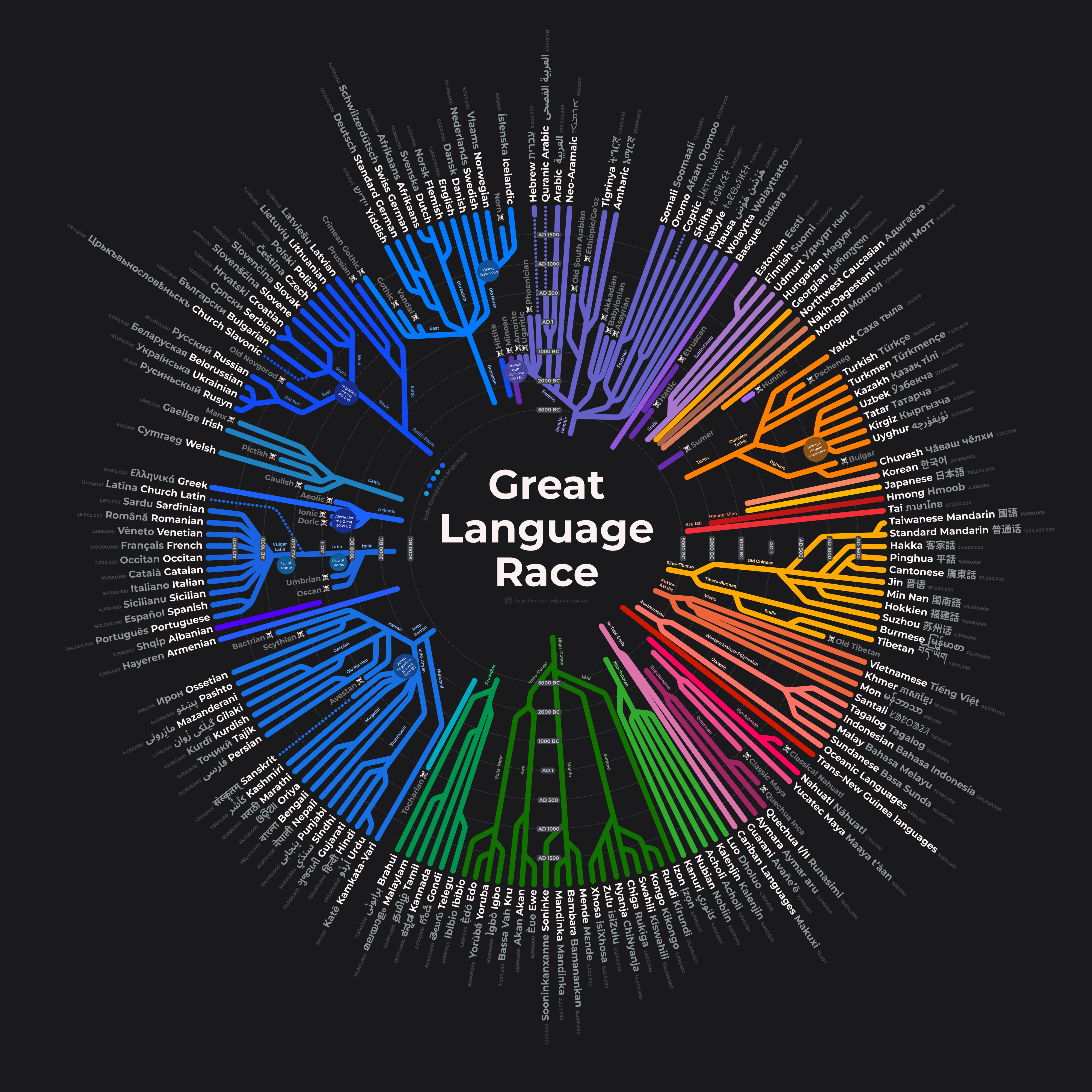

![Global Language Evolution Chart [OC]](https://www.byteseu.com/wp-content/uploads/2025/01/el2nksy80eae1-1536x1536.png "Global Language Evolution Chart [OC]")
20 Comments
> Be sure to add a comment that states the data source AND tool(s) used to create the visualization.
Wikipedia, Figma. Happy New Year!
That’s a cool graphic. Unsure what to do with this information, but thanks.
Uh the native names of Norwegian Swedish Flemish and Dutch are mixed up. But very interesting graph!
svenska and dutch are flipped
The difference in lengths between Sumer and Hebrew is essentially the entire plot of the cyberpunk novel *Snow Crash*.
It’s a weird book.
https://imgur.com/gallery/global-language-evolution-chart-Bo8zUqk
Imgur link with Flemish, Danish, Swedish, and Norwegian native names placed correctly
I absolutely love what you’ve done here and the image is striking! Thank you!
This is way too good,
Amazing job
Hamitic is not a scientific word, it is a biblical term.
The correct name is “AfroAsiatic” for the family that includes Semitic branch
LOL. Supports the “Aryan invasion” of the Indian subcontinent.
Why are the Indo-European languages not shown having a common ancestor?
The Germanic languages are mislabeled.
The selection of languages strikes me as odd. While some local variants like Flemish, Venetian and Occitan are included, national languages like Luxembourgish and Faroese are omitted. The very obscure and extinct language Norn is on there, so a smaller of speakers can’t really be the reason…
It’s a very beautiful graph, but the selection of data doesn’t make much sense to me.
This is amazing, but I’d love a higher quality version so i can read the event bubbles!!
This might be better suited to /r/Infographics. It’s pretty, but it does not fit the rules of this sub for automatically computer generated visualizations.
Doric didn’t go extinct. It’s still spoken in a few isolated villages where it’s known as Tsakonian
Theres no fucking way i zoom in on a chart about all Languages in the history of Mankind and the very first Word i see is the N-Word
“Global” except for the entire Western Hemisphere
u/koylafabrika great work! Just to clarify, Hokkien (Quanzhang) and Min Nan (don’t branch from each other as much as Hokkien is a subgroup of Min Nan. While their etymological roots confusingly refer to overlapping places, and the non-Hokkien Min Nan languages like Teochew (Chaoshan) are only partially mutually intelligible with Hokkien, Hokkien and Min Nan in commonplace become more or less interchangeable terms.
I recommend changing either Min Nan with Fuzhounese, another more specific language like Hokkien (Quanzhang), or Hokkien with Min Dong (Eastern Min), the analogous group for Fuzhounese.
No Cree or Inuktitut or other First Nations languages?
This is incredible. What an amazing bit of data so well laid out!
I know this is good because I read the whole thing thoroughly