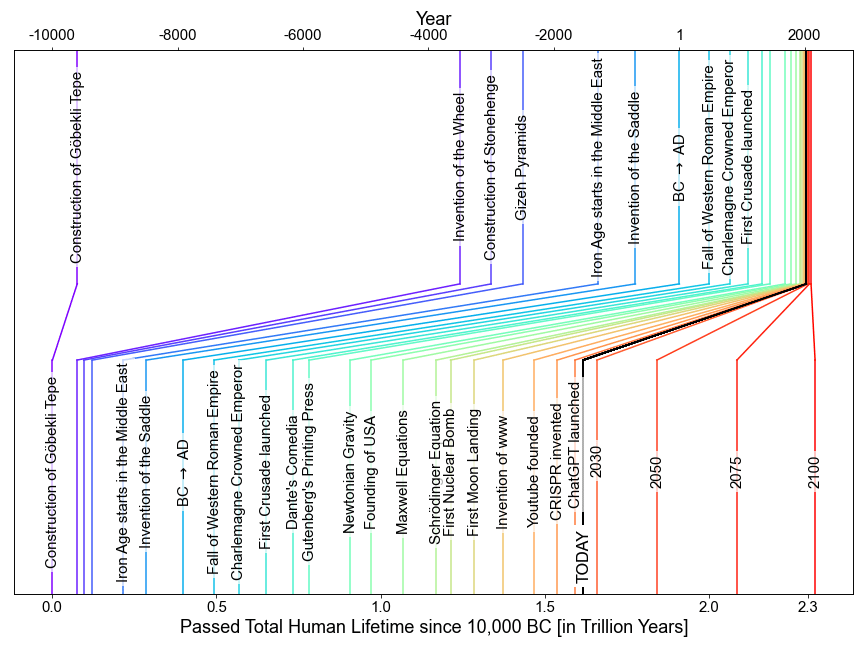
[OC] A timeline of important events and inventions, but scaled by the passed human life time
Posted by abeinszweidrei

[OC] A timeline of important events and inventions, but scaled by the passed human life time
Posted by abeinszweidrei
10 Comments
[OC] I created the visualization with python/matplotlib using population data from the HYDE data set ( https://onlinelibrary.wiley.com/doi/10.1111/j.1466-8238.2010.00587.x ) and population projections from https://www.worldometers.info/world-population/world-population-projections/
Clearly, scientific and technological progress has massively accelerated in the last few decades. But the world population has also grown exponentially, so there is also simply more life time being available for researching new ideas and improving exisiting ones.
For example, in terms of passed human life time, the founding of the USA (1776) is about as far from the Roman Empire as it is from us today.
And again in terms of human life time, the year 2075 (kinda realistic for many of us to still be alive in) is about as far away as the publishing of the Schrödinger Equation in 1926.
Really interesting way to look at things.
It took me a minute to figure out how to read this, but it’s super interesting! I’m excited to be here for the next 50 years (250 million life years) of it!
[deleted]
Data is definitely beautiful, not this one though.
Not the most intuitive graph, but certainly a very interesting way to look at the past!
I guess the fact that it is unintuitive makes it so interesting.
Something about this is oddly comforting. Nice post.
Could definitely use some of the industrial revolution, since that arguably had the largest grouped single impact on modern life. The printing press is a good one. I would definitely add the steam engine, which greatly multiplied our ability to move large masses via shipping or rail, as well as all of the other labor/work replacing uses for engines. Not far under that is the invention of the generator and motor, fostering the electric world we now live in and further increasing industrial output(as now factory machining could be electrically powered instead of steam).
“important events”
“YouTube”
“ChatGPT”
Very cool, but including “YouTube founded” kind of seems like cheating. I don’t really have a great suggestion to replace it though.