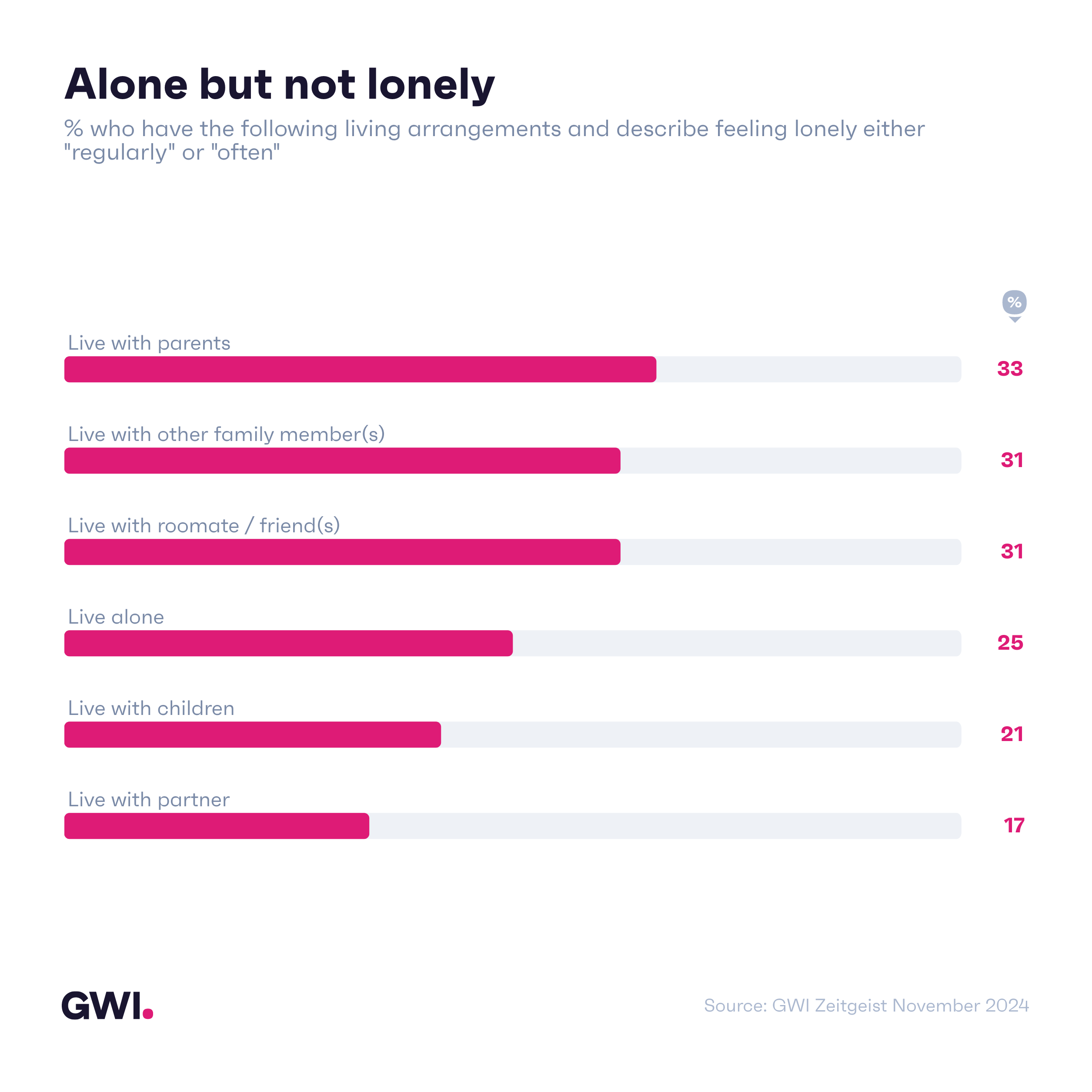
Data source: [GWI Zeitgeist](https://www.gwi.com/zeitgeist) (full disclosure, I work for the company that did this research). This is from an 11 country survey we did in November last year looking at relationships, loneliness and other such things.
Tools used: Datylon
As many of you will seen, the Atlantic’s latest cover story is on “The Anti-Social Century”, and anecdotally I feel like there’s a lot of discussion on this topic at the moment. I think that the author was very astute in saying that solitude and loneliness are not the same thing, as we found the same results in our research. I personally think the jury’s out on whether there’s a loneliness epidemic or not, I’ve seen data arguing for both sides, but I think it’s worth noting that if anything was going to cause it, it’d be more young people being stuck at home with family, or in houseshares.
davidtwk on
Correlation =/= causation
flat_beat on
The title suggests that living with parents makes people lonely. This is not shown by the data. It might be that people who are lonely tend to live with their parents. We don’t know about any causality.
pm_your_karma_lass on
There’s an insane amount of bias here. This is absolutely not a conclusion you can draw here
RevanchistSheev66 on
Watch me flip this statistic single-handedly
GimmeUrBrunchMoney on
In what country or countries? Did you account for the difference between “still lives with parents”, “had to move back in with parents”, and “adult children who invited their parents move in with them to support them”? If the parents move in with the children as they age, are the parents self sufficient when they move in or do they need around the clock care? If they need round the clock care, are the adult children providing that care, or is a hired caregiver providing these services?
Because in an individualistic culture like the United States then there’s a higher likelihood that an adult 30-year-old man who just never left his parents’ place will have a cluster of other factors contributing to loneliness—namely unfuckability—than a 40-year-old adult child with their own home in a less individualistic society with stronger social safety nets who decided to invite their parents to move in to help with the kids, save money, free up time for date nights, and find satisfaction in building/retaining a strong sense of family cohesion.
???
DeathByLemmings on
Or, lonely people are less likely to live alone?
Utoko on
contributing factors(not exclusive) for living with parents:
1. **Limited personal space and privacy.** 🏠 Even in adulthood, it can create feelings of isolation.
2. **Sense of unfulfilled potential.** 😔 May feel “stuck,” lacking the independence of peers.
3. **Social stigma, despite changing norms.** 💔 Can lead to social isolation and feelings of shame.
4. **Less control over life decisions.** 🎛️ Can contribute to feelings of powerlessness.
5. **Challenges in forming relationships.** ❤️ Dating can be more difficult, leading to isolation.
I certainly felt some of these living with my parents for a while, after a certain age it is just awkward, if there is not space.
A friend of mine has 1/2 house with his own kitchen in the parents house. In a case like that that is certainly not the case.
acortical on
There’s a lot of potential for confounding variables (age, for one) to play a large role here. I’d say these data aren’t very interpretable without know more about the sample characteristics
cryptotope on
Major concerns:
* These categories are not all mutually exclusive. How is this addressed in the data collection and presentation? (If I were living in a multigenerational home with my spouse, my child, and a parent, would I be counted in “Live with parents”, “Live with children”, or “Live with partner”?)
* Survey size, recruitment method, and expected margins for error are not presented. Unless this was a *very* large sample, it’s very likely that the there’s no statistically-significant difference between the first three categories.
* OP, can you provide a link to the actual data set you used, rather than just to your employer’s homepage?
Smaller concerns:
There are probably a bunch of underlying and hidden confounders/correlations that aren’t presented here.
For example, age is the most obvious – and probably most important – factor driving this ‘result’. Young adults are more likely to live with family or roommates, and less-likely to have long-term partners or children. Young people are also more likely to experience loneliness–not because they live with their parents, but because they’re still building their adult identities and social networks and support systems.
behOemoth on
I would like to see the additional resolution about finances. People live more and more with their parents because either the parents need money/care or the single all grown adult can’t afford living alone. Being poor makes you definitely feel lonely.

![[OC] Living with parents feels more lonely than actually living on your own](https://www.byteseu.com/wp-content/uploads/2025/01/maa71eqzwxbe1-1536x1536.png "[OC] Living with parents feels more lonely than actually living on your own")
11 Comments
Data source: [GWI Zeitgeist](https://www.gwi.com/zeitgeist) (full disclosure, I work for the company that did this research). This is from an 11 country survey we did in November last year looking at relationships, loneliness and other such things.
Tools used: Datylon
As many of you will seen, the Atlantic’s latest cover story is on “The Anti-Social Century”, and anecdotally I feel like there’s a lot of discussion on this topic at the moment. I think that the author was very astute in saying that solitude and loneliness are not the same thing, as we found the same results in our research. I personally think the jury’s out on whether there’s a loneliness epidemic or not, I’ve seen data arguing for both sides, but I think it’s worth noting that if anything was going to cause it, it’d be more young people being stuck at home with family, or in houseshares.
Correlation =/= causation
The title suggests that living with parents makes people lonely. This is not shown by the data. It might be that people who are lonely tend to live with their parents. We don’t know about any causality.
There’s an insane amount of bias here. This is absolutely not a conclusion you can draw here
Watch me flip this statistic single-handedly
In what country or countries? Did you account for the difference between “still lives with parents”, “had to move back in with parents”, and “adult children who invited their parents move in with them to support them”? If the parents move in with the children as they age, are the parents self sufficient when they move in or do they need around the clock care? If they need round the clock care, are the adult children providing that care, or is a hired caregiver providing these services?
Because in an individualistic culture like the United States then there’s a higher likelihood that an adult 30-year-old man who just never left his parents’ place will have a cluster of other factors contributing to loneliness—namely unfuckability—than a 40-year-old adult child with their own home in a less individualistic society with stronger social safety nets who decided to invite their parents to move in to help with the kids, save money, free up time for date nights, and find satisfaction in building/retaining a strong sense of family cohesion.
???
Or, lonely people are less likely to live alone?
contributing factors(not exclusive) for living with parents:
1. **Limited personal space and privacy.** 🏠 Even in adulthood, it can create feelings of isolation.
2. **Sense of unfulfilled potential.** 😔 May feel “stuck,” lacking the independence of peers.
3. **Social stigma, despite changing norms.** 💔 Can lead to social isolation and feelings of shame.
4. **Less control over life decisions.** 🎛️ Can contribute to feelings of powerlessness.
5. **Challenges in forming relationships.** ❤️ Dating can be more difficult, leading to isolation.
I certainly felt some of these living with my parents for a while, after a certain age it is just awkward, if there is not space.
A friend of mine has 1/2 house with his own kitchen in the parents house. In a case like that that is certainly not the case.
There’s a lot of potential for confounding variables (age, for one) to play a large role here. I’d say these data aren’t very interpretable without know more about the sample characteristics
Major concerns:
* These categories are not all mutually exclusive. How is this addressed in the data collection and presentation? (If I were living in a multigenerational home with my spouse, my child, and a parent, would I be counted in “Live with parents”, “Live with children”, or “Live with partner”?)
* Survey size, recruitment method, and expected margins for error are not presented. Unless this was a *very* large sample, it’s very likely that the there’s no statistically-significant difference between the first three categories.
* OP, can you provide a link to the actual data set you used, rather than just to your employer’s homepage?
Smaller concerns:
There are probably a bunch of underlying and hidden confounders/correlations that aren’t presented here.
For example, age is the most obvious – and probably most important – factor driving this ‘result’. Young adults are more likely to live with family or roommates, and less-likely to have long-term partners or children. Young people are also more likely to experience loneliness–not because they live with their parents, but because they’re still building their adult identities and social networks and support systems.
I would like to see the additional resolution about finances. People live more and more with their parents because either the parents need money/care or the single all grown adult can’t afford living alone. Being poor makes you definitely feel lonely.