Relativistic electron beam could propel probe to Alpha Centauri, study suggests
https://phys.org/news/2025-01-relativistic-electron-propel-probe-alpha.html

Relativistic electron beam could propel probe to Alpha Centauri, study suggests
https://phys.org/news/2025-01-relativistic-electron-propel-probe-alpha.html
7 Comments
Who knows, maybe this tech truly will be the future. Would be pretty cool to actually send probes to other starrs
If the probe gets to Alpha centauri in 40 years at 10% light speed, how is it supposed to slow down?
[deleted]
The super duper lethal dose of radiation though leaves a lot to be desired.
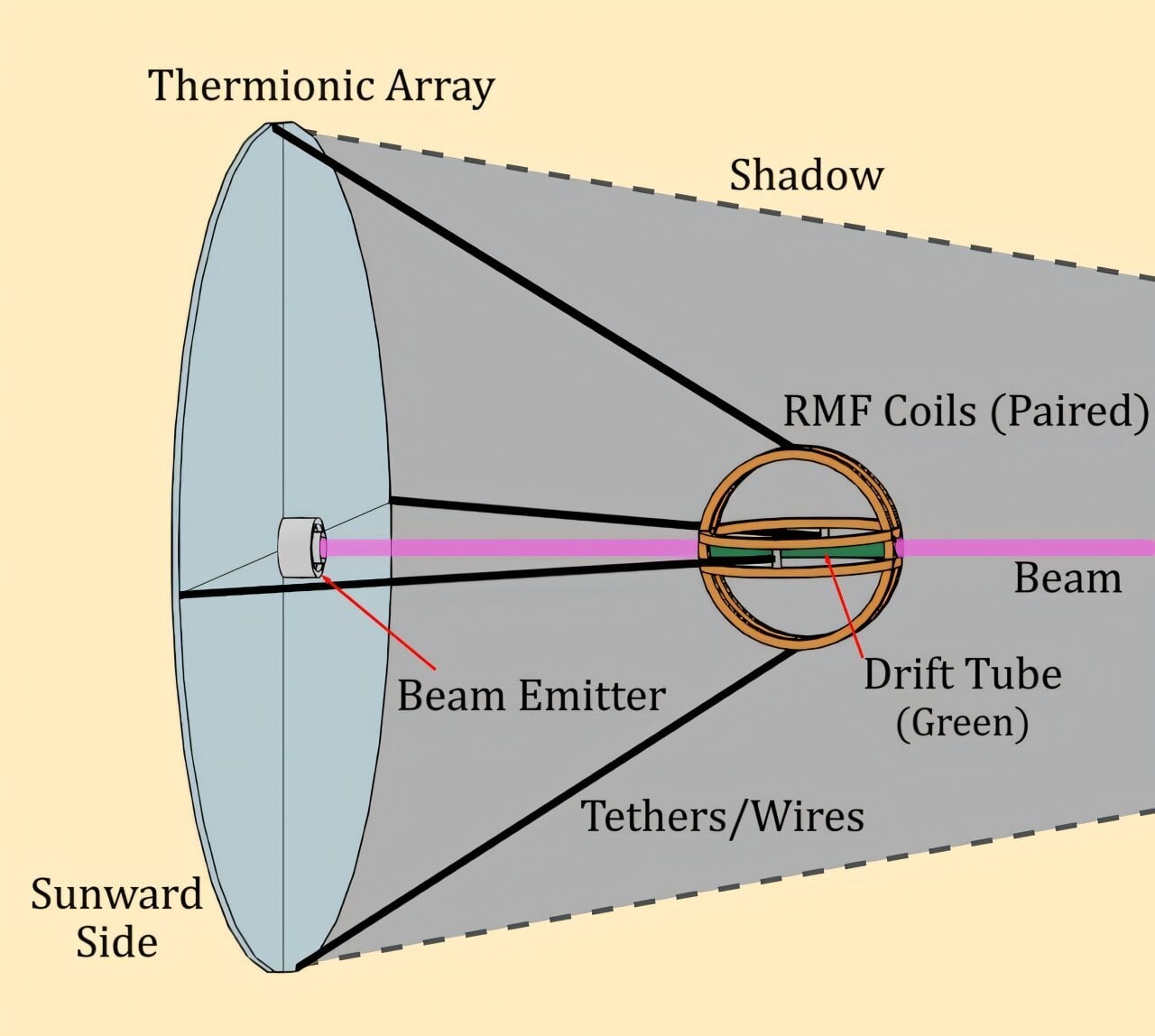
The big question here is the source of the electrons. If all you’re doing is using electrons on the device then you’ll gain a positive charge on it which will diminish the effectiveness of the drive since the craft will become increasingly attracted to its propulsion beam. You’d have to also expel positive charges to offset this, in which case you’re no longer just using an electron beam.
Now, if there was a source of electrons that you could gather and use as you travel then maybe it would work. Such as, if space itself tended to have free electrons you could gather as you travel. It doesn’t tend to have this, because the overall charge of any region tends to be neutral since opposite charges tend to attract.
Couldn’t one just cut off the neck of a CRT tube and then operate it in a vacuum? Then one could run it off of I Love Lucy reruns almost forever.
We need an antenna the size of a car to get data back from our outer solar system, and that’s 100,000 times closer than Alpha Centauri.
Good luck communicating across that distance with a spacecraft the size of a postage stamp. Let alone fitting a camera and a power source to do so onboard.
Not to mention you’re whizzing by any planet of interest you’d like to take a picture of in mere seconds, unless you also now want to make it carry a telescope.
This concept (similar to Breakthrough Starshot) is a fanciful dream and requires technologies in every single subsystem that do not currently and may never exist.
Can we stop giving these thought experiments credence as though they will ever be applicable? Light sails will undoubtedly be useful and we don’t need to dream up fantasies of impossible interstellar voyages for them to be so.