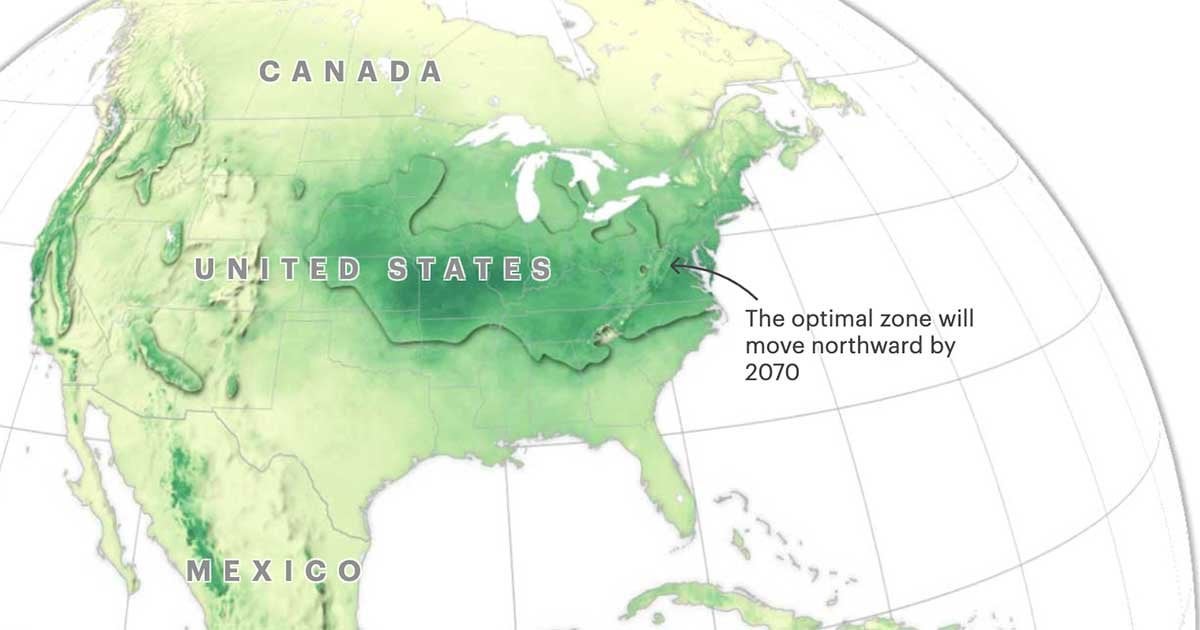
it’s not clear to me at first glance why areas that suddenly move into the ‘good’ area only see 1% gdp growth as a result, while places moving ‘out of the zone’ see -70%
now I get that coastal areas will get worse, but areas moving from yellow to green would certainly gain the same crop advantage that formerly belonged to the old place?
of course, many areas in yellow are still successful farming areas, so then, the first couple pictures I’m confused the point, as it’s not really colored right to show the impact. yellow turns green, whatever, green turns yellow, everyone dies
not disputing any data, just the ‘beauty’ of the data to impart what they mean
Objective_Run_7151 on
This map isn’t new.
It’s ½ a decade old.
cachemonet0x0cf6619 on
New Detroit City is gonna be awesome
So_spoke_the_wizard on
For the past four or five years, we’ve been planning our retirement. Traditionally, retirees move based on taxes and low cost of living. Most of those places are where climate change is going to hit hardest. Not to mention overcrowding and rampant growth.
We are willing to pay taxes for a place that will be environmentally comfortable for the next 25-30 years with a good quality of life. Our family thinks we’re crazy. But we’ve been very successful at finding great places to live that are counter to the trends.
dabiggman on
They’ve been saying this crap for decades now and not one ounce of it comes true. Just like in the 1970’s we were headed for a “new Ice Age.” I can remember being in High School in the early 2000’s and they were saying Wisconsin would be a tropical climate by the 2030’s.
Scare tactics, and nothing more.
Edit: Sources for the whiners:
“The Earth’s Cooling Climate,” Science News, November 15, 1969.• “Colder Winters Held Dawn of New Ice Age,” Washington Post, January 11, 1970.• “Science: Another Ice Age?” Time Magazine, June 24, 1974.• “The Ice Age Cometh!” Science News, March 1, 1975.• “The Cooling World,” Newsweek, April 28, 1975.• “Scientists Ask Why World Climate is Changing; Major Cooling May Be Ahead,” New York Times, May 21, 1975.• “In the Grip of a New Ice Age?” International Wildlife July-August, 1975.• “A Major Cooling Widely Considered to Be Inevitable,” New York Times, September 14, 1975.• “Variations in the Earth’s Orbit, Pacemaker of the Ice Ages,” Science magazine, December 10, 1976.
AbsolutelyFascist on
This is why we need Canada as our 51st state – for climate in the 22nd century. And, obviously, Greenland is for the 23rd century. Maybe Antarctica is for the 24th century. I’m not sure if I’m being sarcastic or not.
80percentlegs on
Are these maps all for RCP8.5? While I suppose that future is possible, it’s HIGHLY unlikely. We’re looking at a reality of +2-2.5C, which will be terrible enough. I’d much rather see those maps.
AeroZep on
What happens to Tennessee after 2070? It stays good and then it’s suddenly terrible.
gordonjames62 on
One interesting feature for me were the maps that also showed Canada.
I live in the Canadian province of New Brunswick (East coast, just north of Maine)
They show Maine and New Brunswick as not very suitable for human habitation (over the past 6000 years).
In the RCP 4.5 scenario, Maine and New Brunswick become more suitable for human habitation by 2070.
**Then it gets weird.**
In the RCP 8.5 scenario we habe Maine and NB back in the less habitable range. It can’t be from the heat, and we are right on the Atlantic ocean.

10 Comments
Gotta get some land back in Minnesota
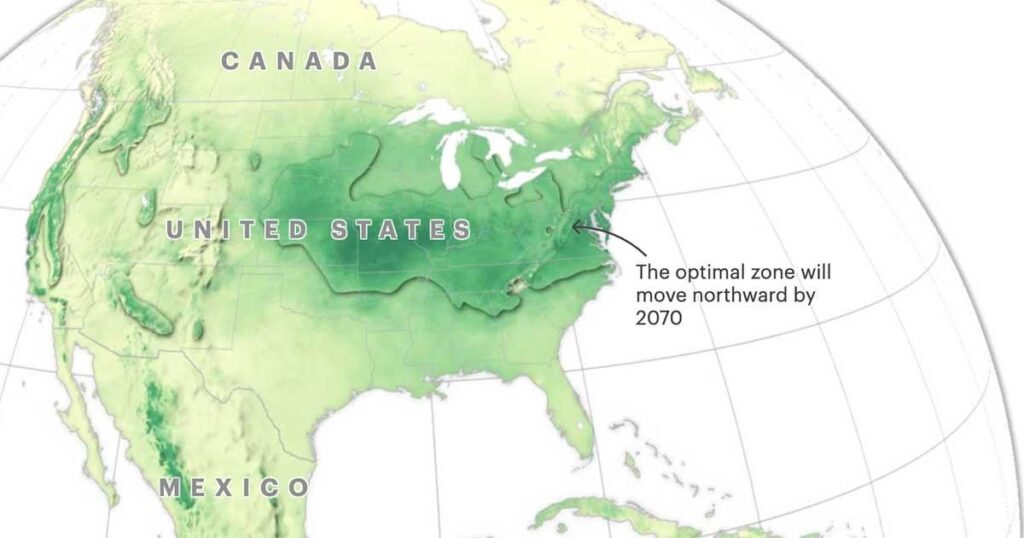
it’s not clear to me at first glance why areas that suddenly move into the ‘good’ area only see 1% gdp growth as a result, while places moving ‘out of the zone’ see -70%
now I get that coastal areas will get worse, but areas moving from yellow to green would certainly gain the same crop advantage that formerly belonged to the old place?
of course, many areas in yellow are still successful farming areas, so then, the first couple pictures I’m confused the point, as it’s not really colored right to show the impact. yellow turns green, whatever, green turns yellow, everyone dies
not disputing any data, just the ‘beauty’ of the data to impart what they mean
This map isn’t new.
It’s ½ a decade old.
New Detroit City is gonna be awesome
For the past four or five years, we’ve been planning our retirement. Traditionally, retirees move based on taxes and low cost of living. Most of those places are where climate change is going to hit hardest. Not to mention overcrowding and rampant growth.
We are willing to pay taxes for a place that will be environmentally comfortable for the next 25-30 years with a good quality of life. Our family thinks we’re crazy. But we’ve been very successful at finding great places to live that are counter to the trends.
They’ve been saying this crap for decades now and not one ounce of it comes true. Just like in the 1970’s we were headed for a “new Ice Age.” I can remember being in High School in the early 2000’s and they were saying Wisconsin would be a tropical climate by the 2030’s.
Scare tactics, and nothing more.
Edit: Sources for the whiners:
“The Earth’s Cooling Climate,” Science News, November 15, 1969.• “Colder Winters Held Dawn of New Ice Age,” Washington Post, January 11, 1970.• “Science: Another Ice Age?” Time Magazine, June 24, 1974.• “The Ice Age Cometh!” Science News, March 1, 1975.• “The Cooling World,” Newsweek, April 28, 1975.• “Scientists Ask Why World Climate is Changing; Major Cooling May Be Ahead,” New York Times, May 21, 1975.• “In the Grip of a New Ice Age?” International Wildlife July-August, 1975.• “A Major Cooling Widely Considered to Be Inevitable,” New York Times, September 14, 1975.• “Variations in the Earth’s Orbit, Pacemaker of the Ice Ages,” Science magazine, December 10, 1976.
This is why we need Canada as our 51st state – for climate in the 22nd century. And, obviously, Greenland is for the 23rd century. Maybe Antarctica is for the 24th century. I’m not sure if I’m being sarcastic or not.
Are these maps all for RCP8.5? While I suppose that future is possible, it’s HIGHLY unlikely. We’re looking at a reality of +2-2.5C, which will be terrible enough. I’d much rather see those maps.
What happens to Tennessee after 2070? It stays good and then it’s suddenly terrible.
One interesting feature for me were the maps that also showed Canada.
I live in the Canadian province of New Brunswick (East coast, just north of Maine)
They show Maine and New Brunswick as not very suitable for human habitation (over the past 6000 years).
In the RCP 4.5 scenario, Maine and New Brunswick become more suitable for human habitation by 2070.
**Then it gets weird.**
In the RCP 8.5 scenario we habe Maine and NB back in the less habitable range. It can’t be from the heat, and we are right on the Atlantic ocean.
**Help me understand what happens under RCP 8.5**