So.. the question here is how can they invest 265 billion dollars in medical costs while also denying 30% of medical claims? this makes it seem like they just can’t afford to not deny that many claims.
Edit: changed the figure of medical claim denials, it was complete misinformation. I am ashamed and will now crawl into a hole.
MrNoSouls on
So this is what they say, but it’s not exactly what is found by congressional hearing right? This doesn’t show exactly what their expenses should have been if they didn’t have the highest denial rate in the world.
juntoalaluna on
This really shows how broken the US health system is.
People blame the Insurance companies – but there isn’t a *huge* profit margin here. They can’t suddenly approve the 20% of claims they deny, because there isn’t the money. It’s broken all the way downstream as well.
wkavinsky on
“But we only make 8% margin” they cried while clearing $32 **billion** in profit last year.
phdoofus on
“Billionaire who says he pays taxes confidently states how much he pays in taxes but is unwilling to show you his tax returns”
wildfire1983 on
This is just United healthcare. If the health care system was “nationalized” and brought under the direction of Medicare/medicaid… That has a proven overhead of about 3% (much much lower than a for-profit insurance company) and no profits… Everything in the green section would then fall into the red section and be distributed as actual care to the nation as opposed to going into the pocket of investors and billionaires. Not only that but the reduced overhead there’d be additional benefits paid out. The fact that we have a for-profit health insurance industry blows my mind.
kblazewicz on
Would be great to see the “Medical costs” broken down further. How much of this money is looping back to the investors also owning UHG? Seems to me the problem is in the absurdly elevated prices of everything health related in the US. Who’s behind that?
MooseBoys on
One key thing to remember is that while Net Income goes to shareholders, executive pay comes out of “Cost of products sold”.
venividiavicii on
This type of analysis doesn’t work for an industry like insurance, or at least it’s wildly misleading.
Their industry is literally the cost, providing financial services and literally no other tangible assets. In order to make a profit in a financial sector, you have to cycle through costs.
lostcauz707 on
Hey, with universal healthcare, there is no profit margin.
asskicker1762 on
Let me get this straight: we’re paying a middle man $400B for them to distribute $264B (smoothing that expense for individuals, i.e. the only point of insurance) while only paying 10% of operating income in taxes.
Carbon-Base on
There should be a, “Net Income from Denying Valid Claims” statement branched under “Net Income”
AbsolutelyFascist on
My interpretation….as a very anti-insurance scheme guy.
When you pay $1 into insurance, and you play infinite times, you will lose an average of 14% every time you play. That’s premiums in, medical costs out: everything else is extraneous bullshit that doesn’t need to be part of the equation. As a consumer, every dollar you spend only returns to you, a negative 14% per year. To put that into perspective, that is worse than playing Roulette with your money.
Imagine that you could make 14% annually on your money, by just avoiding insurance altogether and paying cash for your healthcare.
MayoMcCheese on
but how much goes into fluffers
snakesign on
All I see is it cost 400B dollars to deliver 256B dollars of medical care. That is a terrible efficacy.
fuzzbuzz123 on
For those who don’t get the problem:
Americans are spending 400B on healthcare and getting only 264B worth of healthcare.
Even if UHG approves 100% of claims, they would still be a net negative just because of the “operating costs”, “costs of products sold”, etc.
The whole thing needs to be shut down.
tweakingforjesus on
Under the ACA health insurers are required to spend at least 85% of their revenue on medical costs. UHG spent 85.6%. In other words without the ACA, UHG would spend even less on medical costs and distribute more in net income.
purple-lemons on
$136 billion of inefficiency
Journalist-Cute on
Those evil bastards keeping 8% of premiums for themselves! How dare they! If only they had approved 8% more claims, then no one would hate them, right?
FlyE32 on
Can we emphasize that 27% years over year return on investments? That is crazy and clearly something fishy
Important-Nobody_1 on
Jeeze, those are thin margins. I wonder where they bury their costs?
ecpowerhouse27 on
It’s a catch 22 with the cost of MRI/drugs/devices. The MRI costs a lot because the initial capital investment is high (OEM is making pretty standard profit on selling it to hospital, given the R&D and production costs vs volume they sell); hospital needs to recoup costs as well as cover maintenance/labor/overhead costs. Drugs with crazy price tags are the same concept; low volume due to rare disorder and high R&D costs (millions for clinical trials, especially if several failed trials before getting good results) means the pharm company needs to recoup costs on the drug. Either it’s crazy expensive or it never is created; I think the fact that it exists is a net positive.
Source: I’m an engineer in the med device space, so I have some insights into how much companies in the med tech space spend to get a product to market and how much volume is required to recoup initial investment. Current product I worked on will hit market soon, and it cost roughly $1 mill to get to market. We sell to distributor for about $400 a pop. Materials and labor are roughly $150, so we profit about $250 a unit. Volume per year is hard to predict, but we think around 1000-2000 year 1, then 2000-3000 following years. So it will realistically take 2-3 years before we breakeven on the product, and the average lifespan of a product before being iterated is 5 years, which leaves 2 years of profit above initial investment. That profit will generally be put back into the next product R&D. If anyone in this supply chain is making more than they should, it’s the sales team, as they take that $400 bulk product and sell to hospital for $1000-$1200 to cover sales team, admin costs, etc. They take the risk of buying large quantities, but definitely profit well considering they don’t have the development costs of the OEM.
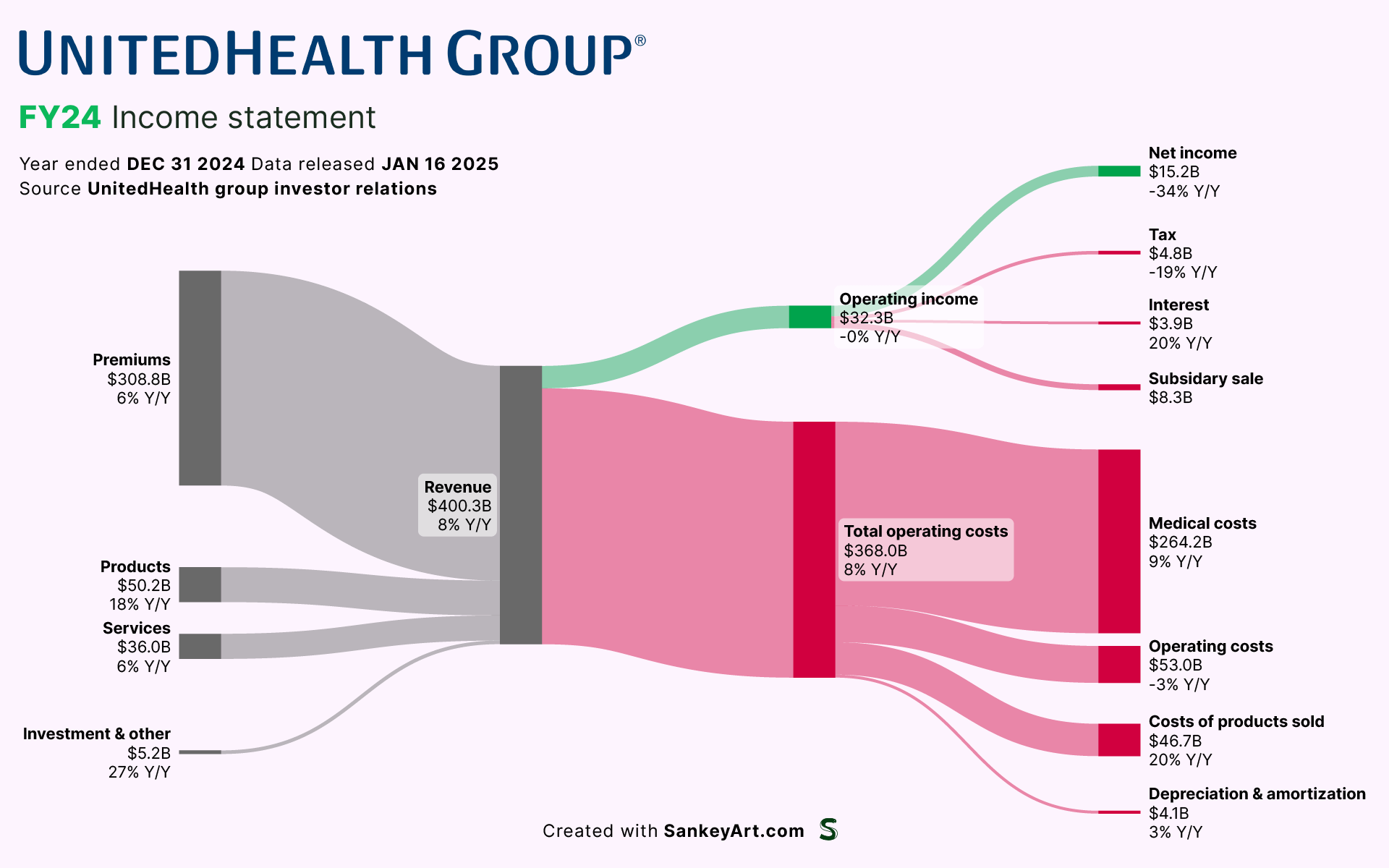

![[OC] How UnitedHealth Group makes money](https://www.byteseu.com/wp-content/uploads/2025/01/xh96e9cuvdde1-1536x960.png "[OC] How UnitedHealth Group makes money")
23 Comments
Source: UnitedHealth Group investor relations: [https://www.unitedhealthgroup.com/content/dam/UHG/PDF/investors/2024/2025-16-01-uhg-reports-fourth-quarter-results.pdf](https://www.unitedhealthgroup.com/content/dam/UHG/PDF/investors/2024/2025-16-01-uhg-reports-fourth-quarter-results.pdf)
Tool: [SankeyArt](http://sankeyart.com) Sankey diagram maker + illustrator
So.. the question here is how can they invest 265 billion dollars in medical costs while also denying 30% of medical claims? this makes it seem like they just can’t afford to not deny that many claims.
Edit: changed the figure of medical claim denials, it was complete misinformation. I am ashamed and will now crawl into a hole.
So this is what they say, but it’s not exactly what is found by congressional hearing right? This doesn’t show exactly what their expenses should have been if they didn’t have the highest denial rate in the world.
This really shows how broken the US health system is.
People blame the Insurance companies – but there isn’t a *huge* profit margin here. They can’t suddenly approve the 20% of claims they deny, because there isn’t the money. It’s broken all the way downstream as well.
“But we only make 8% margin” they cried while clearing $32 **billion** in profit last year.
“Billionaire who says he pays taxes confidently states how much he pays in taxes but is unwilling to show you his tax returns”
This is just United healthcare. If the health care system was “nationalized” and brought under the direction of Medicare/medicaid… That has a proven overhead of about 3% (much much lower than a for-profit insurance company) and no profits… Everything in the green section would then fall into the red section and be distributed as actual care to the nation as opposed to going into the pocket of investors and billionaires. Not only that but the reduced overhead there’d be additional benefits paid out. The fact that we have a for-profit health insurance industry blows my mind.
Would be great to see the “Medical costs” broken down further. How much of this money is looping back to the investors also owning UHG? Seems to me the problem is in the absurdly elevated prices of everything health related in the US. Who’s behind that?
One key thing to remember is that while Net Income goes to shareholders, executive pay comes out of “Cost of products sold”.
This type of analysis doesn’t work for an industry like insurance, or at least it’s wildly misleading.
Their industry is literally the cost, providing financial services and literally no other tangible assets. In order to make a profit in a financial sector, you have to cycle through costs.
Hey, with universal healthcare, there is no profit margin.
Let me get this straight: we’re paying a middle man $400B for them to distribute $264B (smoothing that expense for individuals, i.e. the only point of insurance) while only paying 10% of operating income in taxes.
There should be a, “Net Income from Denying Valid Claims” statement branched under “Net Income”
My interpretation….as a very anti-insurance scheme guy.
When you pay $1 into insurance, and you play infinite times, you will lose an average of 14% every time you play. That’s premiums in, medical costs out: everything else is extraneous bullshit that doesn’t need to be part of the equation. As a consumer, every dollar you spend only returns to you, a negative 14% per year. To put that into perspective, that is worse than playing Roulette with your money.
Imagine that you could make 14% annually on your money, by just avoiding insurance altogether and paying cash for your healthcare.
but how much goes into fluffers
All I see is it cost 400B dollars to deliver 256B dollars of medical care. That is a terrible efficacy.
For those who don’t get the problem:
Americans are spending 400B on healthcare and getting only 264B worth of healthcare.
Even if UHG approves 100% of claims, they would still be a net negative just because of the “operating costs”, “costs of products sold”, etc.
The whole thing needs to be shut down.
Under the ACA health insurers are required to spend at least 85% of their revenue on medical costs. UHG spent 85.6%. In other words without the ACA, UHG would spend even less on medical costs and distribute more in net income.
$136 billion of inefficiency
Those evil bastards keeping 8% of premiums for themselves! How dare they! If only they had approved 8% more claims, then no one would hate them, right?
Can we emphasize that 27% years over year return on investments? That is crazy and clearly something fishy
Jeeze, those are thin margins. I wonder where they bury their costs?
It’s a catch 22 with the cost of MRI/drugs/devices. The MRI costs a lot because the initial capital investment is high (OEM is making pretty standard profit on selling it to hospital, given the R&D and production costs vs volume they sell); hospital needs to recoup costs as well as cover maintenance/labor/overhead costs. Drugs with crazy price tags are the same concept; low volume due to rare disorder and high R&D costs (millions for clinical trials, especially if several failed trials before getting good results) means the pharm company needs to recoup costs on the drug. Either it’s crazy expensive or it never is created; I think the fact that it exists is a net positive.
Source: I’m an engineer in the med device space, so I have some insights into how much companies in the med tech space spend to get a product to market and how much volume is required to recoup initial investment. Current product I worked on will hit market soon, and it cost roughly $1 mill to get to market. We sell to distributor for about $400 a pop. Materials and labor are roughly $150, so we profit about $250 a unit. Volume per year is hard to predict, but we think around 1000-2000 year 1, then 2000-3000 following years. So it will realistically take 2-3 years before we breakeven on the product, and the average lifespan of a product before being iterated is 5 years, which leaves 2 years of profit above initial investment. That profit will generally be put back into the next product R&D. If anyone in this supply chain is making more than they should, it’s the sales team, as they take that $400 bulk product and sell to hospital for $1000-$1200 to cover sales team, admin costs, etc. They take the risk of buying large quantities, but definitely profit well considering they don’t have the development costs of the OEM.