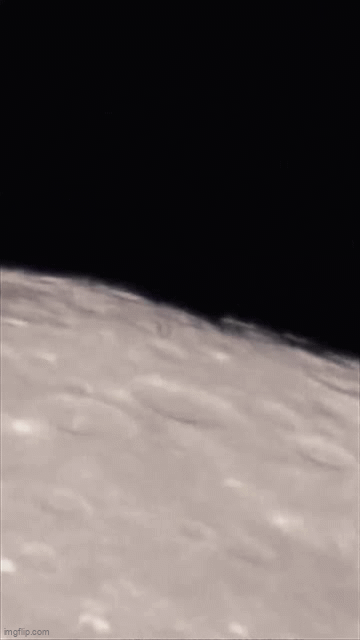
I captured Mars rising over the Moon with a 9” telescope in my backyard
https://i.redd.it/uhvmt10pyude1.gif

I captured Mars rising over the Moon with a 9” telescope in my backyard
https://i.redd.it/uhvmt10pyude1.gif
10 Comments
Great shot! You must have been very patient to capture that.
Photographed the Lunar occultation of Mars on Monday with a 9.25” telescope at a focal length of 3525mm. For comparison, most large telephoto lenses you see at sporting events are between 400-800mm. At such high focal lengths, disturbance in the atmosphere wreaks havoc on light waves, giving the image a shimmering quality like shooting underwater.
Mars is near opposition, when it is fully lit by the sun like a full moon (which we also had Monday). If you look closely you can see the polar ice cap on the Moon’s North Pole (which is on its left in this orientation).
Equipment: Celestron Edge 9.25” telescope, 1.5x custom Barlow lens, Sony A7rIII camera; eq6r-pro equatorial mount.
instagram: @brennanmgilmore
You know they are all waving at us so be sure to wave back!
That’s so cool. When I was a kid, I saw Jupiter through a telescope and I could make out the moons. It was a profound experience.
If I saw what you’re just posted I would have passed out completely!
Very cool, how long did it take you to set that up?
Wow! Coolest space movie I’ve seen in a while. You need to submit this to [APOD.](https://apod.nasa.gov/apod)
Nice! Much better than the sad little photo I took.
Are there charts or reference maps or tables that you used to predict where Mars would exit being eclipsed? Curious how you got to be so precise in your camera placement.
Very cool – well done!
I was skunked here. Total cloud cover.
That’s cool!
I check out the sky at night, find something interesting, family is like meh …