
https://en.wikipedia.org/wiki/Mechanical_counterpressure_suit
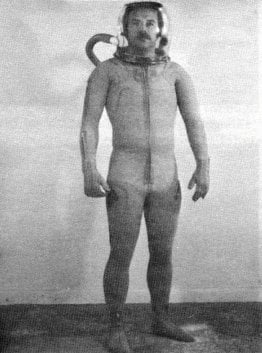
If you've never heard of it, there were successful prototype non-airtight space suits made, although they never were used in space. I am wondering how the helmets worked? In a normal suit we can use artificial materials to ensure an airtight seal for the bubble we put ourselves in, but for a MCP suit that seal would need to be made against the skin of the astronaut or else it would leak into the permeable part of the suit. How did this work?
How Did Helmets For Mechanical Counterpressure Suits Achieve A Seal?
byu/Chunty-Gaff inspace
2 Comments
According to the article you linked:
“The helmet was secured by means of a non-elastic garment of Nomex cloth which wrapped around the chest and under the arms, and by the elastic layers above and below it.”
The same way that a diving helmet for a wetsuit works, it seals around a smaller area than the whole body. In this case it was the upper chest on wards.
These suits usually come in 3 parts a coif of some sorts that seals against the head and neck or shoulders/chest and a helmet that seals against that. With the rest of the suit covering the body only.
These suits are being explored again especially for any significant human presence on mars because they are easier to work in and overall can be also cheaper to produce.
SpaceX also explored these for their EVA suits but eventually still went back to a pressurized suit, at least based on what they said it was mostly because of the timeframe that would be required to prove them for manned missions.