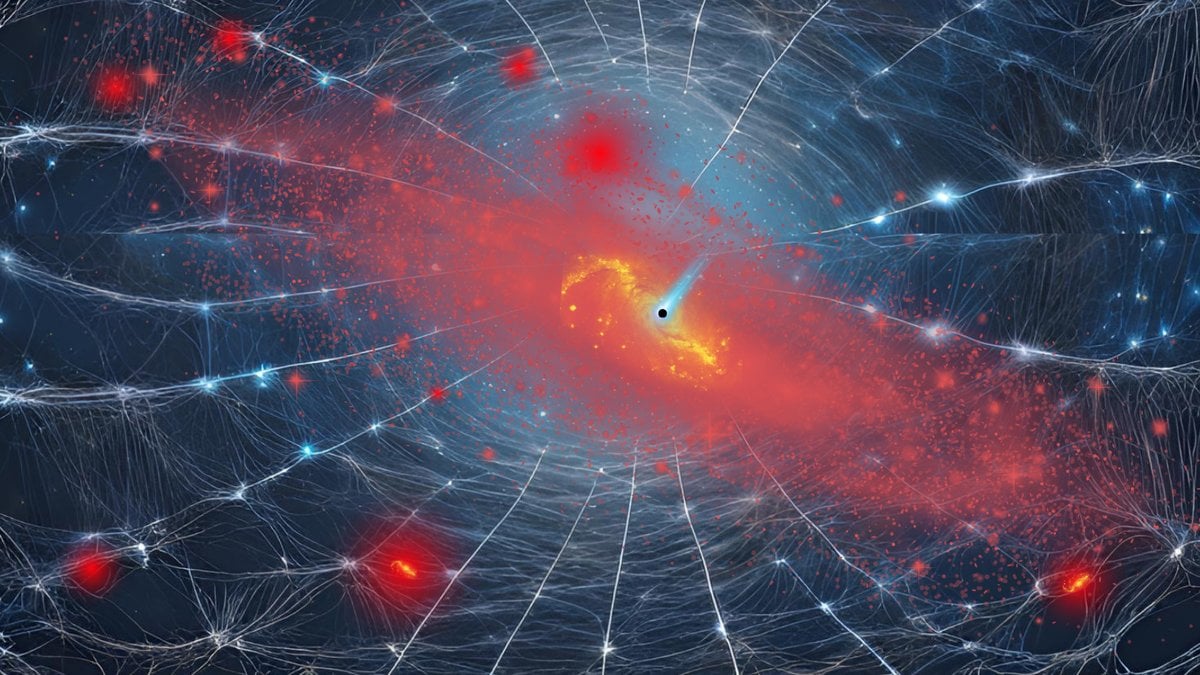
Supermassive black holes in ‘little red dot’ galaxies are 1,000 times larger than they should be, and astronomers don’t know why
https://www.space.com/james-webb-space-telescope-overlymassive-black-holes

Supermassive black holes in ‘little red dot’ galaxies are 1,000 times larger than they should be, and astronomers don’t know why
https://www.space.com/james-webb-space-telescope-overlymassive-black-holes
10 Comments
I know the answer but no one is going to like it.
[removed]
My question is, are the SMBHs extra massive compared to nearby ones or are their galaxies really small?
Maybe cause they are sucking up matter faster than we know and are growing rapidly by the time we see em.
Someone is getting an ‘F’ grade on their Early Universe theory.
All these astronomers should get a new job. They don’t seem to know anything /s
Black holes don’t “suck” up matter. Anything outside the event horizon will just orbit it assuming it’s close enough to be gravitationally bound to the black hole. And most stars in a galaxy are not bound to the SMBH in the center; they orbit the combined center of mass of the entire galaxy. SMBHs wind up in the center of galaxies through other interactions; the galaxy doesn’t orbit it though except for the relatively close stars.
Objects will stay in orbit just like they would a star unless something happens to destabilize them and lose angular momentum, then they could fall towards it but will still most likely wind up in the accretion disk for quite a long time.
Here it comes…
You know it’s coming…
Darker Matter.
It looks that way from our ‘frame of reference’ , what we measure may or may not represent what we think is reality.
Einstein was way smarter than we recognize I think. At the distances we try to measure and the accuracy of the measurements they’re being influenced by relativistic distances that we can not account for or even identify.
Our measurements can’t be separated from relativistic effects- and we can’t quantify the effects because the outcome, the technology, and the fabric of our reality is from a single frame of reference.
We need to stop assuming our measurements at these distances are accurate.
For anyone that’s curious, there’s been an issue floating around for a while that early SMBH’s seem to be growing significantly faster than they should be able to based on various limits. As far as I know nobody is quite sure what’s going on
This seems like an extra possible piece of evidence to throw on the pile that something wonky is going on with the understanding of early black holes, and how they formed and grew