
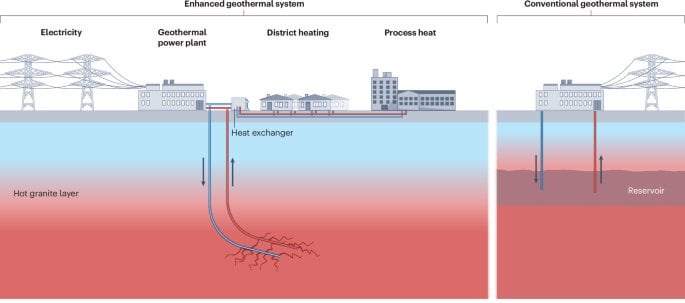
Renewables+batteries have almost wiped out the nuclear industry, now geothermal power may be about to put the final nail in that coffin. New research published in Nature magazine shows drilling times are falling so swiftly, that by 2027 geothermal power will be able to deliver a levelized cost of electricity at US$80 MWh. That's price competitive with nuclear, but that's not the real killer for the nuclear industry.
Although some locations (like Iceland) are very suited to geothermal, many places are just fine too. Geothermal can be built widely all over the world – more crucially, it can be built quickly and to a dependable budget.
The nuclear industry's sole surviving argument was it could provide base load power – but so can geothermal. It will now be vastly more appealing to investors and governments than building new nuclear power, which may be an industry about to go into the last stages of its death spiral.
Geothermal power may be about to kill the Nuclear Energy industry. Drilling costs are falling so fast, by 2027 it will be able to provide baseload electricity at the same price – but unlike nuclear power, it can be built quickly and on budget.
byu/lughnasadh inFuturology
18 Comments
I read somewhere there might be concerns that pumping water below ground might cause tremors. Can I get a quick rundown of geothermal’s cons?
That gives me hope, that the downfall of civilisation will be a bit less cruel and violent.
Sounds like what they are trying at The Eden Project. Definitely one to watch. https://www.edengeothermal.com/the-project/phase-1/
There is a mention of oilfield drilling projects. Is this related to fracking specifically or is it more general?
Not a single deep geothermal pilot has managed to keep a reservoir open at depth after drilling deep enough to produce electricity. It’s not impossible, but drilling is not the problem – high overburden pressure reservoir engineering is.
The sad thing is, that dFt is going to block this, just as off shore wind and solar and storage has been blocked
It is all about creating state – mandated monopolies –0 that are subsidized by taxpayers
Am I the only one that is wondering why OP is beating the “death of Nuclear” narrative so intensely, as opposed to just stating what this is… a research paper about geothermal.
>With further development of EGS to manage induced seismicity risk and increase system flexibility, EGS could provide stable baseload and potentially dispatchable electricity in clean energy systems.
I wonder if this will have the same impact as fears of nuclear melt down.
All it takes is a good earthquake in a zone where these have been built and even the best science won’t convince many geothermal didn’t cause the quake.
It’s also a risk that would be passed on to the taxpayer with that being an increase in insurance costs or damage to uninsured properties.
I hope I’m wrong.
Fervo energy. https://www.volts.wtf/p/enhanced-geothermal-power-is-finally
The biggest drawback is uncertainty. Even with current technology, you can’t guarantee a specific power output. And even then you can’t tell if you are possibly draining the system too much, getting it colder.
But still, good news.
where exactly are you going to put this other than wyoming in the US
For now its ok on a small scale.
Not in a big way all over the world.
Not a good idea to get heat out from the inside of oure planet (en get colder back in).
In the long run we cant risk cooling the inside and feck with the magnetic field
Whatever it takes to get off fossil fuels. We can’t sustain our current route
I have always wondered why this isn’t developed out. Literally endless energy (heat) is beneath us at all times.
**Key points of Article**
*Enhanced geothermal systems (EGS) have the potential to supply clean and firm energy in the form of electricity and/or direct heat.
*EGS projects have been developed since around 1975, with many in Europe. There are larger scale projects currently in development in the USA.
*Several EGS projects operate commercially in Europe. Around 20 well-to-well circulation EGS projects have been developed, but most operate for research purposes or produce modest amounts of energy (a few megawatts electrical or a few tens of megawatts thermal).
*There have been reductions in drilling time and therefore cost in EGS projects developed in the 2020s. Adaptation of oilfield drilling strategies has shortened EGS drilling times by 50–70%.
*Owing to innovation, EGS is expected to be scaled to much larger projects (for example, hundreds of megawatts electrical) at a cost that is competitive with other sources of electricity.
*Induced seismicity is an important issue for EGS, as earthquakes associated with EGS development can impact social acceptance and risk loss of a project’s social license to operate.
This seems like marketing for an unproven concept of stationary power generation! nuclear batteries and small fast reactors are far more realistic considering the way we use power and the future were beeing actively prompted to be part of space and robotics mobility is gonna be the deciding factor.
Geothermal is great…. where it’s naturally viable. Most locations are unsuitable, due to ground instability (most land is too geologically unstable to support long pipe runs), depth to heat source (the layer of ground between the plant and the heat varies greatly), or difficulty of digging (going through granite or basalt bedrock sucks). Geothermal aways has been great, but digging tech is only one (fairly small) part of the equation.
I guess I need to read the paper because there are a number of significant solutions to traditional challenges with mass production of energy via geothermal reservoirs. Going into it, I’m still skeptical that these systems can access sufficient activity away from tectonic activity. And I’ll be interested in how EGS combats over-extraction and loss of fluids that transports heat from porous rock or steam.
Of course, while it is renewable (as long as the well doesn’t go dry), it will never be as abundant as sunlight or fusion.
If someone has access to the paper, that would be great, otherwise I’ll have to email the author.